

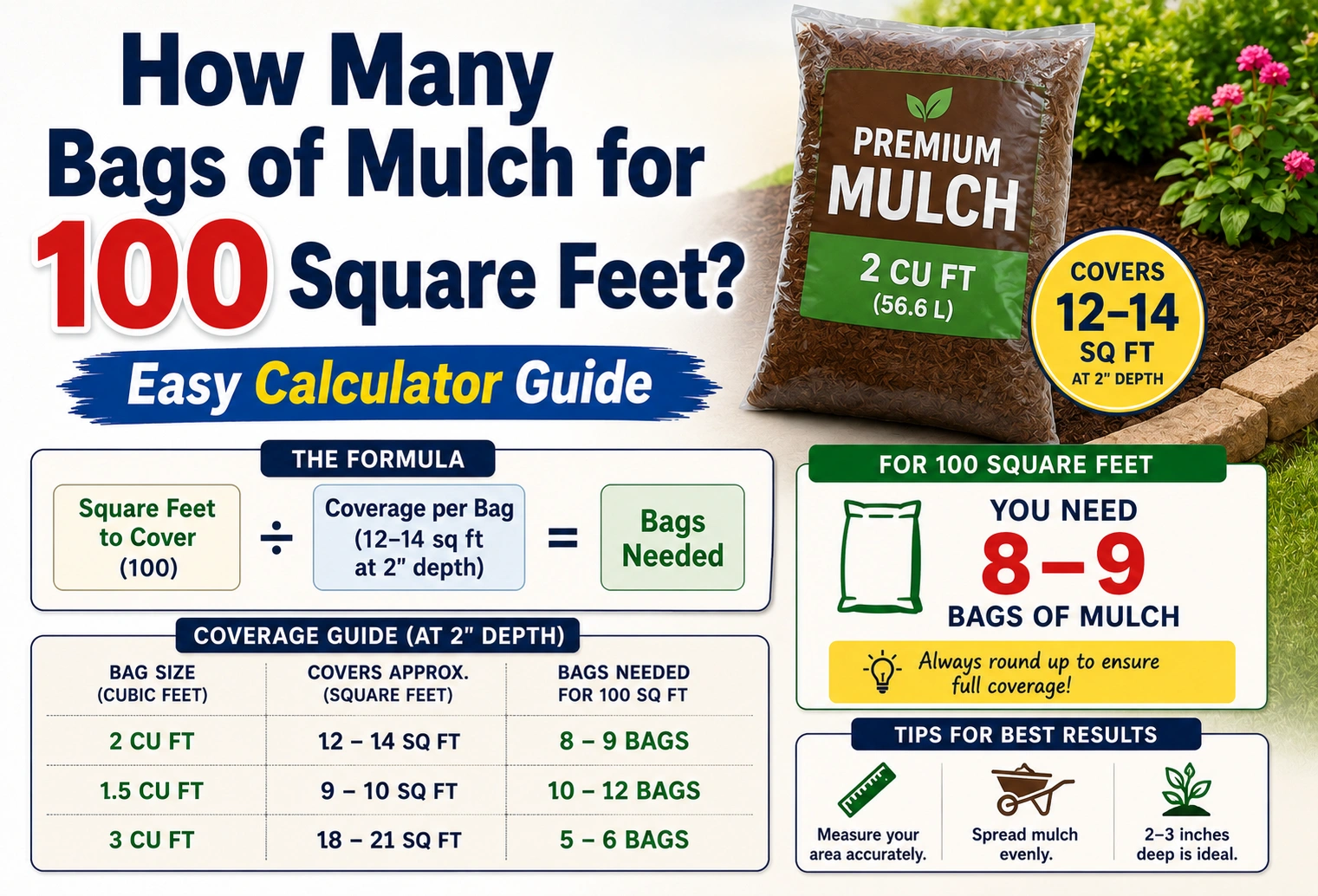
If you’re planning to refresh a flower bed, landscape around trees, or improve your garden, you may be asking how many bags of mulch for 100 square feet. Buying too little mulch means making another trip to the store, while buying too much can waste money and storage space.
The number of bags you need depends on two main factors:
- The size of your mulch bags (most commonly 2 cubic feet)
- The depth of mulch you want to apply
A layer that’s too thin won’t effectively suppress weeds or retain moisture, while one that’s too thick can restrict airflow and harm plant roots.
This guide explains exactly how many bags you’ll need for a 100-square-foot area.
Quick Answer
For 2-cubic-foot bags of mulch, here’s how many you’ll need to cover 100 square feet:
| Mulch Depth | Bags Needed |
|---|---|
| 1 inch | 4 bags |
| 2 inches | 7 bags |
| 3 inches (recommended) | 13 bags |
| 4 inches | 17 bags |
Most landscaping experts recommend a mulch depth of 2–3 inches, making 7 to 13 bags the typical requirement for a 100-square-foot area.
Why Mulch Depth Matters
Mulch does much more than improve the appearance of your yard.
A proper layer helps:
- Reduce weed growth
- Keep soil moist longer
- Protect roots from temperature changes
- Reduce soil erosion
- Improve the overall appearance of flower beds
However, applying too much mulch can trap moisture against stems and tree trunks, increasing the risk of rot and disease.
How Mulch Coverage Is Calculated
Mulch is sold by volume (cubic feet), while gardens are measured by area (square feet).
To determine how much mulch you need, combine the area with your desired depth.
A standard 2-cubic-foot bag covers approximately:
| Mulch Depth | Coverage per 2-cu-ft Bag |
| 1 inch | 24 square feet |
| 2 inches | 12 square feet |
| 3 inches | 8 square feet |
| 4 inches | 6 square feet |
These values are approximate but are widely used by garden centers and mulch manufacturers.
Bags Needed by Mulch Depth
1-Inch Depth
A thin layer is useful for refreshing existing mulch.
For 100 square feet:
100 ÷ 24 ≈ 4 bags
Best for:
- Touch-ups
- Decorative areas
- Existing mulch beds
2-Inch Depth
A 2-inch layer provides good weed suppression while allowing water to reach the soil.
For 100 square feet:
100 ÷ 12 ≈ 7 bags
Best for:
- Flower beds
- Shrubs
- Garden borders
3-Inch Depth (Recommended)
Most landscaping professionals recommend 3 inches of mulch for new garden beds.
For 100 square feet:
100 ÷ 8 ≈ 13 bags
This depth offers:
- Better moisture retention
- Improved weed control
- Longer-lasting coverage
4-Inch Depth
A thicker layer works well in areas with severe weed problems or high soil temperatures.
For 100 square feet:
100 ÷ 6 ≈ 17 bags
Avoid placing mulch this deep directly against plant stems or tree trunks.
Mulch Coverage Chart
| Area | 1 Inch | 2 Inches | 3 Inches | 4 Inches |
| 50 sq ft | 2 bags | 4 bags | 7 bags | 9 bags |
| 100 sq ft | 4 bags | 7 bags | 13 bags | 17 bags |
| 150 sq ft | 7 bags | 13 bags | 19 bags | 25 bags |
| 200 sq ft | 9 bags | 17 bags | 25 bags | 34 bags |
This chart assumes 2-cubic-foot mulch bags.
Step-by-Step Guide to Calculating Mulch
Step 1: Measure the Area
Multiply the length by the width.
Example:
10 feet × 10 feet = 100 square feet
Step 2: Choose Your Mulch Depth
Typical recommendations:
- 1 inch for refreshing mulch
- 2 inches for general landscaping
- 3 inches for new beds
- 4 inches for heavy weed control
Step 3: Determine Bag Size
Most home improvement stores sell:
- 2-cubic-foot bags
- 1.5-cubic-foot bags
- 1-cubic-foot bags
Larger bags mean fewer total bags.
Choosing the Right Mulch
Different mulch materials offer different benefits.
Shredded Hardwood
- Long-lasting
- Excellent weed control
- Popular for flower beds
Pine Bark
- Attractive appearance
- Lightweight
- Good drainage
Cedar Mulch
- Pleasant aroma
- Naturally insect resistant
- Durable
Dyed Mulch
- Available in black, brown, and red
- Decorative landscaping
- Long-lasting color
Common Mistakes When Buying Mulch
Buying Without Measuring
Always calculate the square footage before shopping.
Choosing the Wrong Depth
Too little mulch provides limited benefits.
Too much can damage plants.
Forgetting Existing Mulch
If an old mulch layer remains, you may only need a thin top-up.
Ignoring Bag Size
Not all mulch bags contain the same volume.
Check the label before calculating.
Expert Tips for Mulching
Leave Space Around Tree Trunks
Avoid creating “mulch volcanoes.” Keep mulch a few inches away from trunks and stems.
Water Before Mulching
Moist soil helps plants benefit more from mulch.
Spread Evenly
Use a rake to maintain consistent depth.
Refresh Annually
Most organic mulch should be replenished every year or two as it decomposes.
Practical Example
Suppose you have a flower bed measuring:
- Length: 10 feet
- Width: 10 feet
Area:
10 × 10 = 100 square feet
You want a 3-inch layer.
You’ll need approximately:
13 bags of 2-cubic-foot mulch
This provides excellent weed suppression and moisture retention.
9. FAQs
How many bags of mulch do I need for 100 square feet?
For 2-cubic-foot bags, you’ll typically need:
- 4 bags for a 1-inch layer
- 7 bags for a 2-inch layer
- 13 bags for a 3-inch layer
What is the recommended mulch depth?
Most gardens perform best with 2–3 inches of mulch.
How much does a 2-cubic-foot bag of mulch cover?
Coverage depends on depth:
- About 24 sq ft at 1 inch
- About 12 sq ft at 2 inches
- About 8 sq ft at 3 inches
Is 3 inches of mulch too much?
No. Three inches is widely recommended for most flower beds and landscape areas.
Should I remove old mulch before adding new mulch?
Not always. If the existing mulch is in good condition and not excessively thick, simply loosen it and add a fresh layer on top.
10. Conclusion
If you’re wondering how many bags of mulch for 100 square feet, the answer depends on the depth you plan to apply. For standard 2-cubic-foot bags, you’ll need about 4 bags for a 1-inch layer, 7 bags for a 2-inch layer, 13 bags for a recommended 3-inch layer, and 17 bags for a 4-inch layer. Measuring your area accurately and selecting the proper mulch depth will help you avoid overspending while ensuring healthy plants, improved moisture retention, and effective weed control. With the right amount of mulch, your landscape will look better and require less maintenance throughout the growing season.
Discover More Articles
How Many Square Feet Is a 10×10 Storage Unit? Size Guide