
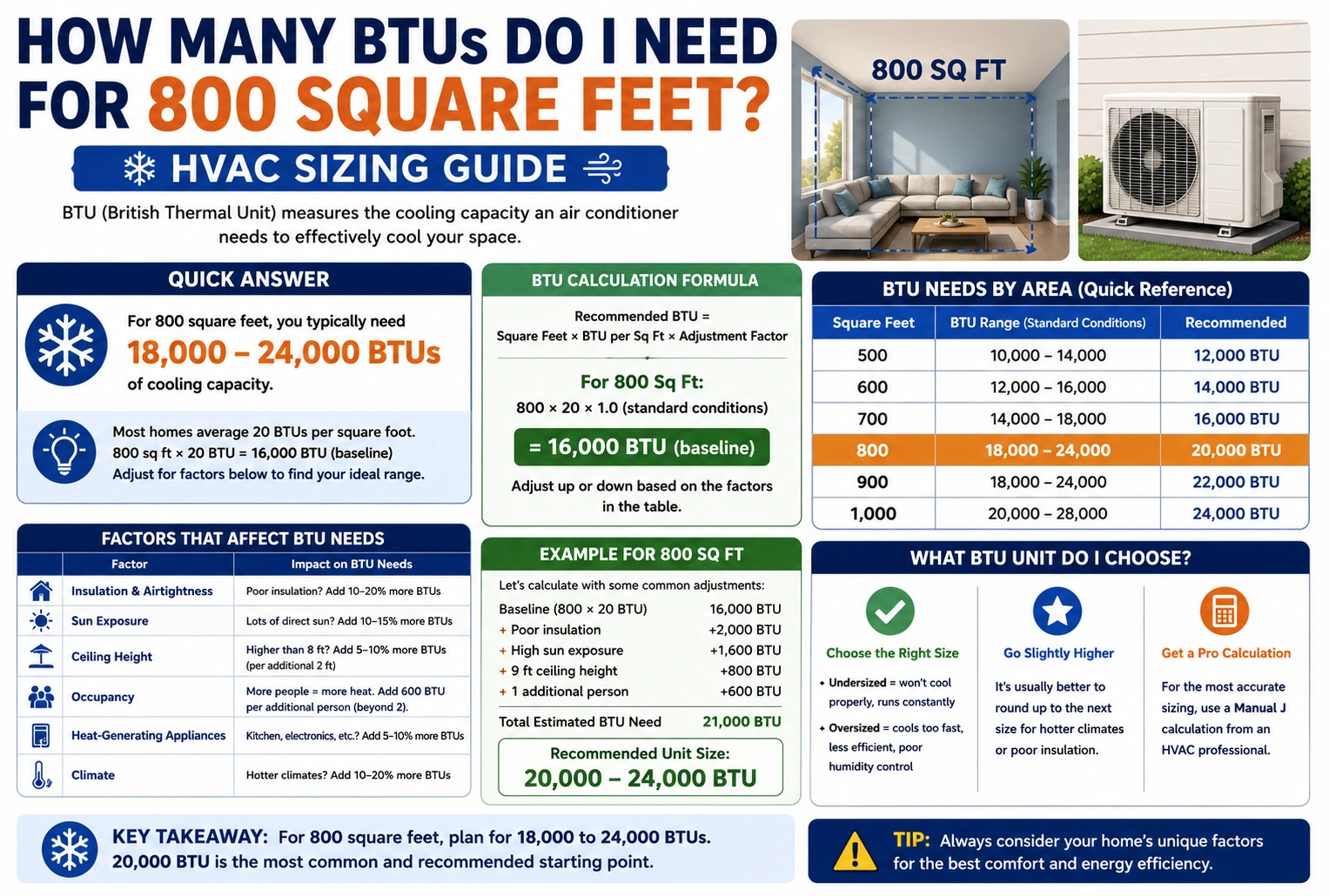
If you’re wondering how many BTUs you need for an 800-square-foot space, the answer depends on whether you’re heating or cooling, as well as factors such as insulation, ceiling height, local climate, windows, and sun exposure.
For most homes:
- Cooling: Approximately 18,000–20,000 BTUs
- Heating: Approximately 24,000–32,000 BTUs
These are general estimates. A professional HVAC load calculation provides the most accurate sizing for your specific home.
Quick Answer
For an 800-square-foot room or home:
| Application | Recommended BTUs |
|---|---|
| Air Conditioner | 18,000–20,000 BTUs |
| Furnace (Heating) | 24,000–32,000 BTUs |
Answer:
✅ Most 800-square-foot spaces need about 18,000–20,000 BTUs for cooling and 24,000–32,000 BTUs for heating, depending on climate and insulation.
Cooling BTU Requirements
Air conditioner sizing is commonly based on square footage.
General guideline:
- 20–25 BTUs per square foot
For an 800-square-foot space:
- 800 × 20 = 16,000 BTUs
- 800 × 25 = 20,000 BTUs
In many homes, an 18,000 BTU air conditioner is a common choice for approximately 800 square feet, though factors like direct sunlight or poor insulation may require a larger unit.
Heating BTU Requirements
Heating systems are usually sized according to climate and insulation quality.
Typical recommendations:
| Climate | BTUs per Square Foot |
| Warm | 30–35 BTUs |
| Moderate | 35–40 BTUs |
| Cold | 40–50 BTUs |
For an 800-square-foot home:
- Warm climate: 24,000–28,000 BTUs
- Moderate climate: 28,000–32,000 BTUs
- Cold climate: 32,000–40,000 BTUs
Your furnace’s efficiency (AFUE) also affects the amount of usable heat delivered.
Factors That Affect BTU Needs
The right BTU rating depends on more than just square footage.
Important factors include:
- Climate zone
- Ceiling height
- Home insulation
- Number of windows
- Window orientation
- Sun exposure
- Number of occupants
- Air leakage
- HVAC efficiency
Homes with excellent insulation often require fewer BTUs than older, draftier homes.
BTU Comparison Chart
| Square Footage | Cooling BTUs | Heating BTUs* |
| 400 sq ft | 8,000–10,000 | 12,000–16,000 |
| 600 sq ft | 12,000–15,000 | 18,000–24,000 |
| 800 sq ft | 18,000–20,000 | 24,000–32,000 |
| 1,000 sq ft | 20,000–24,000 | 30,000–40,000 |
| 1,200 sq ft | 24,000–30,000 | 36,000–48,000 |
*Heating estimates vary by climate and insulation quality.
Choosing the Right HVAC System
When selecting an HVAC unit:
- Don’t rely on square footage alone.
- Consider insulation and local weather conditions.
- Choose an energy-efficient model with a high SEER (for AC) or AFUE (for furnaces).
- Have a professional perform a Manual J load calculation for the most accurate sizing.
An oversized or undersized system can reduce comfort and increase energy costs.
Common Mistakes
Choosing a Unit Based Only on Square Footage
Square footage is a starting point, but insulation, climate, and ceiling height also affect BTU requirements.
Buying an Oversized System
A system that’s too large may cycle on and off frequently, reducing efficiency and humidity control.
Ignoring Energy Efficiency
A high-efficiency HVAC system can improve comfort while lowering operating costs.
Expert Tips
- Seal air leaks around windows and doors before upgrading your HVAC system.
- Improve attic insulation to reduce heating and cooling loads.
- Replace dirty air filters regularly to maintain efficiency.
- Schedule annual HVAC maintenance for peak performance.
9. FAQs
1. How many BTUs do I need for 800 square feet?
Most 800-square-foot spaces require 18,000–20,000 BTUs for cooling and 24,000–32,000 BTUs for heating, depending on climate and insulation.
2. Is an 18,000 BTU air conditioner enough for 800 square feet?
In many well-insulated homes, yes. However, spaces with high ceilings, poor insulation, or significant sun exposure may require closer to 20,000 BTUs.
3. What size furnace do I need for 800 square feet?
A furnace rated between 24,000 and 32,000 BTUs is often suitable for an 800-square-foot home in moderate climates.
4. Does insulation affect BTU requirements?
Yes. Better insulation reduces heat loss in winter and heat gain in summer, lowering the BTU capacity needed.
5. Should I get a professional HVAC load calculation?
Yes. A Manual J load calculation provides the most accurate estimate for heating and cooling needs based on your home’s specific characteristics.
10. Conclusion
If you’re asking how many BTUs do I need for 800 square feet, a good general guideline is 18,000–20,000 BTUs for cooling and 24,000–32,000 BTUs for heating. The ideal size depends on your climate, insulation, ceiling height, window placement, and overall home efficiency.
For the best comfort, energy savings, and system longevity, use these estimates as a starting point and consult an HVAC professional for a detailed load calculation before purchasing a new heating or cooling system.
Discover More Articles
2×2 Is How Many Square Feet? Easy Area Calculation Guide