
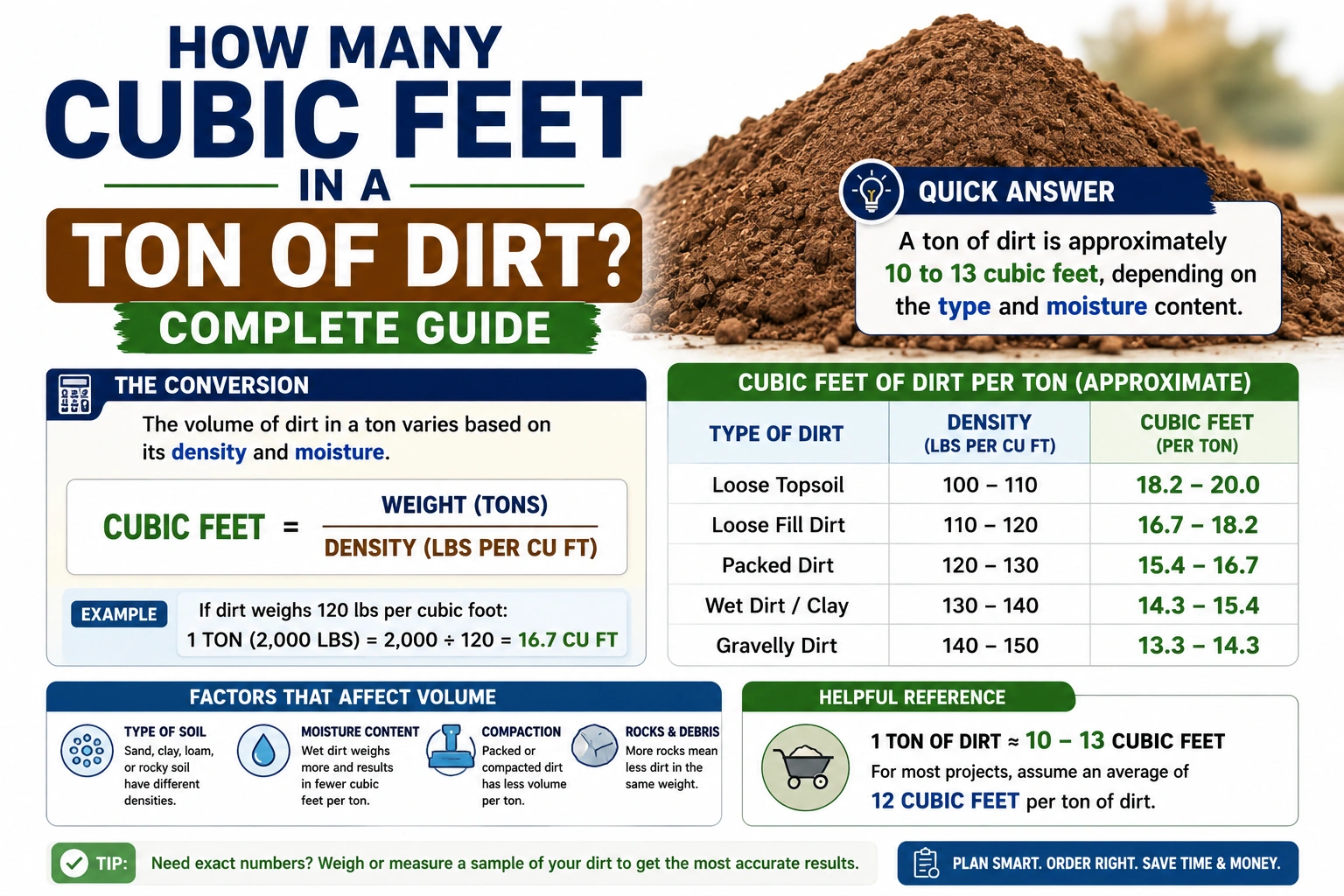
If you are wondering “how many cubic feet in a ton of dirt,” the average answer is:
1 ton of dirt≈20 to 24 cubic feet
So, one ton of dirt typically equals about 20 to 24 cubic feet.
However, the exact amount depends on:
- Soil type
- Moisture content
- Compaction
- Dirt density
This calculation is important for:
- Landscaping
- Gardening
- Construction
- Soil delivery
- Yard grading projects
In this complete guide, you will learn:
- How many cubic feet are in a ton of dirt
- Soil density calculations
- Dirt coverage estimates
- Conversion charts
- Common mistakes
- Expert landscaping tips
Let’s begin.
Quick Answer for Dirt Volume Conversion
The general estimate is:
| Dirt Type | Approximate Cubic Feet per Ton |
|---|---|
| Dry topsoil | 24 cu ft |
| Average dirt | 20–22 cu ft |
| Wet compacted dirt | 18–20 cu ft |
Most landscaping calculations use:
- About 20 cubic feet per ton
Understanding Dirt Weight and Volume
Before converting dirt measurements, it helps to understand these units.
What Is a Ton?
A ton is a unit of weight.
In the United States:
- 1 ton = 2,000 pounds
What Is a Cubic Foot?
A cubic foot measures:
- Volume
It represents:
- A space measuring 1 foot × 1 foot × 1 foot
Why Soil Density Matters
Different soils weigh different amounts.
For example:
- Wet soil weighs more
- Loose soil weighs less
- Clay is heavier than sandy soil
Because of this:
- Dirt volume varies by density
How Many Cubic Feet Are in a Ton of Dirt?
There is no single exact number because dirt density changes.
Standard Soil Density Formula
Most average soil weighs approximately:
1 cubic foot of dirt≈100 pounds
Since:
- One ton equals 2,000 pounds
The calculation becomes:
2000÷100=20
So:
- One ton of dirt is about 20 cubic feet
Topsoil vs Fill Dirt
Different soil types affect volume.
| Soil Type | Approximate Cubic Feet per Ton |
|---|---|
| Topsoil | 20–24 cu ft |
| Fill dirt | 18–22 cu ft |
| Clay soil | 16–20 cu ft |
| Sandy soil | 22–24 cu ft |
Moisture Content Effects
Wet dirt:
- Weighs more
- Covers less volume
Dry dirt:
- Covers more volume
Dirt Volume Conversion Chart
Here is a quick dirt conversion chart.
| Tons of Dirt | Approximate Cubic Feet |
|---|---|
| 1 ton | 20–24 cu ft |
| 2 tons | 40–48 cu ft |
| 3 tons | 60–72 cu ft |
| 5 tons | 100–120 cu ft |
| 10 tons | 200–240 cu ft |
This chart helps simplify landscaping calculations.
Factors That Affect Dirt Volume
Several conditions influence dirt measurements.
Soil Type
Heavy clay soils weigh more than:
- Loose sandy soils
Moisture Levels
Rain increases:
- Soil weight
- Density
Compaction
Compacted dirt takes up:
- Less space
Loose dirt occupies:
- More volume
Organic Content
Soils with mulch or compost may:
- Weigh less
How Much Area Does a Ton of Dirt Cover?
Coverage depends on depth.
Coverage at 1 Inch Depth
One ton of dirt covers approximately:
240 square feet at 1-inch depth
Coverage at 3 Inches Depth
At 3 inches deep:
80 square feet at 3-inch depth
Coverage at 6 Inches Depth
At 6 inches deep:
40 square feet at 6-inch depth
Why Dirt Volume Matters
Understanding dirt volume helps with:
- Budgeting projects
- Ordering correct materials
- Avoiding shortages
- Preventing waste
- Improving landscaping efficiency
Common Dirt Calculation Mistakes
Simple errors can lead to expensive problems.
Ignoring Soil Density
Different soils weigh differently.
Forgetting Moisture Content
Wet dirt is significantly heavier.
Mixing Weight and Volume
Tons measure:
- Weight
Cubic feet measure:
- Volume
Ordering Too Little Material
Landscaping projects often require:
- Extra dirt for settling
Expert Tips for Soil Estimation
Professionals use several strategies for accuracy.
Measure the Area Carefully
Always calculate:
- Length
- Width
- Desired depth
Order Extra Material
Many contractors order:
- 5–10% extra dirt
Understand Local Soil Conditions
Regional soil types vary greatly.
Use Bulk Delivery for Large Projects
Bulk dirt deliveries are often:
- More affordable
Practical Situations Where Dirt Calculations Matter
These conversions help with:
- Lawn leveling
- Garden beds
- Construction fill
- Landscaping
- Drainage projects
- Grading work
- Raised garden installations
FAQs
How many cubic feet are in one ton of dirt?
Typically:
- 20–24 cubic feet
Depending on soil density.
How much does one cubic foot of dirt weigh?
Average dirt weighs approximately:
1 cubic foot≈100 pounds
Is wet dirt heavier than dry dirt?
Yes. Moisture increases soil weight significantly.
How much area does one ton of dirt cover?
Coverage depends on depth:
- About 240 sq ft at 1 inch deep
Why do dirt calculations vary?
Soil density changes due to:
- Moisture
- Compaction
- Soil type
- Organic material
Conclusion
So, how many cubic feet in a ton of dirt?
The average answer is:
- About 20 to 24 cubic feet
1 ton of dirt≈20 to 24 cubic feet
Understanding dirt volume conversions helps with:
- Landscaping projects
- Garden planning
- Soil delivery estimates
- Construction work
- Accurate material ordering
Once you understand the relationship between soil weight and volume, estimating dirt quantities becomes much easier for nearly any outdoor project.
DIscover More Articles
How Many Square Feet Will a 3 Ton AC Unit Cool?