

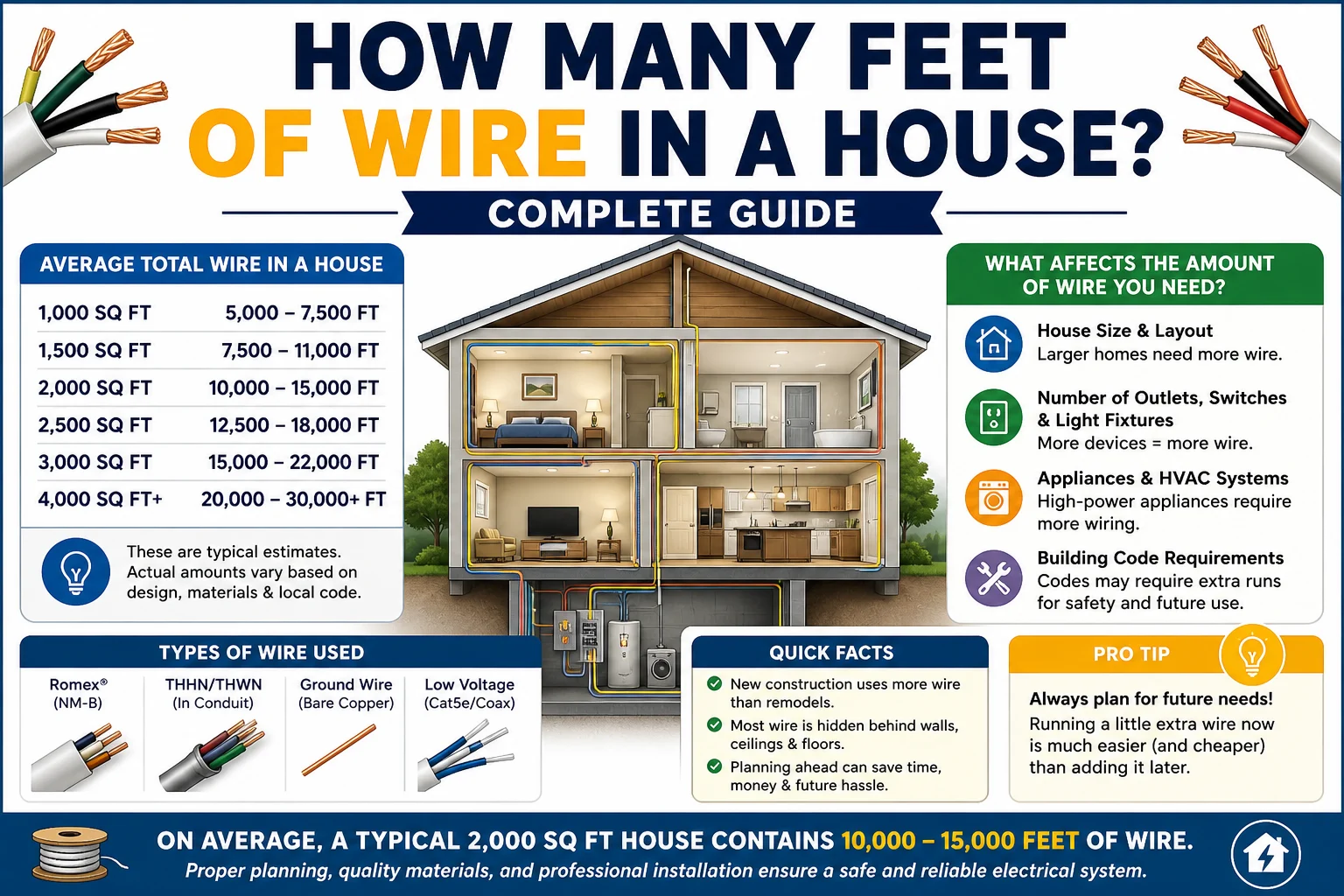
If you’re planning to build, renovate, or simply understand your home better, you might ask: “how many feet of wire in a house?”
This is a practical and important question—especially when estimating costs, planning electrical layouts, or working on DIY projects.
Quick Answer:
👉 The average house contains 2,000 to 6,000 feet of electrical wiring, depending on size, layout, and electrical needs.
But that’s just a rough estimate. Let’s break it down so you can calculate it more accurately.
Quick Answer: Average Wire Length in a House
Here’s a general idea:
- Small house (1,000 sq ft) → 2,000–3,000 feet of wire
- Medium house (2,000 sq ft) → 3,500–5,000 feet
- Large house (3,000+ sq ft) → 5,000–8,000+ feet
👉 On average, a home uses 2–3 feet of wire per square foot.
What Determines the Amount of Wire in a House?
Several factors affect how much wiring is needed:
1. House Size
Larger homes require more wiring for outlets, lights, and appliances.
2. Number of Rooms
More rooms = more switches, outlets, and circuits.
3. Electrical Load
Homes with heavy appliances (AC, heaters, EV chargers) need more wiring.
4. Layout Complexity
Open layouts use less wire, while complex layouts require more.
5. Local Electrical Codes
Building regulations may require extra circuits and safety wiring.
Average Wiring by House Size
Let’s look at detailed estimates.
Small House (1,000 sq ft)
- Wire needed: 2,000–3,000 feet
- Ideal for apartments or small homes
Medium House (2,000 sq ft)
- Wire needed: 3,500–5,000 feet
- Most common residential size
Large House (3,000+ sq ft)
- Wire needed: 5,000–8,000+ feet
- Includes luxury homes with advanced systems
Wiring Per Square Foot Rule
A simple estimation method:
👉 2 to 3 feet of wire per square foot
Example:
- House size = 2,000 sq ft
- Wire estimate =
- 2,000 × 2 = 4,000 feet
- 2,000 × 3 = 6,000 feet
✔️ Estimated range: 4,000–6,000 feet
Types of Electrical Wires Used
Different wires are used in a house:
1. Non-Metallic (NM) Cable
- Common in residential wiring
- Used for outlets and lighting
2. THHN/THWN Wire
- Used in conduits
- Heat-resistant
3. Low Voltage Wiring
- Internet cables
- Security systems
- Doorbells
Room-by-Room Wire Estimation
Let’s break it down further.
Kitchen
- High wiring demand
- Appliances, outlets, lighting
👉 Approx: 500–800 feet
Living Room
- TV, lighting, outlets
👉 Approx: 300–500 feet
Bedrooms
- Lighting, outlets, charging points
👉 Approx: 200–400 feet per room
Bathrooms
- Lighting, fans, outlets
👉 Approx: 150–300 feet
Real-Life Example Calculation
Let’s estimate a 2,000 sq ft house:
- Living room → 400 feet
- Kitchen → 700 feet
- 3 bedrooms → 900 feet
- Bathrooms → 400 feet
- Hallways & extras → 1,000 feet
✔️ Total ≈ 3,400–4,500 feet
Cost of Wiring a House
Wire cost depends on material and labor.
Average cost:
- $2 to $5 per foot (installed)
Example:
- 4,000 feet × $3 = $12,000 total wiring cost
Common Mistakes to Avoid
1. Underestimating wire length
Leads to project delays and extra costs.
2. Ignoring future needs
Always plan for additional outlets or upgrades.
3. Using wrong wire types
Safety risk and code violations.
4. Skipping professional advice
Electrical work requires expertise.
Expert Tips for Accurate Estimation
✔️ Plan your layout first
Know where outlets and appliances will go.
✔️ Add 10–20% extra wire
For safety and future changes.
✔️ Follow local codes
Ensures safety and avoids legal issues.
✔️ Consult an electrician
Especially for large projects.
Frequently Asked Questions
1. How many feet of wire are in an average house?
👉 Typically 2,000 to 6,000 feet
2. How much wire for a 2,000 sq ft house?
👉 Around 4,000–6,000 feet
3. How do I estimate wiring for my house?
👉 Multiply square footage by 2–3 feet
4. What type of wire is used in homes?
👉 Mostly non-metallic (NM) cable
5. How much does house wiring cost?
👉 Around $2–$5 per foot installed
Conclusion
So, how many feet of wire in a house?
👉 The answer depends on size and layout, but generally:
- Small homes: 2,000–3,000 feet
- Medium homes: 3,500–5,000 feet
- Large homes: 5,000–8,000+ feet
Key Takeaways:
- Use 2–3 feet per square foot as a rule
- Plan for extra wiring
- Consider room-by-room needs
- Always prioritize safety and quality
Understanding this helps you plan smarter, budget better, and avoid costly mistakes.
Discover More Articles
How Many Square Feet Is One Pallet of Sod? Complete Guide