

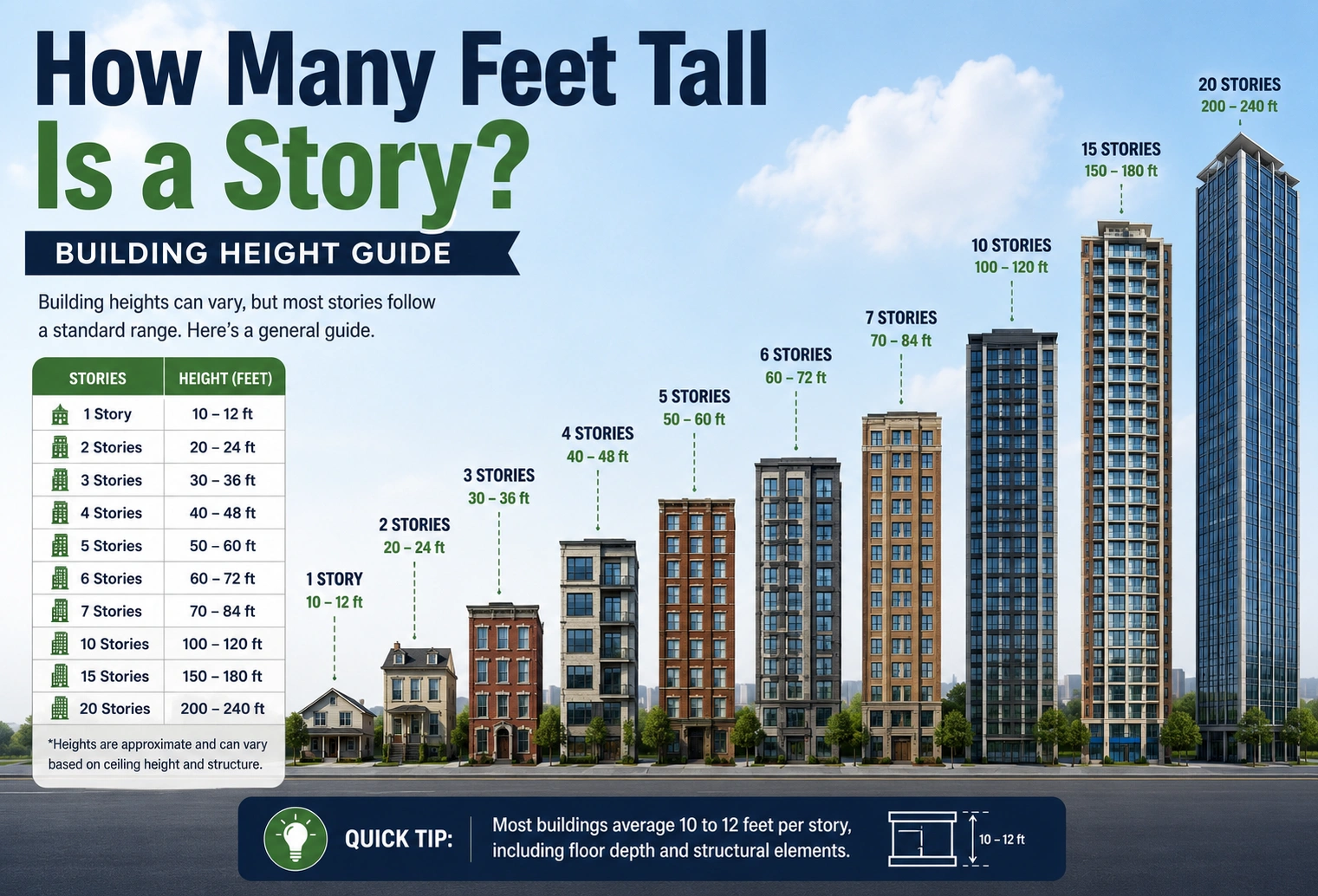
If you’ve ever looked at a building and wondered how many feet tall is a story, you’re not alone. Stories are commonly used to describe building heights, but many people are unsure how those stories translate into actual feet.
Whether you’re comparing buildings, planning a construction project, studying architecture, or estimating the height of a structure, understanding story height is extremely useful.
The short answer is:
One story is typically 10 to 12 feet tall.
However, the exact height depends on the building type, ceiling height, floor thickness, and architectural design.
In this guide, you’ll learn standard story heights, conversion charts, real-world examples, and factors that influence building measurements.
Quick Answer
How Many Feet Tall Is a Story?
A typical story is:
- 10 feet tall in many residential buildings
- 10–12 feet tall on average
- 12–15 feet tall in many commercial buildings
For quick estimates:
✅ 1 story ≈ 10 feet
Many builders, architects, and real estate professionals use this rule of thumb when estimating building height.
What Is a Story in a Building?
Before discussing measurements, it’s important to understand what a story actually means.
Definition of a Story
A story (or storey) is a single level of a building that people can occupy.
Examples include:
- Ground floor
- Second floor
- Third floor
Each occupied level counts as one story.
Why Story Height Matters
Story height affects:
- Building regulations
- Construction costs
- Property values
- Zoning restrictions
- Fire safety requirements
Knowing the height of a story helps estimate a building’s total elevation.
How Many Feet Tall Is a Story?
There is no universal story height.
Different structures use different dimensions.
Residential Buildings
Most homes have:
- 8-foot ceilings
- 1–2 feet of structural space
This creates a floor-to-floor height of approximately:
9–10 feet
Many residential builders round this to:
10 feet per story
Commercial Buildings
Commercial structures often require:
- Larger HVAC systems
- Higher ceilings
- Additional utility space
As a result, commercial stories are usually:
12–15 feet tall
Office buildings, hotels, and retail centers often exceed residential story heights.
Average Story Height Chart
The table below shows typical heights.
| Building Type | Average Height per Story |
|---|---|
| Residential Home | 9–10 ft |
| Apartment Building | 10–12 ft |
| Office Building | 12–15 ft |
| Hotel | 10–14 ft |
| Retail Building | 12–16 ft |
| Warehouse Office Area | 12–20 ft |
For general calculations:
10–12 feet per story is a reliable estimate.
Factors That Affect Story Height
Several factors determine the actual height of a building story.
Ceiling Height
Ceilings vary significantly.
Common residential ceiling heights:
- 8 feet
- 9 feet
- 10 feet
Luxury homes may feature ceilings of:
- 12 feet or more
Floor Thickness
The space between floors contains:
- Joists
- Concrete slabs
- Wiring
- Plumbing
- HVAC systems
These components add additional height.
Roof Design
A roof can add several feet beyond the final story.
Examples include:
- Gable roofs
- Hip roofs
- Mansard roofs
- Flat roofs
Building Type
Different building purposes require different floor-to-floor heights.
For example:
- Homes prioritize comfort.
- Offices prioritize workspace.
- Retail stores prioritize open interiors.
Story-to-Feet Conversion Chart
This chart provides quick estimates.
| Stories | Approximate Height |
|---|---|
| 1 Story | 10–12 ft |
| 2 Stories | 20–24 ft |
| 3 Stories | 30–36 ft |
| 4 Stories | 40–48 ft |
| 5 Stories | 50–60 ft |
| 10 Stories | 100–120 ft |
| 20 Stories | 200–240 ft |
Actual heights may vary based on building design.
Real-World Examples
Let’s compare story heights to familiar structures.
Single-Story House
Most ranch-style homes are:
- About 10 feet tall to the ceiling
- 12–15 feet tall including the roof
Two-Story Home
Typically:
- 20–25 feet tall
Three-Story Townhouse
Often measures:
- 30–35 feet tall
Office Building
A three-story office building may reach:
- 36–45 feet tall
These examples illustrate why story height varies.
Residential vs Commercial Story Heights
The difference is often larger than people expect.
| Feature | Residential | Commercial |
|---|---|---|
| Ceiling Height | 8–10 ft | 10–15 ft |
| Utility Space | Smaller | Larger |
| Floor Thickness | Moderate | Greater |
| Average Story Height | 10 ft | 12–15 ft |
Commercial buildings generally require more vertical space.
Common Misconceptions About Story Height
Every Story Is Exactly 10 Feet
This is one of the most common myths.
Story heights vary widely.
Roof Height Doesn’t Matter
Roof design can significantly affect total building height.
Residential and Commercial Buildings Use the Same Standards
Commercial buildings are often much taller per story.
Ceiling Height Equals Story Height
The ceiling is only part of the total floor-to-floor measurement.
How to Estimate Building Height Using Stories
A simple method works for most situations.
Residential Buildings
Estimate:
Stories × 10 feet
Example:
3 stories × 10 feet = 30 feet
Commercial Buildings
Estimate:
Stories × 12–15 feet
Example:
3 stories × 12 feet = 36 feet
Universal Rule
Many professionals use:
11 feet per story
This often produces a reasonable estimate.
Why Story Height Is Important
Understanding story height helps with:
- Construction planning
- Drone photography
- Real estate comparisons
- Zoning compliance
- Architectural design
- Height restrictions
It provides a simple way to estimate the size of a building without exact measurements.
9. FAQs
1. How many feet tall is one story?
A typical story is 10 to 12 feet tall, although commercial buildings may be taller.
2. Is one story always 10 feet?
No. Ten feet is a common estimate, but actual heights vary by building type and design.
3. How tall is a two-story building?
Most two-story buildings are approximately 20 to 24 feet tall.
4. How many feet is three stories?
A three-story building is usually 30 to 36 feet tall.
5. Why are commercial stories taller?
Commercial buildings need additional space for HVAC systems, utilities, and higher ceilings.
10. Conclusion
If you’re wondering how many feet tall is a story, the most common estimate is 10 to 12 feet per story. Residential buildings typically average around 10 feet per story, while commercial structures often range from 12 to 15 feet due to larger ceilings and mechanical systems.
Although there is no single standard height, using 10 feet per story provides a reliable rule of thumb for quick calculations. Whether you’re estimating building heights, comparing properties, planning construction, or studying architecture, understanding story-to-feet conversions makes it much easier to visualize the true size of a structure.
Discover More Articles
How Many Feet Is 17 Meters? Exact Conversion Guide
How Many Acres Is 18,000 Square Feet? Exact Conversion Guide