
If you’re wondering how many inches is 4mm, the conversion is simple. Since an inch is larger than a millimeter, 4mm represents only a small fraction of an inch.
Quick Answer
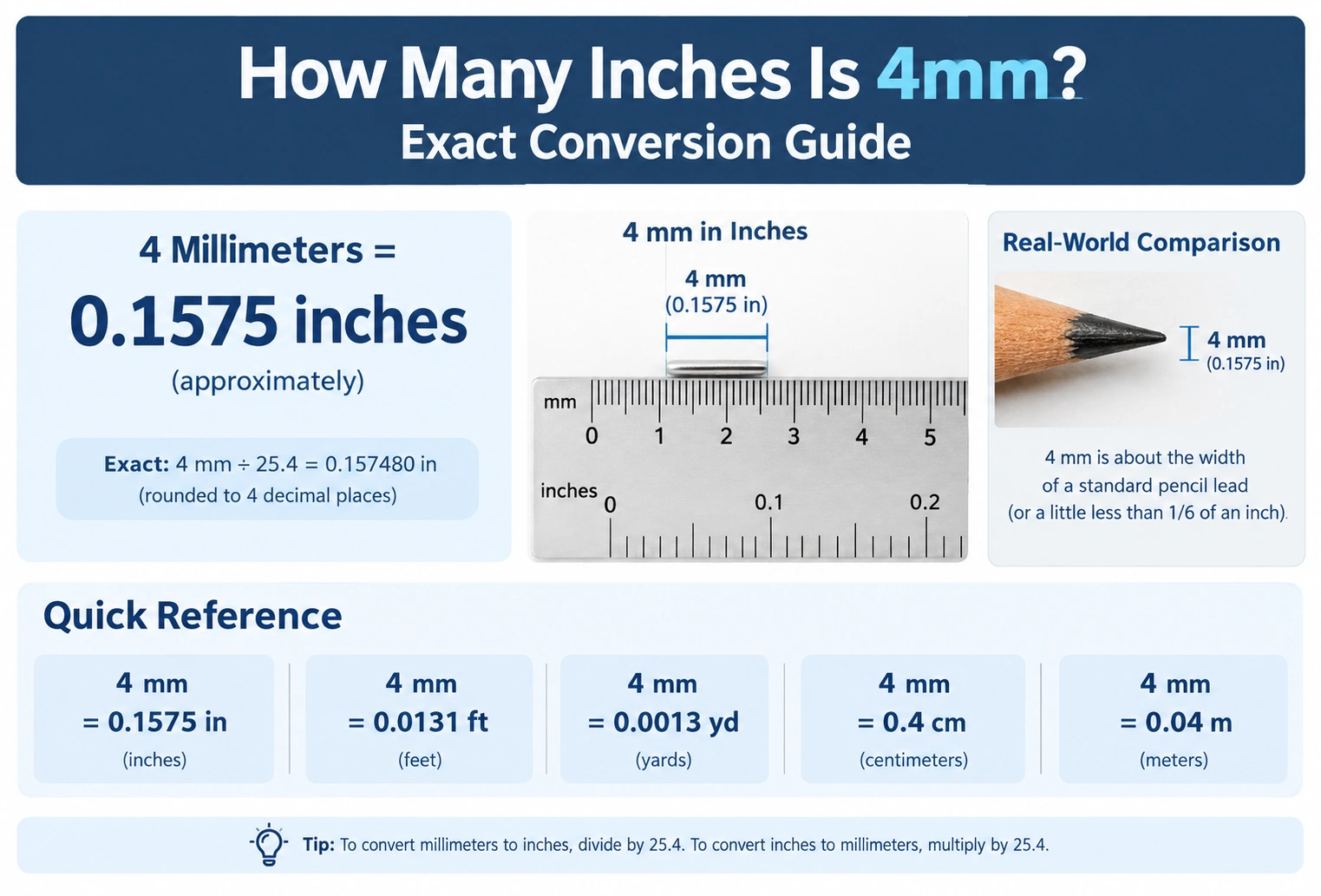
4mm equals approximately 0.1575 inches.
The exact conversion is:
4 ÷ 25.4 = 0.15748 inches
So:
4mm ≈ 0.1575 inches
As a fractional-inch measurement, 4mm is approximately 5/32 inch.
| Measurement | Equivalent |
|---|---|
| 4 millimeters | 4 mm |
| Inches | 0.1575 in |
| Approximate fraction | 5/32 in |
| Centimeters | 0.4 cm |
| Meters | 0.004 m |
| Feet | 0.0131 ft |
Therefore, 4mm is a little over 1/8 inch and noticeably smaller than 1/4 inch.
4mm to Inches Conversion
The standard conversion between millimeters and inches is:
1 inch = 25.4mm
To convert millimeters to inches, divide the millimeter measurement by 25.4.
For 4mm:
4 ÷ 25.4 = 0.1574803…
Rounded to four decimal places:
4mm = 0.1575 inches
| Millimeters | Inches |
|---|---|
| 1 mm | 0.0394 in |
| 2 mm | 0.0787 in |
| 3 mm | 0.1181 in |
| 4 mm | 0.1575 in |
| 5 mm | 0.1969 in |
| 6 mm | 0.2362 in |
| 8 mm | 0.3150 in |
| 10 mm | 0.3937 in |
| 12 mm | 0.4724 in |
| 25.4 mm | 1 in |
This makes it easy to see where 4mm falls relative to other common metric measurements.
How to Convert 4mm to Inches
Use this formula:
Inches = Millimeters ÷ 25.4
Substitute 4mm into the formula:
4 ÷ 25.4 = 0.15748 inches
Rounded:
4mm ≈ 0.1575 inches
The conversion works because one inch is exactly 25.4mm.
Why 4mm Is Less Than an Inch
Since:
4mm < 25.4mm
4mm must be less than 1 inch.
The result of approximately 0.1575 inches confirms this.
This is also why a small millimeter measurement can look very different when expressed in inches.
4mm in Fractional Inches
Many rulers and construction measurements use fractions of an inch instead of decimals.
The decimal conversion of 4mm is approximately:
0.1575 inch
A commonly used nearby fraction is:
5/32 inch = 0.15625 inch
This is very close to 4mm, but it is not exactly equal.
| Measurement | Decimal Inches | Difference From 4mm |
|---|---|---|
| 1/8 in | 0.1250 in | 0.0325 in smaller |
| 4mm | 0.1575 in | — |
| 5/32 in | 0.15625 in | 0.0012 in smaller |
| 3/16 in | 0.1875 in | 0.0300 in larger |
| 1/4 in | 0.2500 in | 0.0925 in larger |
For general measuring, 5/32 inch can be a convenient approximation. For precision applications, however, use the actual 4mm specification or its decimal conversion.
4mm in Other Units
Converting 4mm into other units provides additional ways to understand the measurement.
| Unit | 4mm Equals |
|---|---|
| Millimeters | 4 mm |
| Centimeters | 0.4 cm |
| Meters | 0.004 m |
| Inches | 0.1575 in |
| Feet | 0.0131 ft |
| Yards | 0.00437 yd |
The easiest metric conversion is:
4mm = 0.4cm
Because 10mm equals 1cm, dividing 4mm by 10 gives 0.4cm.
How Big Is 4mm?
4mm is a small measurement.
It is:
- Less than 1/4 inch
- Slightly more than 1/8 inch
- 0.4 centimeter
- Approximately 0.1575 inch
A useful comparison is 5mm. Since 5mm equals approximately 0.1969 inch, 4mm is slightly smaller.
| Reference | Measurement |
|---|---|
| 1/8 inch | 3.175 mm |
| 4mm | 0.1575 inch |
| 5mm | 0.1969 inch |
| 3/16 inch | 4.7625 mm |
| 1/4 inch | 6.35 mm |
So, 4mm is between 1/8 inch and 3/16 inch.
It is closer to 1/8 inch than to 3/16 inch.
4mm Compared With Common Measurements
Comparing 4mm with common inch fractions is useful when working with hardware, materials, tools, or product dimensions.
| Common Inch Measurement | Millimeter Equivalent | Compared With 4mm |
|---|---|---|
| 1/16 in | 1.5875 mm | 2.4125 mm smaller |
| 1/8 in | 3.175 mm | 0.825 mm smaller |
| 4mm | 4 mm | 0.1575 in |
| 5/32 in | 3.96875 mm | 0.03125 mm smaller |
| 3/16 in | 4.7625 mm | 0.7625 mm larger |
| 1/4 in | 6.35 mm | 2.35 mm larger |
| 5/16 in | 7.9375 mm | 3.9375 mm larger |
This comparison shows why 5/32 inch is a close fractional approximation for 4mm.
Where 4mm Measurements Are Used
A 4mm measurement can appear in many areas where small dimensions matter.
Hardware and Fasteners
Metric hardware can be specified in millimeters. Nuts, bolts, washers, screws, and other components may use metric dimensions.
However, a “4mm” specification can refer to different dimensions depending on the product, such as diameter, thickness, or tool size.
Tools
Metric tools often come in millimeter sizes. A 4mm Allen key, hex key, drill bit, or other tool may be identified by its nominal size.
It is important not to assume that a tool’s 4mm label means the tool itself is only 4mm long or wide.
Construction and DIY
Thin materials, hardware, gaps, and other small dimensions may be specified in millimeters.
Knowing that 4mm is approximately 0.1575 inch makes it easier to compare metric specifications with imperial measurements.
Crafts and Jewelry
Small wire, beads, sheets, cords, and other craft materials may use millimeters for their dimensions.
For example, a 4mm bead has a diameter of approximately 0.1575 inch.
Manufacturing
Engineering and manufacturing commonly use millimeters for precise dimensions.
When components need to match an inch-based specification, accurate conversion is important.
How to Measure 4mm
A metric ruler is the easiest tool for measuring 4mm.
Because each centimeter contains 10 millimeters, the fourth small millimeter mark after zero represents 4mm.
For more precise applications, use a digital caliper or another precision measuring instrument.
Measuring Tips
- Start from the ruler’s zero mark.
- Use the millimeter markings rather than estimating.
- Keep the ruler aligned with the object.
- Use a caliper when greater precision is required.
- Check whether the measurement refers to diameter, thickness, width, or length.
If you’re using an inch ruler, 4mm is approximately 0.1575 inch, which falls slightly beyond the 1/8-inch mark.
Common Mistakes When Converting 4mm to Inches
Assuming 4mm Equals 0.16 Inches Exactly
4mm is approximately 0.1575 inches.
It can be rounded to 0.16 inches for general use, but 0.16 is not the exact conversion.
Confusing 4mm With 4cm
There is a major difference between these measurements.
4mm = 0.4cm
Meanwhile:
4cm = 40mm
Therefore, 4cm is ten times longer than 4mm.
| Measurement | Millimeters | Inches |
|---|---|---|
| 4mm | 4 mm | 0.1575 in |
| 4cm | 40 mm | 1.5748 in |
Treating 5/32 Inch as Exact
5/32 inch is very close to 4mm but is not exactly equal.
5/32 inch = 3.96875mm
The difference is small, but it can matter in precision applications.
Using the Wrong Conversion Direction
To convert millimeters to inches, divide by 25.4.
To convert inches to millimeters, multiply by 25.4.
Frequently Asked Questions
How many inches is 4mm?
4mm equals approximately 0.1575 inches.
Is 4mm the same as 1/8 inch?
No. 1/8 inch equals 3.175mm, so 4mm is slightly larger.
Is 4mm close to 5/32 inch?
Yes. 5/32 inch equals 3.96875mm, making it a very close approximation to 4mm.
Is 4mm less than 1/4 inch?
Yes. 1/4 inch equals 6.35mm, so 4mm is considerably smaller.
How many centimeters is 4mm?
4mm equals 0.4 centimeter.
How many inches is 4mm rounded to two decimal places?
Rounded to two decimal places, 4mm equals 0.16 inches.
How many inches is 4mm rounded to the nearest fraction?
A close fractional equivalent is approximately 5/32 inch.
What does 4mm look like?
4mm is a small length, slightly larger than 1/8 inch and smaller than 3/16 inch. It is also less than half a centimeter.
Conclusion
4mm equals approximately 0.1575 inches, making it slightly larger than 1/8 inch and much smaller than 1/4 inch. A close fractional-inch approximation is 5/32 inch.
In metric units, 4mm equals 0.4cm. For everyday comparisons, 0.16 inch is a convenient rounded value, while 0.1575 inch is better when accuracy matters.
Discover More Articles
How Many Inches Is 15 mm? Exact Conversion Guide