

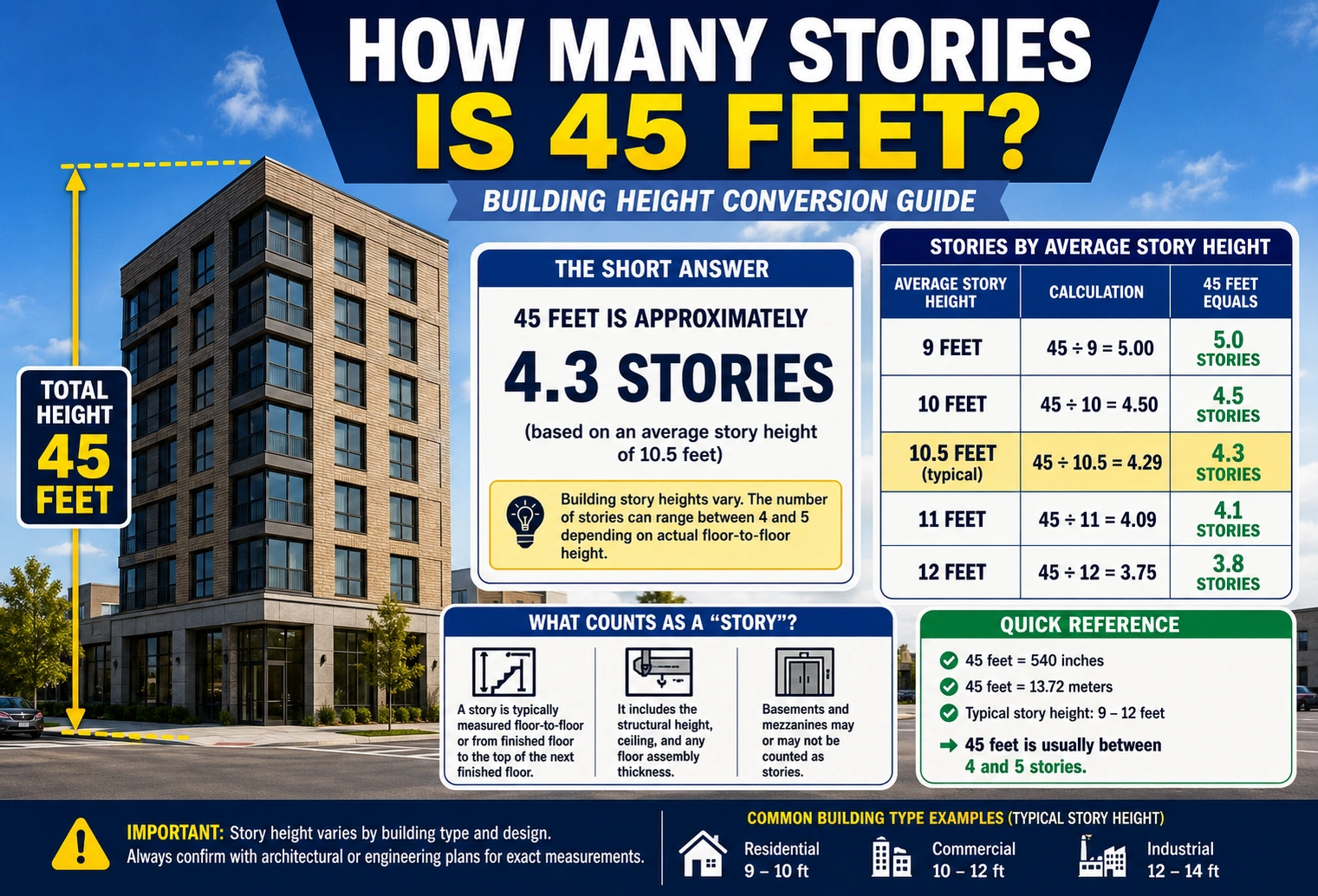
If you’re wondering “how many stories is 45 feet?”, the answer depends on the type of building.
A typical building story is approximately:
- 10 feet tall in residential construction
- 12–15 feet tall in commercial construction
Using the common residential estimate:
45÷10=4.5
So:
- 45 feet is approximately 4 to 5 stories tall
Quick Answer
For most buildings:
| Story Height | Estimated Stories |
|---|---|
| 10 ft per story | 4.5 stories |
| 12 ft per story | 3.75 stories |
| 15 ft per story | 3 stories |
Most people would describe a 45-foot building as:
- About 4 to 5 stories
Understanding Building Story Heights
Story height varies depending on building design.
Residential Buildings
Homes and apartments typically use:
- 8-foot ceilings
- Floor systems and roof structures
Resulting in about:
- 10 feet per story
Commercial Buildings
Office buildings often require:
- Higher ceilings
- HVAC systems
- Mechanical spaces
Leading to:
- 12–15 feet per story
Why Story Heights Vary
Factors include:
- Ceiling height
- Building type
- Structural design
- Mechanical systems
- Architectural style
How to Convert Feet to Stories
A simple estimate can be made using average story height.
Formula
Use:
Stories=Height Per StoryBuilding Height
Residential Building Example
Assuming 10 feet per story:
45÷10=4.5
Result:
- About 4.5 stories
Commercial Building Example
Assuming 15 feet per story:
45÷15=3
Result:
- About 3 stories
What Does a 45-Foot Building Look Like?
A 45-foot-tall building is roughly equivalent to:
- A 4-story apartment building
- A small hotel
- A mid-sized office building
- Several stacked residential homes
It is noticeably taller than most single-family houses.
Feet-to-Stories Conversion Chart
| Height (Feet) | Approximate Stories |
|---|---|
| 20 ft | 2 stories |
| 30 ft | 3 stories |
| 40 ft | 4 stories |
| 45 ft | 4–5 stories |
| 50 ft | 5 stories |
| 60 ft | 6 stories |
Factors That Affect Story Height
Ceiling Height
Higher ceilings increase total building height.
Mechanical Equipment
Commercial structures often require additional space between floors.
Roof Design
Flat roofs and pitched roofs can affect total height.
Building Codes
Local regulations sometimes influence floor-to-floor heights.
Common Conversion Mistakes
Assuming Every Story Is Exactly 10 Feet
Actual story heights vary considerably.
Ignoring Roof Height
Some building measurements include roof structures.
Mixing Residential and Commercial Standards
Commercial stories are often taller than residential stories.
Practical Examples
Example 1: Apartment Building
Height:
- 45 feet
Calculation:
45÷10=4.5
Result:
- Approximately 4–5 stories
Example 2: Office Building
Height:
- 45 feet
Calculation:
45÷15=3
Result:
- Approximately 3 stories
Example 3: Mixed-Use Building
Using 12 feet per floor:
45÷12=3.75
Result:
- About 4 stories
FAQs
How many stories is 45 feet?
For most residential buildings:
- About 4 to 5 stories
How many floors is 45 feet?
Typically:
- 4–5 residential floors
- 3–4 commercial floors
What is the average height of one story?
Most residential stories average:
- About 10 feet
Is 45 feet taller than a four-story building?
In many cases, yes.
A typical four-story residential building is around 40 feet tall.
How many stories is a 50-foot building?
Calculation:
50÷10=5
Result:
- Approximately 5 stories
Conclusion
So, how many stories is 45 feet?
The answer depends on building type, but generally:
- 45 feet equals about 4 to 5 residential stories
- 45 feet equals about 3 to 4 commercial stories
45÷10=4.5 stories
Understanding story-to-height conversions is useful for:
- Construction planning
- Real estate analysis
- Architecture
- Building regulations
- Property development
For most everyday comparisons, a 45-foot building is roughly equivalent to a 4- to 5-story structure.
Discover More Articles
How Many Feet of Intestines Do Humans Have? Complete Digestive System Guide
How Many Square Feet Does a Gallon of Paint Cover? Complete Coverage Guide