
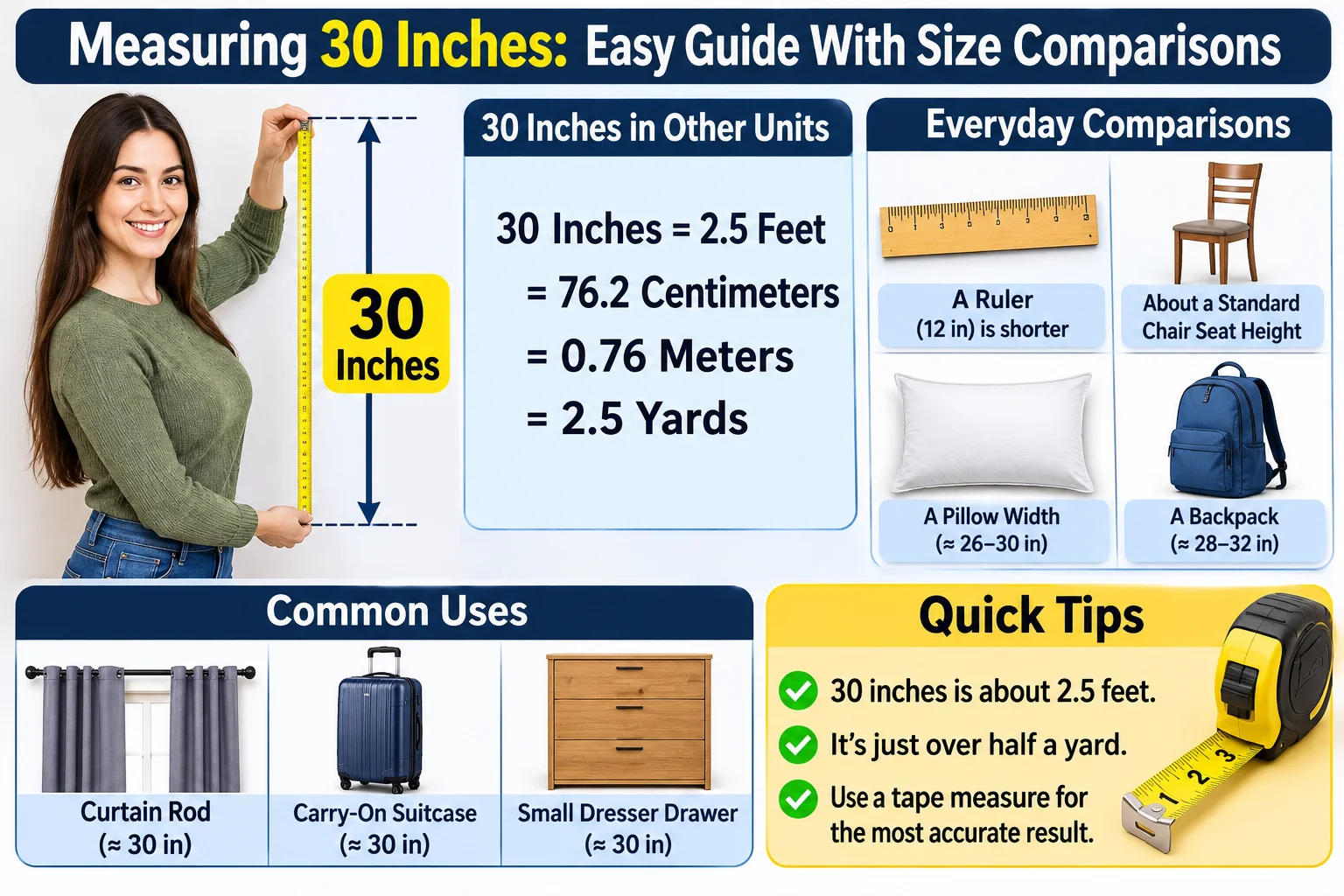
Measuring 30 inches means finding a length equal to 2.5 feet, 76.2 centimeters, or 762 millimeters. It is a common measurement used for furniture, household objects, shelves, appliances, clothing, and DIY projects.
Thirty inches is also 2 feet and 6 inches, making it easy to understand when using a standard measuring tape. If you do not have a measuring tool nearby, everyday objects can help you visualize this length. This guide explains how to measure 30 inches accurately, what it looks like, and how to convert it into other units.
How Long Is 30 Inches?
Thirty inches is equal to 2.5 feet because one foot contains 12 inches.
The calculation is:
30 ÷ 12 = 2.5 feet
Therefore, 30 inches is exactly 2 feet and 6 inches. It is also equal to 76.2 centimeters, which makes it a little more than three-quarters of a meter.
Here are the main conversions:
- 30 inches = 2.5 feet.
- 30 inches = 76.2 centimeters.
- 30 inches = 762 millimeters.
- 30 inches = 0.8333 yards.
- 30 inches = 0.762 meters.
| Measurement Unit | Equivalent to 30 Inches |
|---|---|
| Inches | 30 in |
| Feet | 2.5 ft |
| Feet and inches | 2 ft 6 in |
| Yards | 0.8333 yd |
| Centimeters | 76.2 cm |
| Millimeters | 762 mm |
| Meters | 0.762 m |
These conversions are useful when measuring furniture, checking product dimensions, or following instructions that use different measurement systems.
How to Measure 30 Inches Accurately
You can measure 30 inches using a measuring tape, ruler, or yardstick. The best method depends on the size of the object and the tools available.
1. Using a Measuring Tape
A measuring tape is one of the easiest tools for measuring 30 inches.
Follow these steps:
- Place the zero end of the tape at the starting point.
- Extend the tape along the length you want to measure.
- Keep the tape straight and flat.
- Find the 30-inch marking.
- Check that the endpoint lines up with the correct mark.
Some measuring tapes also display feet and inches. In that case, you can look for the marking that reads 2 feet and 6 inches.
For accurate results, avoid bending the tape or measuring diagonally across the object.
2. Using a Ruler
A standard 12-inch ruler can measure 30 inches, but you need to move it more than once.
Follow these steps:
- Place the ruler at the starting point.
- Measure the first 12 inches.
- Move the ruler forward and measure another 12 inches.
- Measure the remaining 6 inches.
- Add all three measurements together.
12 + 12 + 6 = 30 inches
Therefore, two complete ruler lengths plus another 6 inches equal 30 inches.
Make sure each new measurement begins exactly where the previous one ends. Small gaps or overlaps can affect the final result.
3. Using a Yardstick
A standard yardstick measures 36 inches, which is 6 inches longer than 30 inches.
To measure 30 inches with a yardstick:
- Place the zero end at the starting point.
- Locate the 30-inch marking.
- Check where the object ends.
A yardstick is convenient because it allows you to measure 30 inches without repeatedly moving a shorter ruler.
4. Measuring Without a Measuring Tool
If you do not have a ruler or tape measure, you can estimate 30 inches by comparing the length with familiar objects.
For example, three standard US letter-size sheets of paper placed end to end along their 11-inch sides measure 33 inches. That is 3 inches longer than 30 inches.
You can also use an object with a known length, such as a standard yardstick, and estimate the difference.
These comparisons are useful for rough estimates, but they should not replace a measuring tool when accuracy matters.
What Does 30 Inches Look Like?
Thirty inches is about the height of a small table or the width of some household furniture. It is also 6 inches shorter than a standard yardstick.
To visualize this length:
- It is equal to 2 feet and 6 inches.
- It is 6 inches shorter than 3 feet.
- It is 6 inches longer than 2 feet.
- It is approximately 76 centimeters long.
- It is 2.5 times the length of a 12-inch ruler.
Imagine placing two 12-inch rulers end to end. You would have 24 inches. Adding another 6 inches gives you the full 30-inch measurement.
Common Objects That Are Around 30 Inches Long
Several everyday objects have dimensions close to 30 inches. They can help you understand this length when you do not have a measuring tool nearby.
| Everyday Object | Approximate Measurement | Comparison With 30 Inches |
|---|---|---|
| Small dining table height | Around 30 inches | Often close |
| Standard kitchen countertop height | Around 36 inches | 6 inches longer |
| Yardstick | 36 inches | 6 inches longer |
| Three letter-size paper sheets (long sides) | 33 inches | 3 inches longer |
| Small desk width | Varies | Some are close |
| Large storage box length | Varies | Some are close |
| Two and a half 12-inch rulers | 30 inches | Exact |
These examples are visual references rather than universal standards. Furniture and storage products come in different sizes, so always check their actual dimensions.
A standard yardstick is especially useful because its 36-inch length makes it easy to identify a point 6 inches before the end.
Converting 30 Inches Into Other Units
You may need to convert 30 inches into feet, centimeters, millimeters, or meters when measuring materials or comparing product dimensions.
Here are the basic conversion formulas:
- Inches to feet: Divide inches by 12.
- Inches to yards: Divide inches by 36.
- Inches to centimeters: Multiply inches by 2.54.
- Inches to millimeters: Multiply inches by 25.4.
- Inches to meters: Multiply inches by 0.0254.
30 Inches to Feet
One foot contains 12 inches.
30 ÷ 12 = 2.5 feet
Therefore, 30 inches equals 2.5 feet, or 2 feet and 6 inches.
30 Inches to Centimeters
One inch equals 2.54 centimeters.
30 × 2.54 = 76.2 centimeters
Therefore, 30 inches equals 76.2 centimeters.
30 Inches to Millimeters
One inch equals 25.4 millimeters.
30 × 25.4 = 762 millimeters
Therefore, 30 inches equals 762 millimeters.
30 Inches to Meters
One inch equals 0.0254 meters.
30 × 0.0254 = 0.762 meters
Therefore, 30 inches equals 0.762 meters.
30 Inches to Yards
One yard equals 36 inches.
30 ÷ 36 = 0.8333 yards
Therefore, 30 inches equals approximately 0.8333 yards.
Complete Inches Conversion Table
The following table compares 30 inches with nearby measurements.
| Inches | Feet | Centimeters | Millimeters | Meters |
|---|---|---|---|---|
| 12 inches | 1 ft | 30.48 cm | 304.8 mm | 0.3048 m |
| 18 inches | 1.5 ft | 45.72 cm | 457.2 mm | 0.4572 m |
| 24 inches | 2 ft | 60.96 cm | 609.6 mm | 0.6096 m |
| 30 inches | 2.5 ft | 76.2 cm | 762 mm | 0.762 m |
| 36 inches | 3 ft | 91.44 cm | 914.4 mm | 0.9144 m |
| 42 inches | 3.5 ft | 106.68 cm | 1,066.8 mm | 1.0668 m |
| 48 inches | 4 ft | 121.92 cm | 1,219.2 mm | 1.2192 m |
This table makes it easier to compare lengths and convert measurements without repeating the calculations.
Practical Uses of a 30-Inch Measurement
A 30-inch measurement is useful in many everyday situations, especially when working with furniture, home improvement projects, and household equipment.
1. Furniture and Home Planning
Thirty inches is a common approximate height for many dining tables and desks.
If you are buying furniture, measuring 30 inches can help you compare product dimensions and check whether a table fits comfortably in a room.
However, actual furniture heights vary, so always check the manufacturer’s specifications.
2. Kitchen and Countertop Planning
Some kitchen work surfaces are approximately 30 inches deep, although standard countertop dimensions vary.
Knowing this measurement can help when planning cabinets, work surfaces, or kitchen storage.
Make sure you distinguish between the depth, width, and height of a product.
3. DIY and Construction Projects
Thirty inches is useful when cutting wood, measuring shelves, marking wall spaces, or building small structures.
For example, if a wooden board needs to be 30 inches long, measure the full distance before cutting.
Accurate measurements help reduce material waste and prevent fitting problems.
4. Shopping for Household Products
Many products list their dimensions in inches. Knowing what 30 inches looks like can help you compare desks, storage units, shelves, appliances, and other household items.
Check all three dimensions when buying a product. A 30-inch width does not necessarily mean it is also 30 inches tall or deep.
5. Clothing and Fabric Measurements
Thirty inches may be used when measuring fabric, garment lengths, or certain body measurements.
For example, a 30-inch fabric cut is equal to 2.5 feet. When measuring fabric, keep it flat and avoid stretching it.
Common Mistakes When Measuring 30 Inches
Even a simple measurement can become inaccurate if you use the wrong starting point or measuring method.
Here are some common mistakes to avoid:
- Starting at the edge instead of zero: Some rulers and measuring tapes have a small gap before the zero mark. Always check the starting point.
- Confusing inches with feet: Thirty inches equals 2.5 feet, not 30 feet.
- Measuring at an angle: Keep the tape straight along the length you want to measure.
- Leaving gaps between ruler measurements: When using a 12-inch ruler more than once, align each new starting point with the previous endpoint.
- Using approximate objects as exact references: Tables, desks, and shelves vary in size. Use a measuring tape when accuracy matters.
- Mixing up length and width: An object can be 30 inches wide but have a different length or height.
- Forgetting the correct conversion: Thirty inches equals 76.2 centimeters, not 30 centimeters.
Frequently Asked Questions
1. How many feet are in 30 inches?
There are 2.5 feet in 30 inches. Divide 30 by 12 because one foot contains 12 inches.
2. How many centimeters is 30 inches?
Thirty inches equals 76.2 centimeters. Multiply 30 by 2.54 to get the answer.
3. Is 30 inches the same as 2 feet and 6 inches?
Yes. Two feet contain 24 inches, and adding another 6 inches gives 30 inches.
4. What common object is about 30 inches long?
A small dining table may be around 30 inches high, depending on its design. A standard yardstick is 36 inches long, so it is 6 inches longer than this measurement.
5. How can I measure 30 inches without a measuring tape?
You can use a 12-inch ruler twice and then measure another 6 inches. Alternatively, a yardstick can help you locate the 30-inch mark directly.
6. Is 30 inches longer than 1 meter?
No. Thirty inches equals 0.762 meters, which is shorter than one meter by 0.238 meters, or 23.8 centimeters.
Conclusion
Measuring 30 inches is easy when you know that it equals 2.5 feet, 76.2 centimeters, or 762 millimeters. You can measure this distance using a tape measure, yardstick, or standard ruler. A 30-inch length is useful for furniture, home improvement, shopping, and DIY projects. For accurate results, always begin at the zero mark, keep your measuring tool straight, and double-check the measurement before cutting or installing materials.
Discover More Articles
Twin Bed Measurement: Standard Size, Dimensions, and Complete Guide
Measure 3 Feet: Easy Guide With Size Comparisons
Measuring 11 Inches: Exact Length, Conversions, and Everyday Comparisons