
If you’ve ever wondered 55 mph how many feet to stop, you’re asking an important road safety question. Knowing how much distance a vehicle needs to come to a complete stop can help you avoid collisions, maintain a safe following distance, and become a more defensive driver.
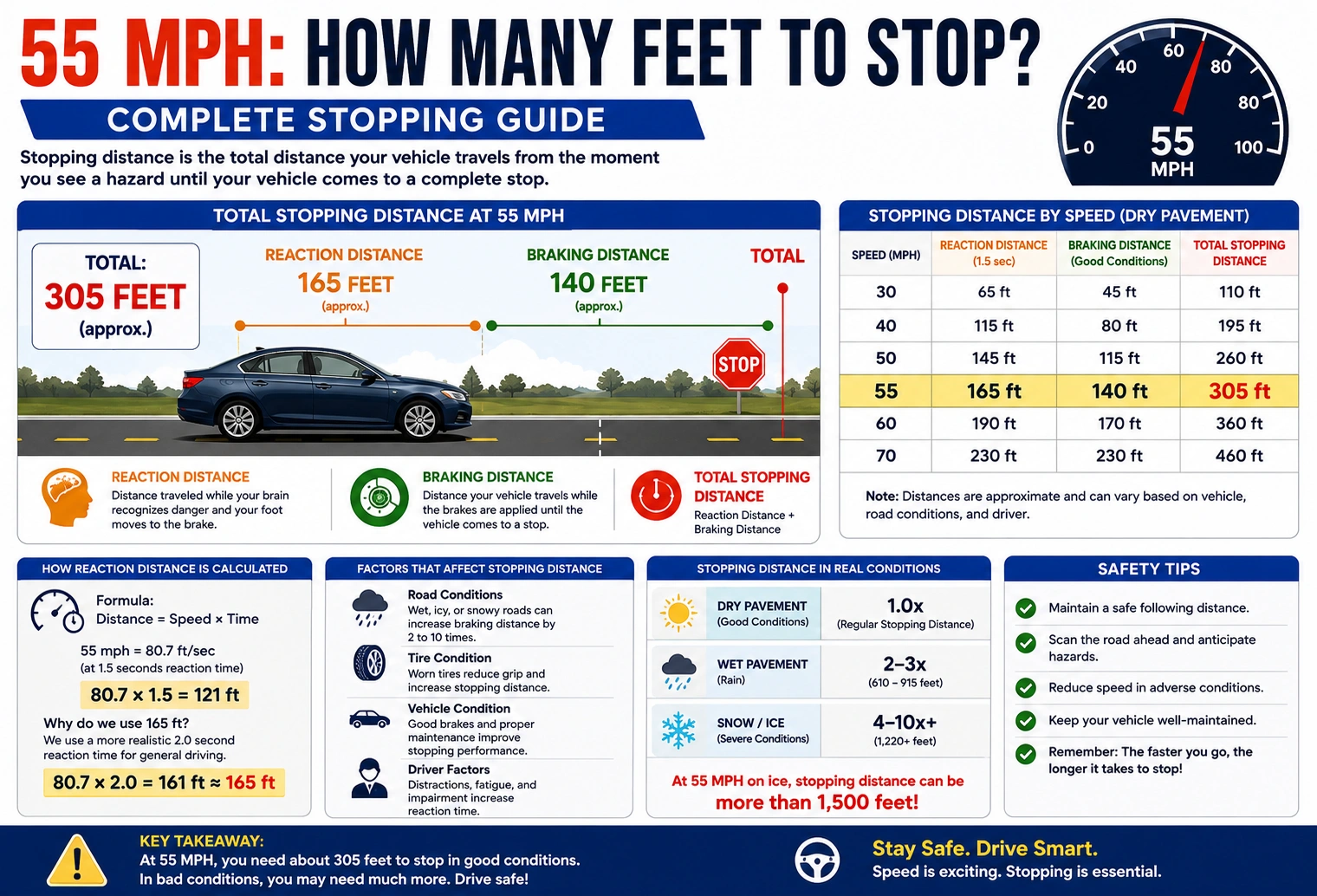
Under ideal conditions—such as a dry road, good tires, functioning brakes, and an alert driver—a passenger vehicle traveling at 55 mph typically requires about 265 feet to stop completely. This total includes both the reaction distance and the braking distance.
Keep in mind that actual stopping distances vary depending on road conditions, weather, vehicle type, tire condition, and driver reaction time.
Quick Answer
| Speed | Approximate Total Stopping Distance* |
|---|---|
| 55 mph | About 265 feet |
*Based on ideal driving conditions with an alert driver and dry pavement.
Answer: A vehicle traveling at 55 mph generally needs about 265 feet to stop completely.
Understanding Stopping Distance
Stopping distance is the total distance your vehicle travels from the moment you notice a hazard until it comes to a complete stop.
It has two main parts:
- Reaction distance – the distance traveled while you recognize the hazard and move your foot to the brake pedal.
- Braking distance – the distance the vehicle travels after the brakes are applied until it stops.
Total Stopping Distance = Reaction Distance + Braking Distance
Reaction Distance at 55 MPH
Reaction distance depends on:
- Driver alertness
- Reaction time
- Speed
At 55 mph, a vehicle travels about 81 feet per second.
With a typical reaction time of about 1.5 seconds, the reaction distance is approximately:
81 × 1.5 ≈ 121 feet
This means the car keeps moving for over 120 feet before the brakes are even applied.
Braking Distance at 55 MPH
Braking distance begins when the brake pedal is pressed.
On dry pavement with good brakes and tires, the braking distance from 55 mph is approximately:
144 feet
Braking distance can increase significantly if:
- The road is wet.
- Tires are worn.
- Brakes are poorly maintained.
- The vehicle is heavily loaded.
Total Stopping Distance
Adding the two parts together:
| Component | Distance |
|---|---|
| Reaction Distance | About 121 feet |
| Braking Distance | About 144 feet |
| Total Stopping Distance | About 265 feet |
This is why maintaining a safe following distance is so important at highway speeds.
Stopping Distance Chart
| Speed | Reaction Distance | Braking Distance | Total Stopping Distance |
|---|---|---|---|
| 20 mph | 44 ft | 20 ft | 64 ft |
| 30 mph | 66 ft | 45 ft | 111 ft |
| 40 mph | 88 ft | 80 ft | 168 ft |
| 50 mph | 110 ft | 125 ft | 235 ft |
| 55 mph | 121 ft | 144 ft | 265 ft |
| 60 mph | 132 ft | 180 ft | 312 ft |
| 70 mph | 154 ft | 245 ft | 399 ft |
These values are approximate and assume ideal driving conditions.
Factors That Affect Stopping Distance
Several factors can make stopping distances shorter or longer.
Road Conditions
Dry pavement offers the best traction.
Wet, snowy, or icy roads can dramatically increase braking distance.
Tire Condition
Worn tires reduce grip and increase stopping distance.
Check tire tread regularly for safe performance.
Brake Performance
Well-maintained brakes stop vehicles more efficiently.
Worn brake pads or damaged components can lengthen stopping distances.
Vehicle Weight
Heavier vehicles generally require more distance to stop.
Loaded trucks and SUVs often take longer than smaller passenger cars.
Driver Reaction Time
Fatigue, distractions, or impaired driving increase reaction time, adding many extra feet before braking begins.
Real-World Examples
Highway Driving
You’re traveling at 55 mph and a vehicle ahead suddenly brakes.
Even if you’re paying attention, your car may travel more than 120 feet before you begin braking, then another 144 feet before stopping.
School Zone Transition
As a speed limit drops from 55 mph to 25 mph, slowing down early significantly reduces stopping distance and improves safety.
Rainy Conditions
On wet roads, stopping distances can increase considerably because tires have less traction.
Always increase your following distance during bad weather.
Safe Driving Tips
To improve safety at highway speeds:
- Keep a safe following distance.
- Stay alert and avoid distractions.
- Maintain your brakes and tires.
- Reduce speed in rain, snow, or fog.
- Leave extra space behind large trucks.
- Avoid tailgating.
Following the three-second rule (or more in poor conditions) gives you additional time to react.
Common Mistakes
Assuming Braking Starts Instantly
Many drivers forget that reaction time adds a significant distance before braking even begins.
Following Too Closely
Tailgating leaves little room to stop safely if traffic slows suddenly.
Ignoring Road Conditions
Stopping distances on wet or icy roads are much longer than on dry pavement.
Poor Vehicle Maintenance
Worn tires and brakes reduce stopping performance and increase accident risk.
Expert Tips
- Look well ahead while driving to anticipate hazards.
- Replace worn tires before they become unsafe.
- Service brakes according to your vehicle manufacturer’s recommendations.
- Increase following distance in bad weather.
- Remember that stopping distance increases rapidly as speed increases.
Quick Reference Table
| Speed | Total Stopping Distance |
|---|---|
| 25 mph | About 85 feet |
| 35 mph | About 136 feet |
| 45 mph | About 195 feet |
| 55 mph | About 265 feet |
| 65 mph | About 344 feet |
| 75 mph | About 450 feet |
9. Frequently Asked Questions
1. How many feet does it take to stop at 55 mph?
Under ideal conditions, a typical passenger vehicle requires about 265 feet to stop completely.
2. Does weather affect stopping distance?
Yes. Rain, snow, and ice reduce tire traction and increase stopping distances.
3. What is reaction distance at 55 mph?
An alert driver traveling at 55 mph typically covers about 121 feet before applying the brakes.
4. Why is total stopping distance important?
It helps drivers maintain safe following distances and avoid rear-end collisions.
5. Do larger vehicles need more stopping distance?
Yes. Heavier vehicles generally require more distance to stop than smaller passenger cars.
10. Conclusion
If you’re asking 55 mph how many feet to stop, the typical answer is about 265 feet under ideal driving conditions. This includes approximately 121 feet of reaction distance and 144 feet of braking distance. However, actual stopping distances vary depending on factors such as road surface, weather, tire condition, brake performance, vehicle weight, and driver alertness.
Understanding stopping distances is essential for safe driving. By maintaining your vehicle, avoiding distractions, reducing speed in poor weather, and leaving enough following distance, you can improve your ability to stop safely and reduce the risk of accidents.
Discover More Articles
How Many Square Feet Are in 1 Foot? Explained Simply
How Many Feet in a Statute Mile? Exact Conversion Guide
Crow’s Feet Botox: How Many Units Do You Need? Complete Guide