
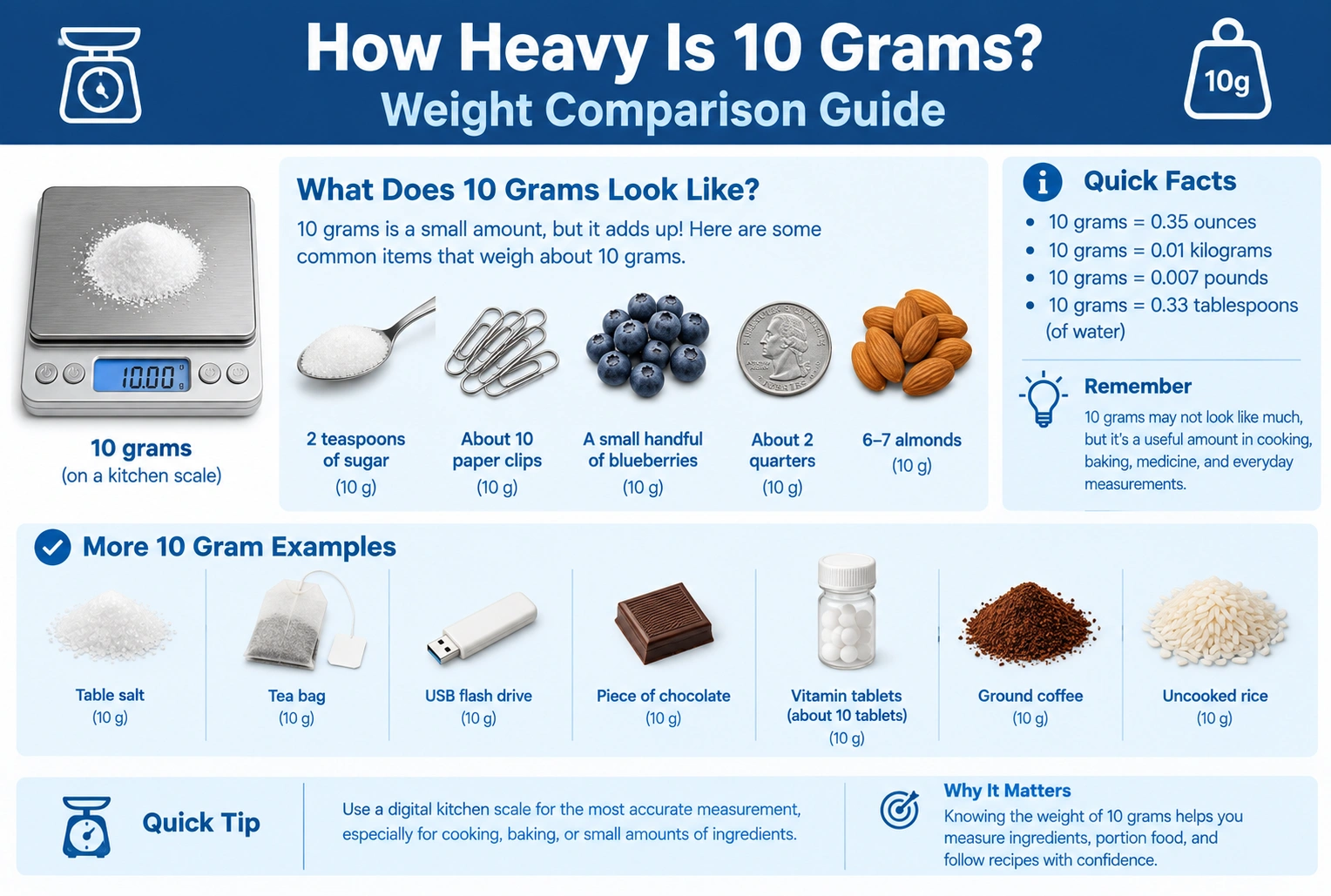
If you’re wondering how heavy 10 grams is, it is a very small amount of mass. Ten grams is light enough to be easily held between your fingers, but it is still a measurable amount that can matter when weighing food, jewelry, craft materials, or small objects.
10 grams equals 0.3527 ounces, 0.02205 pounds, or 10,000 milligrams.
For an everyday reference, 10 grams is roughly the weight of two U.S. nickels. Since one U.S. nickel weighs 5 grams, two nickels together weigh exactly 10 grams.
Quick Answer
10 grams weighs:
- 10 grams
- 10,000 milligrams
- 0.3527 ounces
- 0.02205 pounds
- 0.01 kilograms
So, 10 grams is about 0.35 ounces.
A simple way to visualize 10 grams is to imagine two U.S. nickels placed together. Each nickel has a mass of 5 grams, making two nickels exactly 10 grams.
Keep in mind that grams measure mass, while everyday language often uses “weight” to describe how heavy something feels. In ordinary use, however, saying that an object weighs 10 grams is perfectly understandable.
10 Grams in Other Weight Units
Converting 10 grams into other units helps put the measurement into perspective.
| Unit | Equivalent to 10 Grams |
|---|---|
| Grams | 10 g |
| Milligrams | 10,000 mg |
| Kilograms | 0.01 kg |
| Ounces | 0.3527 oz |
| Pounds | 0.02205 lb |
| Metric tons | 0.00001 t |
For everyday use, the most useful conversion is:
10 grams ≈ 0.35 ounces
It is also exactly 1/100 of a kilogram.
10 Grams to Milligrams
There are 1,000 milligrams in one gram.
Therefore:
10 × 1,000 = 10,000 milligrams
So:
10 grams = 10,000 milligrams
10 Grams to Ounces
One gram is approximately 0.035274 ounces.
Therefore:
10 × 0.035274 ≈ 0.35274 ounces
So:
10 grams ≈ 0.3527 ounces
10 Grams to Pounds
There are 453.592 grams in one pound.
Therefore:
10 ÷ 453.592 ≈ 0.02205 pounds
So:
10 grams ≈ 0.02205 pounds
What Does 10 Grams Look Like?
Unlike length, weight cannot be seen directly. The size of a 10-gram object depends on the material it is made from because different materials have different densities.
For example, 10 grams of metal may occupy much less physical space than 10 grams of a lightweight material.
This is why comparing 10 grams by mass rather than physical size is important.
One of the simplest references is a pair of U.S. nickels:
- 1 U.S. nickel = 5 grams
- 2 U.S. nickels = 10 grams
This provides a convenient physical reference for the mass.
Everyday Objects That Weigh About 10 Grams
Several small objects can help you visualize how much 10 grams is. Exact weights can vary, so these examples are best used as general references.
1. Two U.S. Nickels
This is one of the clearest comparisons.
A U.S. nickel has a mass of 5 grams, so:
5 g + 5 g = 10 g
Two nickels therefore provide an exact 10-gram reference when they are in their standard minted condition.
2. Two 5-Gram Weights
If you have small calibration or craft weights, two 5-gram weights together equal 10 grams.
This is useful for learning what 10 grams feels like without needing to hold a scale reading.
3. A Small Portion of Food
Small quantities of ingredients such as spices, seeds, sugar, or other foods can weigh around 10 grams.
However, the physical volume varies depending on the ingredient.
For example, 10 grams of sugar does not occupy the same amount of space as 10 grams of a dense spice or a liquid.
4. Small Craft Materials
Beads, charms, buttons, hardware pieces, and other small craft supplies can sometimes weigh around 10 grams.
The number of pieces required to reach 10 grams depends on the material and individual item size.
5. Small Jewelry Pieces
Some small jewelry items or components can have a mass close to 10 grams.
Jewelry is often measured precisely, so a digital scale is preferable when the exact mass matters.
How Heavy Is 10 Grams Compared With Common Weights?
Comparing 10 grams with larger and smaller measurements makes the difference easier to understand.
| Mass | Relationship to 10 Grams |
|---|---|
| 1 gram | 1/10 of 10 g |
| 2 grams | 1/5 of 10 g |
| 5 grams | Half of 10 g |
| 10 grams | Reference weight |
| 20 grams | Twice as heavy |
| 50 grams | 5 times as heavy |
| 100 grams | 10 times as heavy |
| 500 grams | 50 times as heavy |
| 1 kilogram | 100 times as heavy |
This shows that 10 grams is a very small mass compared with common household quantities such as 100 grams or 1 kilogram.
10 Grams Compared With an Ounce
An ounce is a commonly used unit for small weights in the United States.
One ounce equals approximately 28.35 grams.
That means 10 grams is considerably less than one ounce.
| Weight | Grams |
|---|---|
| 0.1 oz | 2.84 g |
| 0.25 oz | 7.09 g |
| 10 g | 10 g |
| 0.5 oz | 14.17 g |
| 1 oz | 28.35 g |
| 2 oz | 56.70 g |
So 10 grams is approximately 35.3% of an ounce.
Another useful way to think about it is that it would take about 2.84 portions of 10 grams to equal one ounce.
How to Measure 10 Grams Accurately
If you need exactly 10 grams, the most reliable method is to use a digital scale.
Step 1: Place the Scale on a Flat Surface
Set the scale on a stable, level surface. This helps produce a consistent measurement.
Step 2: Turn the Scale On
Select grams as the measurement unit if the scale offers multiple options.
Look for a display showing g.
Step 3: Tare the Container
If you are putting the material into a bowl or container, place the empty container on the scale and press the tare button.
The display should return to zero.
Step 4: Add the Material
Slowly add the item or material until the display reaches:
10.0 g
For greater precision, follow the scale’s stated resolution and avoid adding material too quickly.
Can You Measure 10 Grams Without a Scale?
You can estimate 10 grams using familiar objects, but you cannot reliably determine an exact 10-gram mass simply by looking at or holding something.
For example, two standard U.S. nickels provide an exact mass reference, but an unfamiliar object cannot be accurately judged by feel.
If accuracy matters, use a digital scale.
Why Understanding 10 Grams Is Useful
Knowing what 10 grams represents can be helpful in several situations.
Cooking and Baking
Recipes may call for ingredients in grams, especially when precise measurements are important.
A kitchen scale can measure small quantities such as 10 grams much more accurately than estimating by volume.
Jewelry
Precious metals and jewelry components can be measured in grams. Small differences in mass may matter when buying, selling, or evaluating an item.
Crafts
Beads, clay, resin components, powders, and other craft materials may be sold or used by weight.
Understanding 10 grams helps you estimate how much material you are handling.
Shipping
Small products and components can be measured in grams before being packaged for shipping.
Although shipping costs often depend on larger weight brackets, knowing the item’s mass is useful for planning.
Education
Ten grams provides a simple example when learning metric mass measurements.
Students can compare 1 gram, 10 grams, 100 grams, and 1 kilogram to understand how the metric system scales.
Common Mistakes When Measuring 10 Grams
Confusing Grams With Ounces
Grams and ounces are different units.
10 grams ≈ 0.353 ounces, not 10 ounces.
Assuming Physical Size Determines Mass
A larger object is not necessarily heavier than a smaller object.
A lightweight material can take up more space while having the same mass as a much smaller dense object.
Using Volume as an Exact Weight
A tablespoon, teaspoon, cup, or other volume measurement does not automatically equal a fixed number of grams.
The mass depends on the material’s density.
Forgetting to Tare the Container
If you place a container on a scale without using the tare function, the scale may include the container’s mass in the total.
Always zero the scale before measuring the material if you need exactly 10 grams.
Relying Only on Touch
People are not reliable at estimating very small masses by feel.
If the measurement is important, use a suitable scale.
FAQs
How heavy is 10 grams?
10 grams is approximately 0.3527 ounces or 0.02205 pounds. It is a small amount of mass.
Is 10 grams a lot?
For most everyday objects, 10 grams is a very small mass. It is equal to 10,000 milligrams and about 0.35 ounces.
What weighs exactly 10 grams?
Two standard U.S. nickels have a combined mass of 10 grams, since each nickel has a mass of 5 grams.
How many ounces are 10 grams?
10 grams equals approximately 0.3527 ounces.
How many pounds are 10 grams?
10 grams equals approximately 0.02205 pounds.
How many milligrams are in 10 grams?
There are 10,000 milligrams in 10 grams.
How much is 10 grams in kilograms?
10 grams = 0.01 kilograms.
Can I measure 10 grams without a scale?
You can estimate it using reference objects, such as two standard U.S. nickels, but an actual scale is needed for precise measurement.
What does 10 grams look like?
There is no single visual size for 10 grams because different materials have different densities. Two U.S. nickels provide a useful physical reference for 10 grams.
Is 10 grams the same as 10 milliliters?
No. Grams measure mass, while milliliters measure volume. Ten grams may occupy different volumes depending on the substance.
Conclusion
10 grams is a small mass equal to 10,000 milligrams, approximately 0.3527 ounces, or 0.02205 pounds. A simple way to visualize it is to think of two U.S. nickels, which have a combined mass of 10 grams.
For exact measurements, especially when cooking, crafting, weighing jewelry, or handling small materials, a digital scale is the most reliable way to measure 10 grams accurately.
Discover More Articles
How Many Feet Is 38 Inches? Exact Conversion Guide