

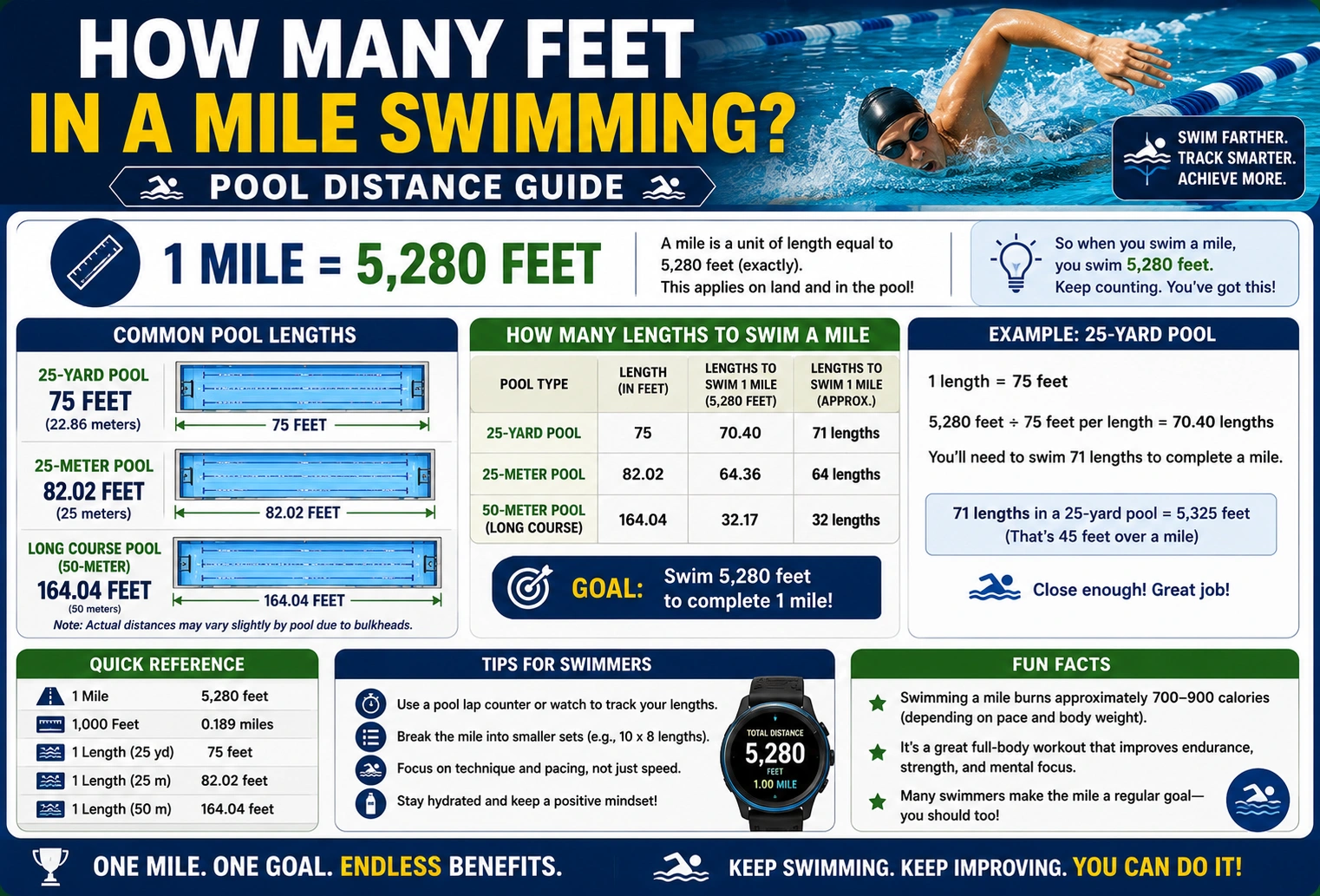
If you’ve ever asked how many feet in a mile swimming, the answer depends on whether you’re referring to a regular (statute) mile or the swimming mile commonly used in competitive swimming.
A standard land mile and the traditional swimming mile are not exactly the same distance. This often causes confusion for beginners and even experienced swimmers.
The most important fact is:
✅ A statute mile equals exactly 5,280 feet.
However, competitive swimmers often refer to 1,500 meters (approximately 4,921 feet) as the “swimming mile” because it is the closest standard race distance to one mile.
In this guide, you’ll learn the differences, pool lap equivalents, and how to calculate a mile in various swimming pools.
Quick Answer
There are two common meanings of a swimming mile:
Statute Mile
- 5,280 feet
- 1,760 yards
- 1,609.34 meters
Traditional Swimming Mile
- 1,500 meters
- 4,921 feet
- Approximately 0.93 statute miles
Answer:
If someone asks how many feet are in a mile swimming, the standard answer is:
✅ 5,280 feet for a true mile.
In competitive swimming, however, many people refer to 1,500 meters (about 4,921 feet) as the “swimming mile.”
Is a Swimming Mile the Same as a Regular Mile?
Not exactly.
There are two commonly used distances:
Regular (Statute) Mile
Used for:
- Running
- Walking
- Road races
- Open-water events that specify one mile
Distance:
5,280 feet
Swimming Mile
Traditionally used in competitive swimming.
Distance:
1,500 meters
Although slightly shorter than a statute mile, it has long been accepted as the standard “mile” race in pool competitions.
How Many Feet Are in a Mile?
A standard mile always equals:
- 5,280 feet
- 63,360 inches
- 1,760 yards
- 1.609 kilometers
This measurement never changes, regardless of whether you’re walking, running, or swimming.
Swimming Mile vs. Statute Mile
| Measurement | Distance |
|---|---|
| Statute Mile | 5,280 feet |
| Swimming Mile (1,500 m) | 4,921 feet |
| Difference | About 359 feet |
The swimming mile is approximately 6.8% shorter than a statute mile.
How Many Pool Laps Equal a Mile?
The number of laps depends on the size of the pool.
25-Yard Pool
One length = 25 yards
One mile:
- 70.4 lengths
- 35.2 laps (down and back)
Most swimmers round this to:
72 lengths (36 laps) for convenience.
25-Meter Pool
One length = 25 meters
A true mile:
- About 64.4 lengths
- About 32.2 laps
A 1,500-meter swimming mile equals:
- 60 lengths
- 30 laps
50-Meter Olympic Pool
One length = 50 meters
A true mile:
- About 32.2 lengths
- About 16.1 laps
A 1,500-meter swimming mile equals:
- 30 lengths
- 15 laps
Why Swimmers Use Different Mile Distances
Competitive swimming developed around metric pool sizes.
The 1,500-meter freestyle became the longest standard Olympic pool event, leading many swimmers to casually refer to it as the “mile.”
In open-water swimming, races labeled as 1 mile are usually the full 1,609.34-meter statute mile unless otherwise specified.
Always check the race information to confirm the exact distance.
Benefits of Swimming a Mile
Swimming a mile offers numerous fitness benefits.
Improves Cardiovascular Health
Continuous swimming strengthens the heart and lungs.
Builds Endurance
Long-distance swimming increases stamina and muscular endurance.
Burns Calories
Depending on body weight and intensity, swimming a mile can burn several hundred calories.
Low-Impact Exercise
Swimming is gentle on the joints, making it suitable for many fitness levels.
Strengthens Multiple Muscle Groups
Swimming works the arms, shoulders, back, core, hips, and legs simultaneously.
Tips for Swimming Your First Mile
If you’re training to swim a mile:
- Build distance gradually.
- Focus on proper breathing.
- Maintain a steady pace.
- Practice efficient stroke technique.
- Stay hydrated before and after workouts.
- Track your laps carefully.
Consistency is more important than speed when building endurance.
Common Mistakes
Confusing a Swimming Mile With a Statute Mile
Remember:
- Statute mile = 5,280 feet
- Swimming mile = 1,500 meters (4,921 feet)
Losing Count of Laps
Many swimmers use waterproof lap counters or smartwatches to keep track.
Starting Too Fast
Swimming at a sustainable pace helps you finish stronger.
Expert Tips
- Learn your pool’s exact length before calculating laps.
- Mix interval workouts with long-distance swims.
- Improve technique before increasing speed.
- Warm up and cool down properly to reduce fatigue.
9. FAQs
1. How many feet are in a swimming mile?
A true mile contains 5,280 feet. However, the traditional competitive swimming mile of 1,500 meters equals approximately 4,921 feet.
2. Why is a swimming mile only 1,500 meters?
The 1,500-meter freestyle became the longest standard Olympic pool race, and swimmers commonly refer to it as the “swimming mile,” even though it is shorter than a statute mile.
3. How many laps are in a mile in a 25-yard pool?
A true mile is about 70.4 lengths, so swimmers often complete 72 lengths (36 laps) for convenience.
4. How many laps are in a mile in an Olympic pool?
In a 50-meter pool, a true mile is about 32 lengths, while a 1,500-meter swimming mile is 30 lengths.
5. Is swimming a mile difficult?
For beginners, it can be challenging. With consistent training, proper pacing, and good technique, most swimmers can gradually build the endurance needed to complete a mile.
10. Conclusion
If you’re wondering how many feet in a mile swimming, the answer depends on which “mile” you’re referring to. A true statute mile is 5,280 feet, while the traditional swimming mile used in competitive swimming is 1,500 meters, or about 4,921 feet.
Understanding this distinction helps you calculate pool laps, prepare for races, and plan effective swim workouts. Whether you’re training in a 25-yard pool, a 25-meter pool, or an Olympic-size pool, knowing the exact distance ensures you can track your progress accurately and achieve your swimming goals.
Discover More Articles
How Many Square Feet Will a 4 Ton AC Cool? Size Guide