
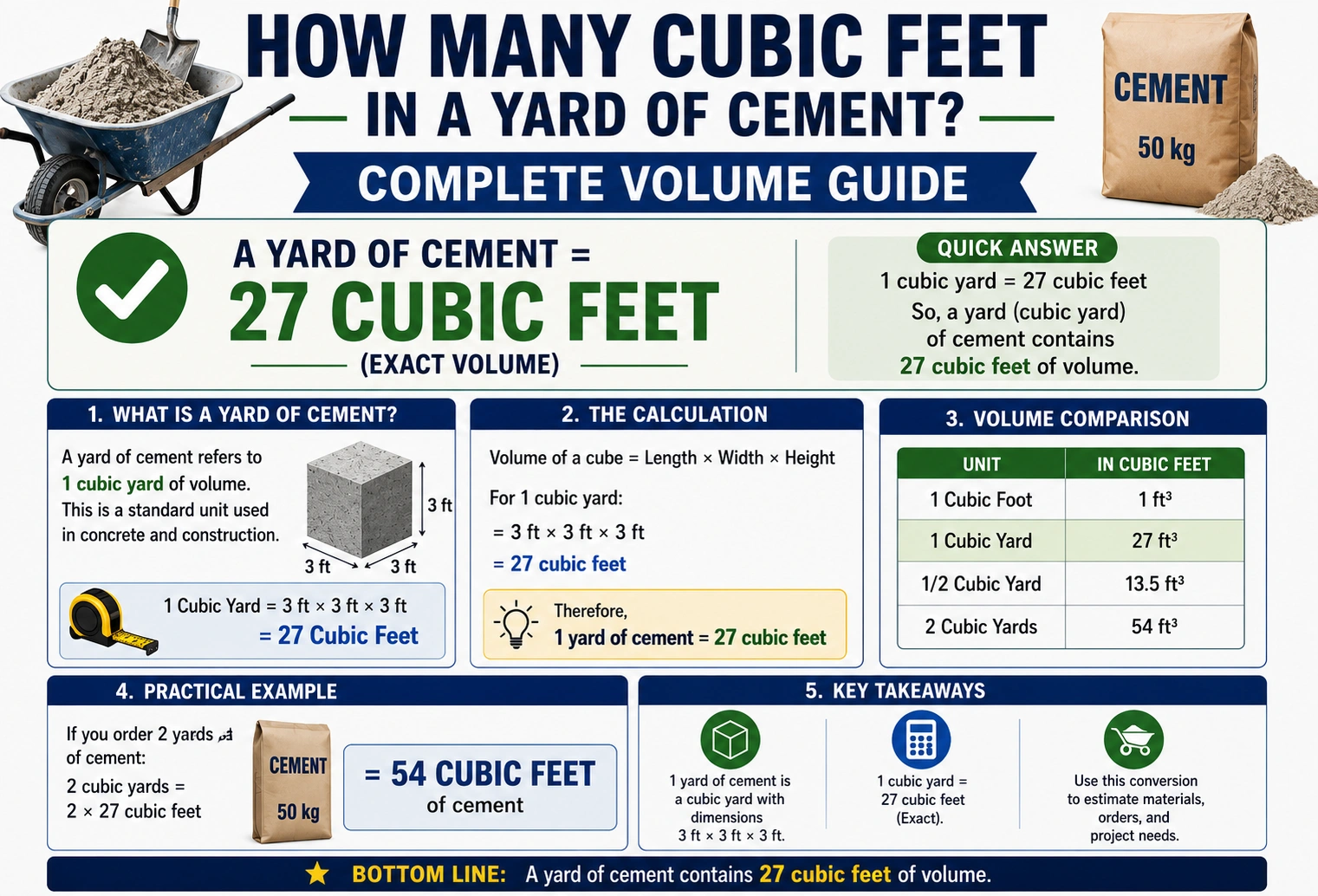
If you’re wondering “how many cubic feet in a yard of cement?”, the exact answer is:
1 cubic yard=27 cubic feet
So, one cubic yard of cement (or concrete) contains exactly 27 cubic feet.
This is one of the most common volume conversions used in:
- Concrete projects
- Construction work
- Landscaping
- Foundation planning
- Material estimates
Understanding this conversion helps ensure you order the correct amount of material and avoid costly shortages.
Quick Answer
The standard conversion is:
- 1 cubic yard = 27 cubic feet
For any concrete or cement calculation, this is the number contractors use.
Understanding Cubic Yards and Cubic Feet
Before converting measurements, it’s helpful to understand both units.
What Is a Cubic Foot?
A cubic foot is a volume measurement.
It represents a cube measuring:
- 1 foot long
- 1 foot wide
- 1 foot high
Mathematically:
1×1×1=1 cubic foot
What Is a Cubic Yard?
A cubic yard is a larger volume measurement.
Since:
- 1 yard = 3 feet
A cubic yard measures:
- 3 feet long
- 3 feet wide
- 3 feet high
Why the Conversion Matters
Concrete suppliers typically sell material by the cubic yard.
Construction plans often use cubic feet.
Converting between the two is essential for accurate estimates.
How Many Cubic Feet Are in a Yard of Cement?
Let’s calculate it step by step.
Conversion Formula
Since one yard equals three feet:
3×3×3
Step-by-Step Calculation
Multiply the dimensions:
3×3×3=27
Final Result
Therefore:
1 cubic yard=27 cubic feet
This conversion never changes regardless of the material.
Cubic Yard to Cubic Feet Conversion Chart
Use this chart for quick reference.
| Cubic Yards | Cubic Feet |
|---|---|
| 1 yd³ | 27 ft³ |
| 2 yd³ | 54 ft³ |
| 3 yd³ | 81 ft³ |
| 4 yd³ | 108 ft³ |
| 5 yd³ | 135 ft³ |
| 10 yd³ | 270 ft³ |
This chart helps simplify project planning.
Common Construction Uses
Understanding cubic yards is important for many projects.
Concrete Slabs
Driveways, patios, and garage floors are commonly measured in cubic yards.
Sidewalks
Sidewalk pours often require volume calculations before ordering concrete.
Foundations
Accurate yard calculations help prevent expensive over-ordering or shortages.
How to Calculate Concrete Needed
You can estimate concrete volume with a simple formula.
Length × Width × Depth Formula
Use:
Volume=Length×Width×Depth
This provides total cubic feet.
Example Calculation
Suppose a slab measures:
- 12 feet long
- 10 feet wide
- 0.5 feet thick
Calculation:
12×10×0.5=60
Volume:
- 60 cubic feet
Converting Cubic Feet to Cubic Yards
Divide cubic feet by 27:
Cubic Yards=27Cubic Feet
For the example:
60÷27≈2.22
You would need approximately:
- 2.22 cubic yards of concrete
Why This Conversion Matters
Knowing that one cubic yard equals 27 cubic feet helps:
- Estimate material costs
- Order concrete accurately
- Reduce waste
- Improve project planning
- Simplify contractor calculations
Common Calculation Mistakes
Avoid these common errors.
Confusing Square Feet with Cubic Feet
Square feet measure area.
Cubic feet measure volume.
Forgetting Depth
Concrete calculations require thickness.
Ignoring depth leads to major estimation errors.
Not Ordering Extra Material
Most contractors add:
- 5–10% extra
To account for waste and variations.
Mixing Units
Always keep measurements in the same unit system before calculating.
Expert Tips for Concrete Projects
Measure Carefully
Double-check:
- Length
- Width
- Depth
Before ordering.
Add a Waste Factor
A small surplus helps avoid shortages during the pour.
Convert Early
Convert cubic feet to cubic yards before contacting suppliers.
Round Up
Most professionals round up rather than down when ordering concrete.
Practical Examples
Example 1: One Cubic Yard
1 yard=27 cubic feet
Result:
- 27 cubic feet
Example 2: Two Cubic Yards
2×27=54
Result:
- 54 cubic feet
Example 3: Five Cubic Yards
5×27=135
Result:
- 135 cubic feet
FAQs
How many cubic feet are in a yard of cement?
Exactly:
- 27 cubic feet
Is a cubic yard the same as 27 cubic feet?
Yes.
By definition:
1 yd3=27 ft3
How do I convert cubic yards to cubic feet?
Multiply by:
- 27
How do I convert cubic feet to cubic yards?
Divide by:
- 27
Why do concrete suppliers use cubic yards?
Because large construction volumes are easier to measure and sell in cubic yards.
Conclusion
So, how many cubic feet in a yard of cement?
The exact answer is:
- 27 cubic feet
1 cubic yard=27 cubic feet
This conversion is essential for:
- Concrete projects
- Landscaping work
- Foundation construction
- Material estimation
- DIY building projects
Once you remember that one cubic yard equals 27 cubic feet, calculating concrete and cement quantities becomes much easier and more accurate.
Discover More Articles
How Many Square Feet Is a Mini Mansion? Size Guide & Examples