
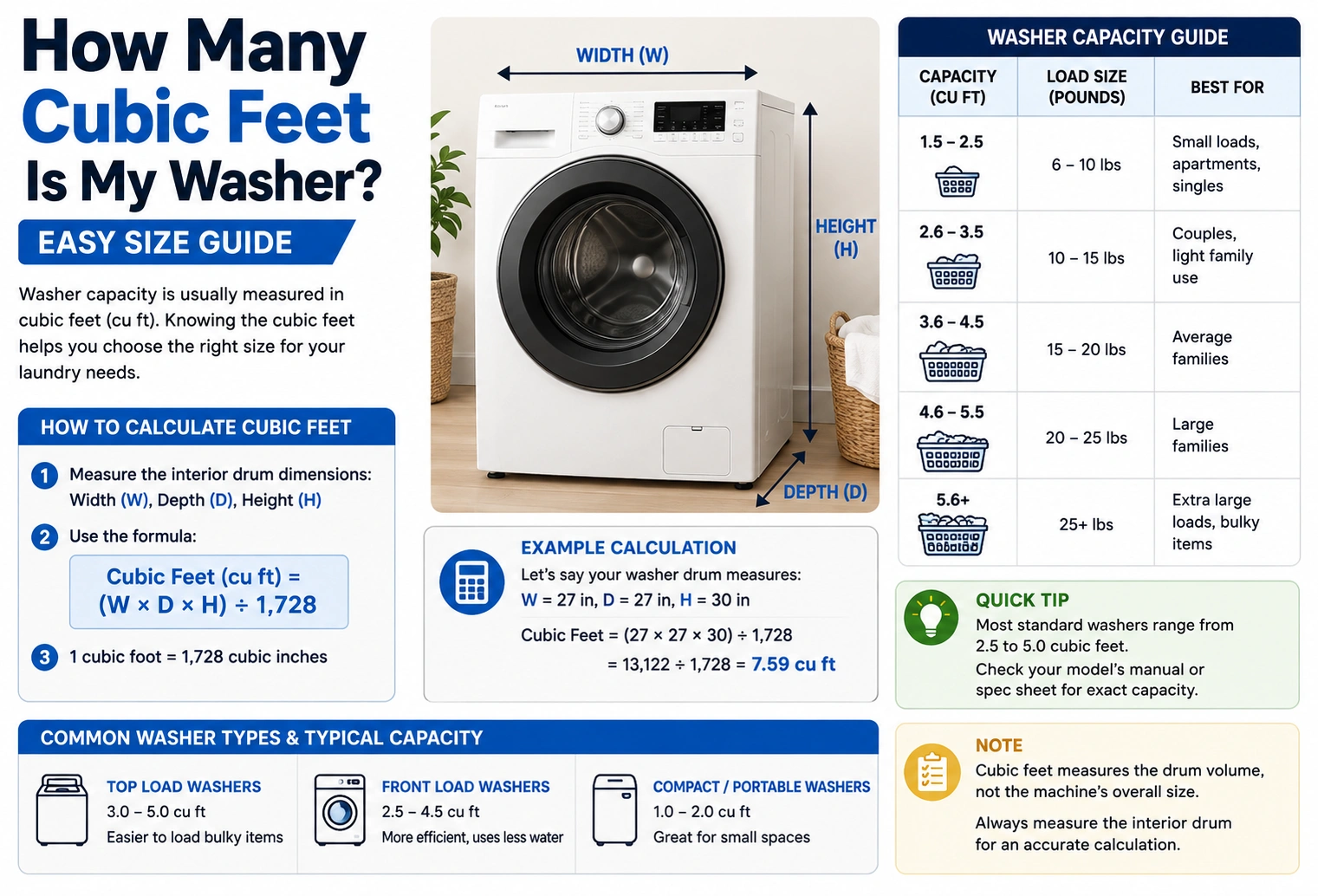
If you’re wondering how many cubic feet is my washer, you can usually find the answer by checking the washer’s model number, owner’s manual, product label, or manufacturer specifications.
If you don’t have that information, you can estimate the washer’s capacity by measuring the inside of the washing machine drum.
Most residential washing machines have capacities somewhere around 2.5 to 5.5 cubic feet, depending on the type and model.
Quick Answer
A typical household washer is often between 2.5 and 5.5 cubic feet.
Common examples include:
- Compact washer: about 2.0–2.5 cu. ft.
- Standard washer: about 3.5–4.5 cu. ft.
- Large washer: about 4.5–5.0 cu. ft.
- Extra-large washer: about 5.0–5.5+ cu. ft.
The exact capacity of your washer depends on its model.
How to Find Your Washer’s Cubic Feet
The easiest and most accurate way to find your washer’s capacity is to identify the model number.
Look for a label or sticker in places such as:
- Inside the washer door
- Inside the lid
- Along the door frame
- On the back of the machine
- On the side panel
- Near the control panel
Once you have the model number, you can look up the manufacturer’s specifications.
The capacity is usually listed as cu. ft., cubic feet, or capacity.
Check the Model Number
Your washer’s model number is more useful than its exterior dimensions.
Two washing machines can have similar outside dimensions but different drum capacities.
For example, one 27-inch-wide washer might have a capacity of 4.0 cubic feet, while another model with a similar exterior size might have a larger or smaller drum.
If you have the model number, use the manufacturer’s documentation to find the exact capacity.
Measure the Washer Drum
If you can’t find the model number, you can estimate the capacity by measuring the inside of the drum.
For a roughly cylindrical washer drum, use:
Volume = π × radius² × depth
Measure:
- The inside diameter of the drum.
- The inside depth from the back of the drum to the opening.
- Divide the diameter by 2 to find the radius.
Then substitute the measurements into the formula.
How to Calculate Washer Cubic Feet
Suppose the inside drum has:
- Diameter = 24 inches
- Depth = 20 inches
First find the radius:
24 ÷ 2 = 12 inches
Then calculate the volume:
π × 12² × 20
This gives approximately:
9,048 cubic inches
Because there are 1,728 cubic inches in one cubic foot, divide by 1,728:
9,048 ÷ 1,728 ≈ 5.24 cubic feet
So the estimated drum capacity would be approximately 5.2 cubic feet.
Keep in mind that actual washer drums aren’t perfect cylinders, so this method provides an estimate rather than an exact manufacturer’s capacity.
Why Washer Capacity Is Measured in Cubic Feet
Washer capacity measures the amount of space available inside the drum.
Unlike the washer’s outside dimensions, cubic feet tell you approximately how much laundry the drum can accommodate.
For example:
4.5 cubic feet
describes the approximate volume of the washer’s interior drum.
This makes capacity more useful for comparing how much clothing different washing machines can handle.
Common Washer Sizes
Washing machines come in several capacity categories.
| Washer Type | Approximate Capacity |
|---|---|
| Compact | 1.5–2.5 cu. ft. |
| Small | 2.5–3.5 cu. ft. |
| Standard | 3.5–4.5 cu. ft. |
| Large | 4.5–5.0 cu. ft. |
| Extra-large | 5.0–5.5+ cu. ft. |
These are general ranges. Individual manufacturers may classify their washers differently.
How Much Laundry Fits in Different Washer Sizes?
Washer capacity can help determine the size of loads you can comfortably wash.
2.5 Cubic Feet
A washer around 2.5 cubic feet is generally suited to smaller loads and compact living spaces.
3.5 Cubic Feet
A 3.5-cubic-foot washer can handle typical household laundry loads and may be suitable for smaller households.
4.0 Cubic Feet
A 4.0-cubic-foot washer provides more room for larger loads.
4.5 Cubic Feet
A 4.5-cubic-foot washer is often considered a spacious household option.
5.0+ Cubic Feet
Large-capacity washers provide substantial drum space and can accommodate larger loads, although the appropriate load size still depends on the manufacturer’s recommendations.
Washer Capacity vs. Exterior Dimensions
It’s important not to confuse washer capacity with the physical size of the appliance.
A washer might have exterior dimensions such as:
- 27 inches wide
- 30 inches deep
- 40 inches high
Those measurements describe the appliance’s outside dimensions.
The cubic-foot rating describes the volume of the washing drum.
They are related, but they aren’t the same measurement.
Front-Load vs. Top-Load Washer Capacity
Both front-load and top-load washers are available in different capacities.
Front-load machines often use a horizontally oriented drum, while traditional top-load machines generally have a vertically oriented tub.
Capacity varies by model rather than simply by washer type.
Therefore, you shouldn’t assume that every front-load washer is larger than every top-load washer.
Check the specific capacity rating.
What Does a 4.5-Cubic-Foot Washer Mean?
A washer rated at 4.5 cubic feet has approximately 4.5 cubic feet of internal drum volume.
This is generally considered a relatively large residential washer.
The actual amount of clothing you should put in the machine depends on the manufacturer’s load recommendations, fabric type, and cycle.
More capacity doesn’t mean the washer should always be filled completely.
How to Find Washer Capacity Without a Model Number
If the model number is missing or unreadable, you can:
- Measure the inside diameter.
- Measure the inside depth.
- Calculate the approximate cylindrical volume.
- Convert cubic inches to cubic feet.
Use:
Cubic feet = cubic inches ÷ 1,728
For a cylindrical drum:
Cubic inches = π × radius² × depth
This method can provide a useful estimate when manufacturer information isn’t available.
Why Your Measurement May Not Match the Listed Capacity
Your calculation may differ from the manufacturer’s stated capacity for several reasons.
The washer drum may have:
- Curved surfaces
- Rounded edges
- An agitator
- A central impeller
- Irregular interior shapes
- Space that isn’t intended for clothing
Manufacturers may also use standardized methods for calculating usable drum volume.
For this reason, the manufacturer’s published capacity should be considered the most reliable number.
9. FAQs
1. How many cubic feet is a normal washer?
Many household washers are approximately 3.5 to 5.0 cubic feet, although compact and extra-large models can fall outside this range.
2. How do I find out how many cubic feet my washer is?
Find the washer’s model number and check the manufacturer’s specifications. You can also estimate the capacity by measuring the inside of the drum.
3. Is a 4.5-cubic-foot washer considered large?
Yes. A 4.5-cubic-foot washer generally provides substantial capacity for household laundry.
4. Can I calculate washer capacity myself?
Yes. For an approximately cylindrical drum, measure the diameter and depth, calculate the volume, and convert the result to cubic feet.
5. How many cubic inches are in a cubic foot?
There are 1,728 cubic inches in one cubic foot.
6. Does washer size refer to cubic feet?
When people discuss washer “size” in terms of capacity, they often mean the drum capacity measured in cubic feet. Exterior width, depth, and height are separate measurements.
7. Is a 5.0-cubic-foot washer bigger than a 4.0-cubic-foot washer?
Yes. A 5.0-cubic-foot washer has approximately 1 cubic foot more internal capacity than a 4.0-cubic-foot model.
10. Conclusion
If you’re asking how many cubic feet is my washer, the exact answer depends on the specific model. Many household washers fall between approximately 2.5 and 5.5 cubic feet, with standard models commonly around 3.5–4.5 cubic feet.
The easiest way to identify your washer’s capacity is to find its model number and check the manufacturer’s specifications. If that isn’t possible, you can measure the inside of the drum and estimate its volume using the cylindrical-volume formula.
Remember that the manufacturer’s listed capacity is more accurate than a simple measurement because washing-machine drums aren’t perfect cylinders and may have internal components that affect usable space.
Discover More Articles
How Many Square Feet Is a 32-Ft Camper? Size Guide