

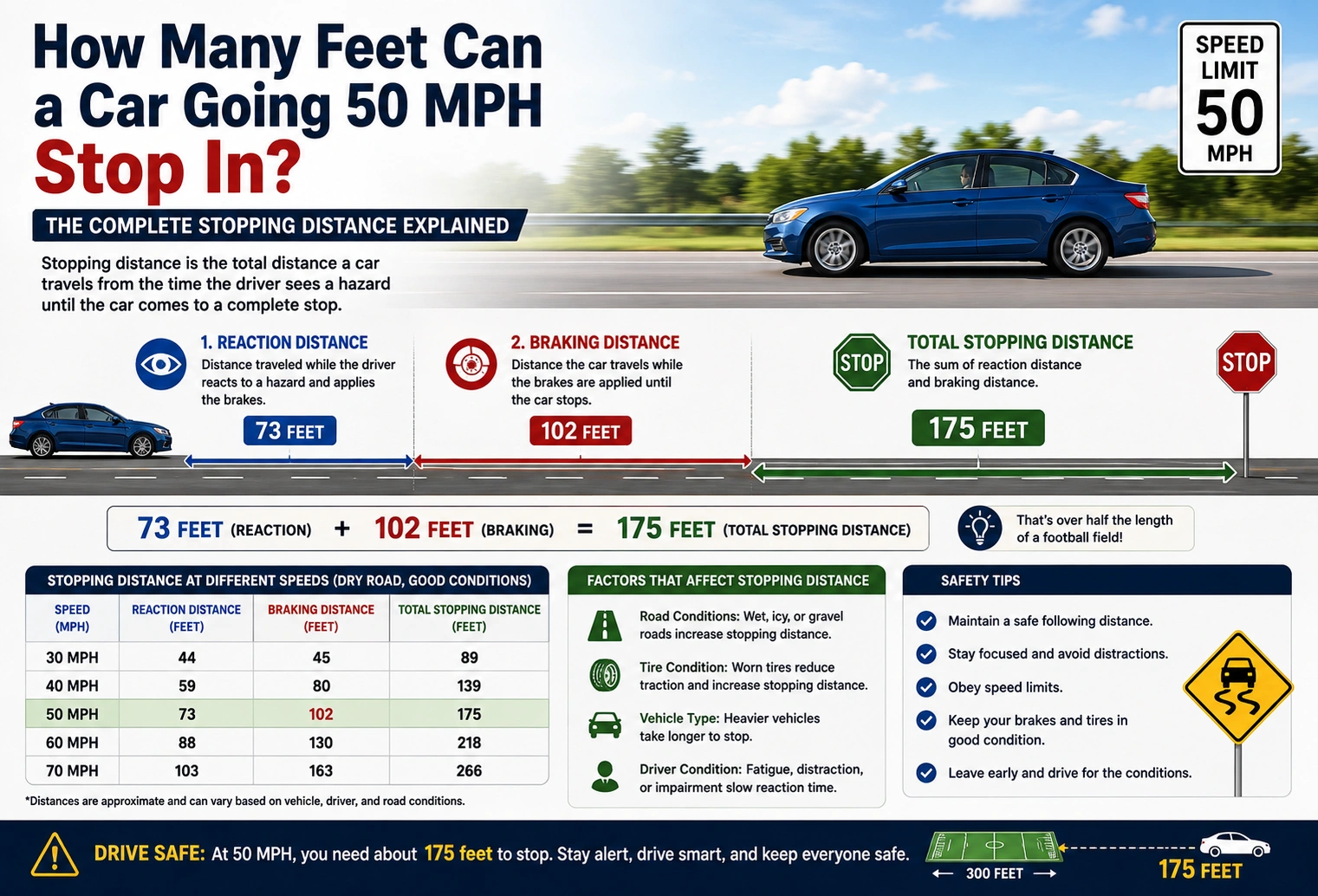
If you’re wondering how many feet a car going 50 mph can stop in, there isn’t one universal number.
A vehicle’s total stopping distance depends on driver reaction time, braking performance, tires, road conditions, vehicle weight, and other factors.
As a practical estimate, a car traveling at 50 mph may need roughly 175–200 feet to come to a complete stop on dry pavement, including the distance traveled while the driver reacts.
The actual distance can be shorter or longer depending on the vehicle and conditions.
Quick Answer
At 50 mph, a vehicle travels approximately:
73.3 feet every second.
That means even a one-second reaction time adds more than 73 feet before the brakes begin slowing the vehicle.
A useful simplified estimate is:
| Component | Approximate Distance |
|---|---|
| Reaction distance at 1 second | 73 ft |
| Braking distance | Approximately 100–125 ft |
| Total stopping distance | Approximately 175–200 ft |
These figures are estimates rather than a guarantee for every vehicle.
How Far Does a Car Travel in One Second at 50 MPH?
Before calculating stopping distance, it helps to convert 50 mph into feet per second.
One mile contains 5,280 feet, and one hour contains 3,600 seconds.
Therefore:
50 × 5,280 ÷ 3,600 = 73.33 feet per second
So a vehicle traveling at 50 mph covers approximately:
73 feet every second.
This is why reaction time has such a major effect on stopping distance.
What Is Stopping Distance?
Stopping distance is the total distance a vehicle travels from the moment the driver recognizes a hazard until the vehicle comes to a complete stop.
It consists primarily of two parts:
Stopping distance = reaction distance + braking distance
Reaction distance occurs before the brakes begin slowing the vehicle.
Braking distance is the distance traveled after the brakes are applied until the vehicle stops.
Reaction Distance at 50 MPH
Reaction time varies from driver to driver.
For example, if a driver takes one second to recognize a hazard and begin braking, the car travels approximately:
73 feet
before braking begins.
With a 1.5-second reaction time:
73.33 × 1.5 ≈ 110 feet
With a 2-second reaction time:
73.33 × 2 ≈ 147 feet
This demonstrates why distracted driving or delayed reactions can dramatically increase total stopping distance.
Braking Distance at 50 MPH
Once the brakes are applied, the vehicle begins slowing down.
Braking distance depends on factors such as:
- Tire condition
- Brake condition
- Road surface
- Vehicle weight
- Tire pressure
- Traction
- Brake technology
- Weather
- Vehicle speed
On dry pavement with good tires and properly functioning brakes, a modern passenger vehicle may require roughly 100–125 feet of braking distance from 50 mph, although actual test results vary.
Total Stopping Distance at 50 MPH
Suppose a driver has a one-second reaction time.
The vehicle travels approximately:
73 feet during reaction
If braking then requires approximately 100–125 feet:
73 + 100 = 173 feet
to:
73 + 125 = 198 feet
That produces an estimated total stopping distance of approximately:
175–200 feet
This is a useful real-world range, not an exact stopping distance for every car.
Why Speed Makes Such a Big Difference
Braking distance increases much faster than speed.
Under idealized conditions, braking distance is approximately proportional to the square of speed.
That means doubling speed can require roughly four times the braking distance, assuming other factors remain comparable.
For example, increasing speed from 25 mph to 50 mph does not simply double the braking distance—it can increase it by approximately four times.
This is one reason maintaining a safe following distance is so important.
Factors That Affect Stopping Distance
Driver Reaction Time
A driver who reacts quickly travels less distance before braking begins.
Distraction, fatigue, alcohol, drugs, or simply failing to notice a hazard can increase reaction time.
Road Conditions
Dry pavement generally provides better traction than wet, icy, or snowy roads.
Reduced traction can substantially increase braking distance.
Tires
Worn or improperly inflated tires can reduce available traction and affect stopping performance.
Vehicle Condition
Brake condition, suspension components, tire condition, and other mechanical factors can influence how quickly a vehicle stops.
Vehicle Load
A heavily loaded vehicle may behave differently during braking than a lightly loaded vehicle.
Slope
A vehicle traveling downhill can require more distance to stop than the same vehicle traveling on level ground, all else being equal.
Visibility
Poor visibility can delay hazard recognition, increasing reaction distance even if the vehicle’s braking system works normally.
Wet vs. Dry Pavement
Stopping distance can increase when roads become wet because available tire traction is reduced.
There is no single universal wet-road stopping distance because the result depends on:
- Water depth
- Tire tread
- Tire type
- Road surface
- Vehicle
- Speed
- ABS operation
- Driver response
On snow or ice, stopping distances can become dramatically longer.
For this reason, drivers should reduce speed and increase following distance when traction is poor.
How 50 MPH Compares With Other Speeds
Stopping distance becomes much more important as speed increases because the vehicle has more kinetic energy and travels farther during the driver’s reaction time.
For a rough comparison, a vehicle traveling at:
| Speed | Feet Per Second |
|---|---|
| 20 mph | 29.3 ft/s |
| 30 mph | 44.0 ft/s |
| 40 mph | 58.7 ft/s |
| 50 mph | 73.3 ft/s |
| 60 mph | 88.0 ft/s |
| 70 mph | 102.7 ft/s |
At 50 mph, a car covers more than 73 feet every second.
That means a driver who takes just two seconds to recognize a hazard and react can travel approximately 147 feet before braking begins.
50 MPH Stopping Distance Compared With Following Distance
A vehicle traveling at 50 mph should not be followed closely simply because the road appears clear.
If something unexpected happens ahead, the driver needs enough space to:
- Recognize the hazard
- React
- Move their foot to the brake
- Apply the brakes
- Slow the vehicle
- Stop completely
The faster the vehicle is traveling, the more distance is needed for these steps.
A safe following distance should therefore account for traffic, weather, visibility, road conditions, and vehicle condition, rather than relying on one fixed number of feet.
Can a Car Stop in 100 Feet at 50 MPH?
It is possible for some vehicles and test conditions to produce relatively short braking distances, but 100 feet should not be treated as a guaranteed total stopping distance.
Remember that total stopping distance includes reaction distance.
At 50 mph, the vehicle already travels approximately 73 feet during one second of reaction time.
So even if a particular vehicle could brake to a stop in 100 feet after the brakes are applied, the total distance would be considerably longer once reaction distance is included.
Does ABS Reduce Stopping Distance?
Anti-lock braking systems, commonly called ABS, help prevent the wheels from locking during hard braking.
ABS can help the driver maintain steering control while braking aggressively and can provide effective braking on many road surfaces.
However, ABS does not eliminate the laws of physics.
Stopping distance still depends on:
- Speed
- Tire traction
- Road surface
- Vehicle condition
- Driver reaction
- Weather
Drivers should not assume that ABS allows them to follow another vehicle closely.
How Long Does It Take to Stop From 50 MPH?
The exact stopping time varies by vehicle and conditions.
A driver’s reaction can take approximately one second or longer, followed by the time required for the vehicle to decelerate to zero.
Because the vehicle is traveling approximately 73 feet per second, even a small delay can add significant distance.
For example:
1-Second Reaction
73.3 feet traveled before braking.
1.5-Second Reaction
110 feet traveled before braking.
2-Second Reaction
146.7 feet traveled before braking.
This is why avoiding distractions is particularly important at highway speeds.
What Happens to Stopping Distance on Ice?
Stopping on ice can require dramatically more distance than stopping on dry pavement.
Ice provides much less traction between the tires and road surface.
Snow, freezing rain, standing water, and loose gravel can also reduce traction.
There is no reliable single number that applies to every icy road.
The safest approach is to:
- Reduce speed
- Increase following distance
- Avoid sudden steering
- Brake smoothly when possible
- Leave additional room for unexpected hazards
Frequently Asked Questions
How many feet does it take a car to stop at 50 mph?
A useful general estimate is about 175–200 feet on dry pavement when including approximately one second of reaction time, but actual stopping distance varies by vehicle, driver, tires, and road conditions.
How many feet does a car travel per second at 50 mph?
A car traveling 50 mph travels approximately 73.3 feet per second.
How far does a car travel before the brakes are applied at 50 mph?
With a one-second reaction time, the vehicle travels approximately 73 feet before braking begins.
With a two-second reaction time, it travels approximately 147 feet.
Does wet pavement increase stopping distance?
Yes. Wet pavement can reduce tire traction and increase braking distance. The amount of increase depends on the tires, vehicle, road surface, water depth, and speed.
Does stopping distance increase with speed?
Yes. Reaction distance increases directly with speed, while braking distance generally increases approximately with the square of speed under otherwise similar conditions.
How far should you follow a car going 50 mph?
There isn’t one universal number of feet that is safe in every situation. A driver should maintain a sufficient time gap and increase it when conditions are poor, such as during rain, darkness, heavy traffic, or reduced visibility.
Does a heavier car take longer to stop?
Vehicle mass can affect braking behavior, but stopping distance depends on many factors, including tire grip, brake system, road surface, and vehicle design. You should not assume that a heavier vehicle automatically requires a specific additional number of feet.
Can a car stop instantly at 50 mph?
No. A moving vehicle requires time and distance to decelerate. Even before braking begins, the vehicle continues traveling while the driver recognizes and responds to a hazard.
Conclusion
If you’re asking how many feet a car going 50 mph can stop in, there is no single exact number for every vehicle.
As a practical estimate, a passenger car traveling at 50 mph may require roughly 175–200 feet to stop on dry pavement when a one-second reaction time is included. The actual distance can vary substantially.
The most important number to remember is that 50 mph equals approximately 73.3 feet per second. A delayed reaction can therefore add dozens or even more than 100 feet to the total stopping distance.
Rain, snow, ice, worn tires, poor brakes, downhill roads, heavy loads, and distracted or tired driving can further increase the distance needed to stop. For safe driving, allow considerably more space when conditions are less than ideal rather than relying on a minimum stopping-distance estimate.
Discover More Articles
How Many Cubic Feet Is My Washer? Easy Size Guide