
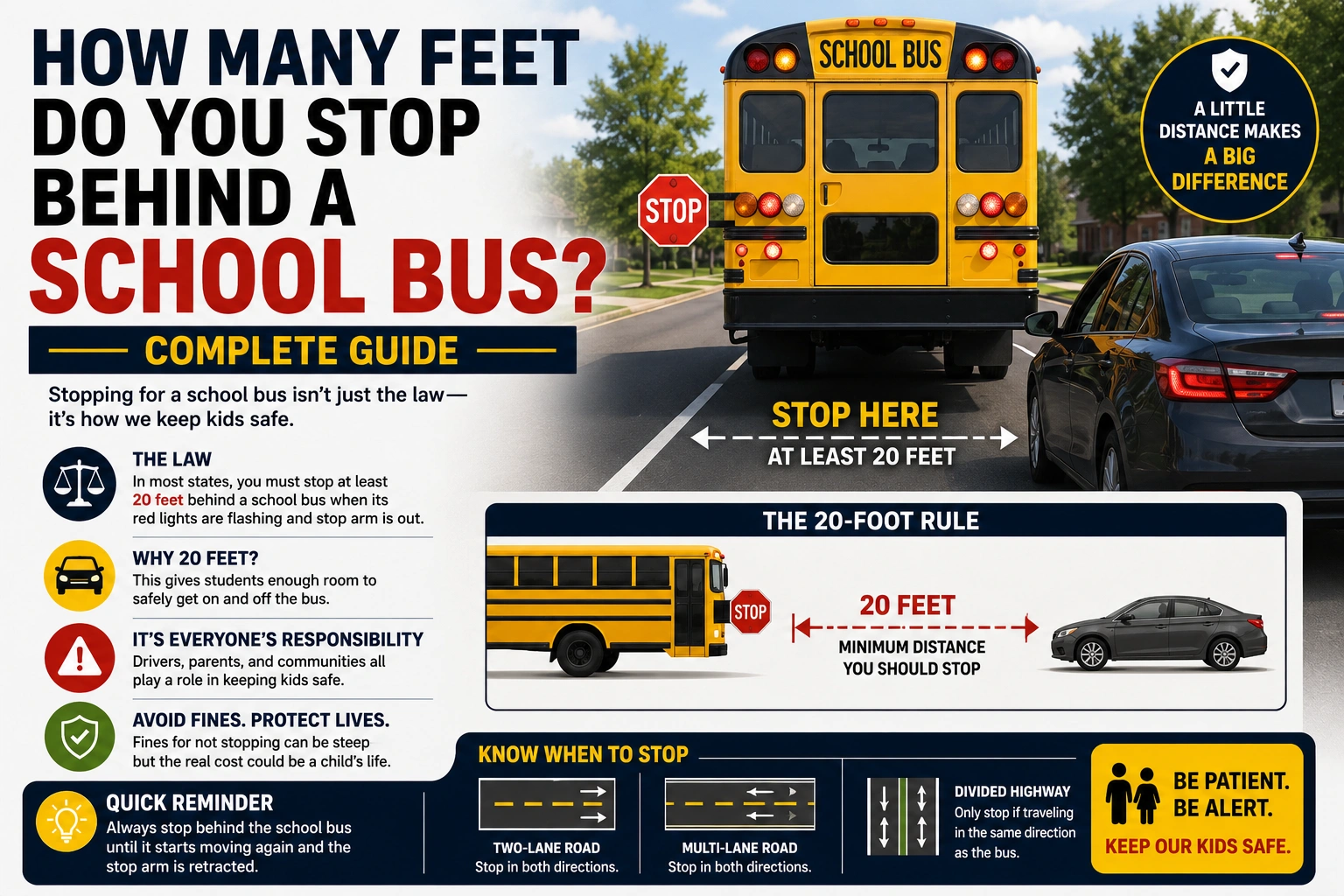
If you’re wondering how many feet do you stop behind a school bus, you’re asking an important road safety question.
Stopping correctly behind a school bus helps protect children entering or exiting the bus. School bus laws are taken very seriously because even small mistakes can lead to accidents or legal penalties.
In most situations, drivers are recommended to stop:
👉 At least 20 feet behind a school bus
However, exact rules can vary slightly depending on state laws and road conditions.
In this guide, you’ll learn school bus stopping distances, safety rules, legal requirements, and practical driving tips.
Quick Answer: Recommended Stopping Distance
👉 Drivers should generally stop at least 20 feet behind a school bus when the bus has:
- Flashing red lights
- Extended stop arm
- Active student loading or unloading
This distance creates a safe zone for children crossing the road.
Why You Must Stop Behind a School Bus
School buses carry children who may:
- Cross unexpectedly
- Be difficult to see
- Move quickly around traffic
Stopping at a safe distance helps prevent accidents.
Student Safety
Children often cross directly in front of the bus.
Stopping farther back gives:
- Better visibility
- More reaction time
- Safer crossing space
Legal Requirements
In many places, failing to stop for a school bus can result in:
- Heavy fines
- License points
- Suspended driving privileges
Some states even use bus-mounted cameras to catch violations.
School Bus Stop Laws Explained
Flashing Yellow Lights
Yellow lights mean:
👉 The bus is preparing to stop
Drivers should:
- Slow down
- Prepare to stop
Flashing Red Lights
Red lights mean:
👉 Children are loading or unloading
At this point:
- Traffic must stop
- Passing is illegal in most situations
Stop Arm Extended
When the stop arm swings out:
👉 Drivers must remain stopped until:
- Lights stop flashing
- Stop arm retracts
- Bus begins moving again
Recommended Following Distance
Even when the bus is moving, drivers should maintain a safe following distance.
A common recommendation is:
👉 Stay at least 4–5 seconds behind the bus
This helps:
- Avoid sudden braking accidents
- Improve visibility
- Protect children nearby
What Happens If You Pass a Stopped School Bus?
Passing a stopped school bus is extremely dangerous.
Possible consequences include:
| Violation | Possible Penalty |
|---|---|
| Illegal passing | Heavy fine |
| Reckless driving | License suspension |
| Causing injury | Criminal charges |
School Bus Rules by Road Type
Laws vary depending on the road.
Two-Lane Roads
Traffic in both directions usually must stop.
Multi-Lane Roads
Rules differ by state.
Sometimes:
- Both directions stop
- Or only traffic traveling with the bus stops
Divided Highways
If there is a physical median:
- Opposite-direction traffic may not need to stop
Always follow local laws.
Real-Life Safety Examples
Neighborhood School Stop
A school bus stops with flashing red lights.
Correct action:
👉 Stop at least 20 feet behind the bus.
Busy Road Example
Children may cross multiple lanes.
Extra stopping distance improves safety.
Rainy Conditions
Wet roads increase stopping distance.
Drivers should stop even farther back.
Why the 20-Foot Distance Matters
The 20-foot rule helps:
- Keep children visible
- Prevent rear-end collisions
- Allow room for emergencies
It also gives the bus driver a better view of traffic.
Common Mistakes Drivers Make
Following Too Closely
Tailgating school buses reduces reaction time.
Passing Too Soon
Never move until:
- Red lights stop flashing
- Stop arm retracts
Ignoring Weather Conditions
Rain, snow, and fog increase stopping distance.
Distracted Driving
Phones and distractions near school zones are extremely risky.
Tips for Safe Driving Near School Buses
Slow Down Early
Prepare to stop as soon as yellow lights flash.
Stay Alert for Children
Children can appear suddenly from blind spots.
Leave Extra Space
More distance means more safety.
Obey Local Laws
School bus rules vary slightly by state.
School Bus Safety Statistics
School buses are among the safest vehicles on the road, but danger increases during:
- Loading
- Unloading
- Street crossing
Most school bus-related injuries happen outside the bus.
Defensive Driving Around School Buses
Good drivers:
- Expect sudden stops
- Avoid aggressive passing
- Watch mirrors carefully
- Stay patient
Quick Safety Rule to Remember
👉 Yellow lights = slow down
👉 Red lights = stop completely
And always:
👉 Stop at least 20 feet behind the bus
9. FAQs
1. How many feet do you stop behind a school bus?
Drivers should usually stop at least 20 feet behind the bus.
2. Do all lanes stop for a school bus?
It depends on the road type and state laws.
3. Can you pass a school bus with flashing red lights?
No, passing is illegal in most situations.
4. What do flashing yellow lights mean?
The bus is preparing to stop.
5. Why is stopping distance important?
It protects children entering or exiting the bus.
10. Conclusion
So, how many feet do you stop behind a school bus?
👉 The recommended distance is generally at least 20 feet behind the bus.
This safety rule helps:
- Protect children
- Prevent accidents
- Improve driver reaction time
Whenever you see flashing school bus lights:
- Slow down immediately
- Stop completely when required
- Wait until the bus safely moves again
Safe driving around school buses protects everyone on the road—especially children.
Discover More Articles
How Many Cubic Square Feet in a Yard? Complete Guide