
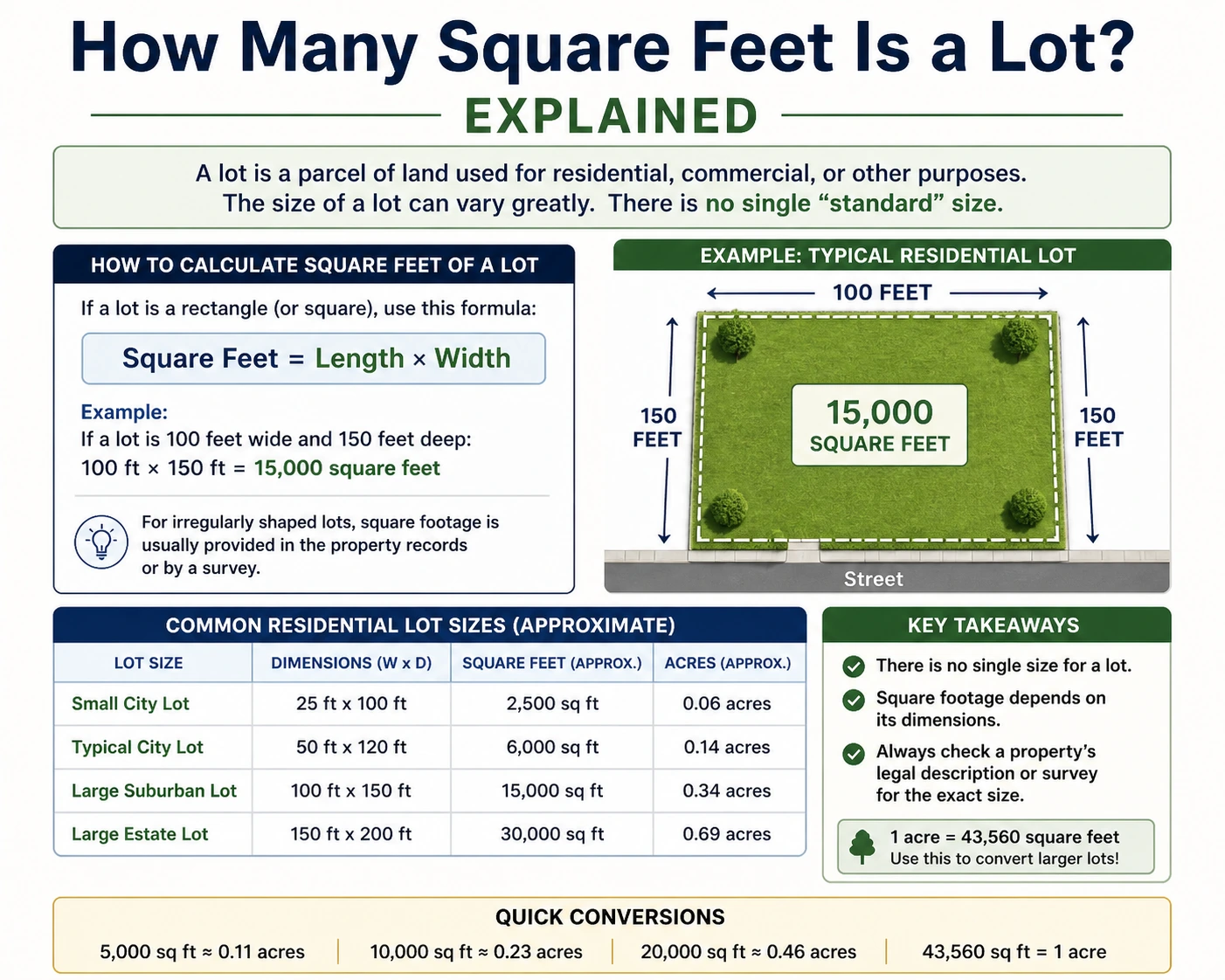
If you’ve ever wondered how many square feet is a lot, you’re not alone. The term “lot” is commonly used in real estate, but it doesn’t refer to a fixed size.
Instead, a “lot” simply means a piece of land, and its size can vary widely depending on location, purpose, and property type.
In this guide, you’ll learn:
- What a lot really means
- Typical lot sizes in square feet
- How to calculate lot area
- Real-life examples and comparisons
Let’s start with a quick answer.
Quick Answer: Square Feet in a Lot
👉 There is no fixed number of square feet in a lot
However, typical residential lot sizes are:
- Urban areas: 2,500 – 5,000 sq ft
- Suburban areas: 5,000 – 10,000 sq ft
- Rural areas: 10,000 sq ft to several acres
👉 A common average is around 7,000–8,000 square feet
What Does “Lot” Mean in Real Estate?
Definition of a Lot
A lot is a defined parcel of land owned or intended for development.
It can be used for:
- Residential homes
- Commercial buildings
- Agriculture
- Investment
Why Lot Size Varies
Lot sizes differ based on:
- Location (city vs countryside)
- Zoning regulations
- Property type
- Developer planning
So, one “lot” in a city may be much smaller than one in a rural area.
How Many Square Feet Is a Lot (Explained Clearly)
Average Residential Lot Size
Here’s a general breakdown:
| Area Type | Typical Lot Size |
|---|---|
| Urban | 2,500–5,000 sq ft |
| Suburban | 5,000–10,000 sq ft |
| Rural | 10,000+ sq ft |
👉 Most homes sit on lots between 5,000 and 10,000 square feet
Urban vs Suburban vs Rural Lots
- Urban lots: Smaller, compact, closer together
- Suburban lots: Medium-sized, more space
- Rural lots: Large, open land
This variation explains why there’s no single answer.
Common Lot Size Examples
Here are some typical lot dimensions:
| Dimensions (ft) | Square Feet |
|---|---|
| 50 × 100 | 5,000 sq ft |
| 60 × 120 | 7,200 sq ft |
| 70 × 120 | 8,400 sq ft |
| 80 × 125 | 10,000 sq ft |
These are common residential lot sizes.
How to Calculate Lot Size in Square Feet
Formula
Area=Length×Width
Step-by-Step Example
Let’s say your lot is:
- Length = 60 feet
- Width = 120 feet
Now calculate:
👉 60 × 120 = 7,200 square feet
So, your lot size is 7,200 sq ft
Square Feet vs Acres
Sometimes land is measured in acres.
Key Conversion:
👉 1 acre = 43,560 square feet
So:
- 5,000 sq ft = 0.11 acre
- 10,000 sq ft = 0.23 acre
This helps you compare property sizes more easily.
Real-Life Comparisons
To visualize lot sizes:
- 5,000 sq ft: Small suburban home lot
- 7,200 sq ft: Average residential lot
- 10,000 sq ft: Spacious suburban property
- 43,560 sq ft: 1 acre (large property)
Why Lot Size Matters
Understanding lot size is important for:
1. Home Buying
Bigger lots offer more outdoor space.
2. Property Value
Larger lots often increase value.
3. Construction Planning
Determines how much you can build.
4. Privacy and Space
More land means more distance from neighbors.
Common Mistakes
Avoid these errors:
❌ Assuming All Lots Are the Same
Lot sizes vary widely.
❌ Confusing Square Feet with Acres
They are different units.
❌ Ignoring Usable Space
Not all land may be buildable.
❌ Guessing Instead of Measuring
Always calculate properly.
Expert Tips for Understanding Lot Size
✔ Check Property Listings
They usually include exact square footage.
✔ Use Maps and Tools
Satellite tools help visualize land.
✔ Understand Local Standards
Lot sizes vary by region.
✔ Think Beyond Numbers
Consider layout, shape, and usability.
FAQs
1. How many square feet is a lot?
There is no fixed size, but most residential lots are 5,000–10,000 sq ft.
2. What is the average lot size?
Around 7,000–8,000 square feet in many suburban areas.
3. How do I calculate lot size?
Multiply length × width in feet.
4. How many square feet are in an acre?
43,560 square feet.
5. Is 5,000 sq ft a small lot?
Yes, it’s considered a smaller residential lot.
Conclusion
So, how many square feet is a lot?
👉 The truth is: there’s no single answer
A “lot” simply refers to a piece of land, and its size can range from a few thousand square feet to several acres.
However, most residential lots typically fall between:
👉 5,000 and 10,000 square feet
Understanding this helps you make smarter decisions when buying, building, or comparing properties.
The key takeaway is this:
- Focus on square footage, not just the term “lot”
- Always measure or check exact dimensions
- Consider how usable the space is—not just how big it is
In real estate, size matters—but how you use the space matters even more.
Discover More Articles
How Many Feet of Lights for 6 Foot Tree? Complete Guide