
If you’re learning to drive or preparing for your test, you’ve probably asked: how many feet for parallel parking?
This is one of the most important skills every driver needs, especially in cities where parking space is limited.
Understanding the exact space required makes parallel parking much easier and less stressful.
In this guide, you’ll learn the standard measurements, real-world differences, and practical tips to master it.
Quick Answer: Parallel Parking Space Size
👉 You typically need 22 to 26 feet for parallel parking
This is the standard range used in most driving tests and real-life situations.
What Is Parallel Parking
Parallel parking means parking your car along a curb between two vehicles.
Why It’s Important
- Essential for city driving
- Required in most driving tests
- Helps maximize parking space
How Many Feet for Parallel Parking in Driving Tests
Driving tests are designed to simulate real conditions.
Typical Test Dimensions
- Length: 22–26 feet
- Width: 7–10 feet
Cone Spacing
- Cones are placed to mark boundaries
- Distance usually reflects real parking spaces
Real-World Parallel Parking Space Size
In real life, parking spaces can vary.
Street Parking
- Often tighter than test spaces
- May be as small as 20 feet
City Variations
- Busy cities = smaller spaces
- Suburban areas = larger spaces
Parallel Parking Space Breakdown
Here’s a simple table:
| Component | Measurement |
|---|---|
| Length | 22–26 ft |
| Width | 7–10 ft |
| Distance from curb | 6–12 inches |
How to Judge Parking Distance
Knowing the size is helpful—but judging it is key.
Use Visual References
- Align your car with the front vehicle
- Watch your mirrors
Use Car Length
- Most cars ≈ 14–16 feet
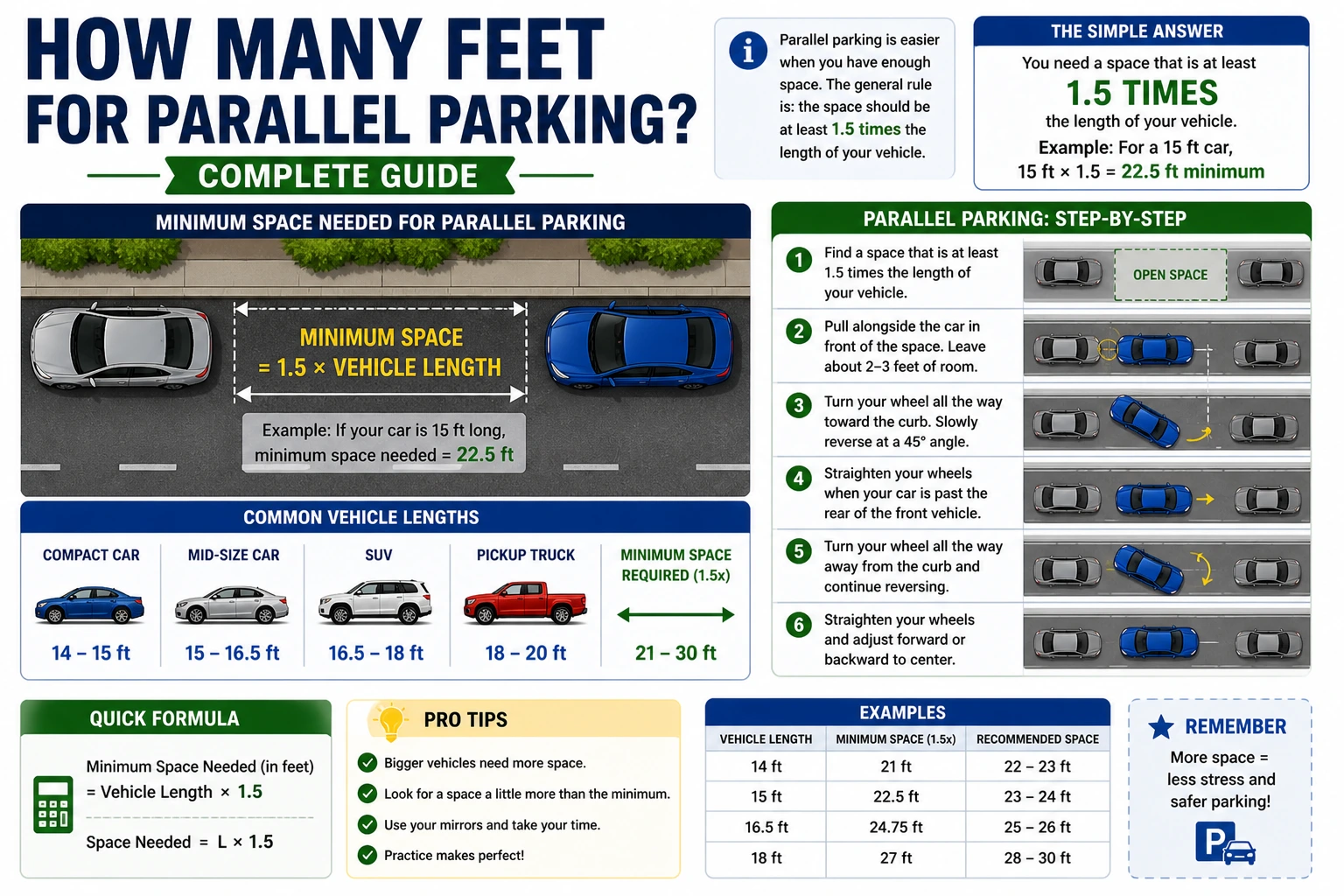
👉 Parking space ≈ 1.5× your car length
Step-by-Step Parallel Parking Method
1. Position Your Car
- Stop beside the front vehicle
- Keep 2–3 feet gap
2. Reverse Slowly
- Turn wheel toward curb
3. Straighten
- When at 45-degree angle
4. Turn Opposite
- Bring car into space
5. Adjust
- Center your car
Common Mistakes
Turning Too Early or Late
Leads to poor alignment.
Hitting the Curb
Often caused by oversteering.
Not Using Mirrors
Reduces accuracy.
Expert Tips
Go Slow
Control is more important than speed.
Practice with Cones
Set up a 22–26 ft space.
Use Reference Points
Find fixed visual cues.
Practice Recommendations
Daily Practice
- 20–30 minutes
- Use measured space
Try Different Spaces
- Tight spots
- Wide spots
Real-Life Example
If your car is 15 feet long:
- Parking space = 24 feet
- Extra space = 9 feet
This gives room to maneuver.
Why It Feels Difficult
- Limited visibility
- Fear of hitting cars
- Lack of practice
But with repetition, it becomes easy.
9. FAQs
1. How many feet for parallel parking exactly?
Usually 22–26 feet.
2. Is the test space bigger than real life?
Yes, slightly bigger to make it fair.
3. Can I adjust during parking?
Yes, minor adjustments are allowed.
4. How close should I be to the curb?
Within 6–12 inches.
5. What is the easiest way to learn?
Practice consistently with measured space.
10. Conclusion
So, how many feet for parallel parking?
👉 Typically 22 to 26 feet
This range gives enough room to safely maneuver your car while still testing your skills.
The key to success is simple:
- Practice with real measurements
- Move slowly
- Use consistent techniques
Once you understand the space and build confidence, parallel parking becomes much easier—and even second nature.
Discover more articles
1 Yard of Concrete Is How Many Square Feet? Complete Guide