

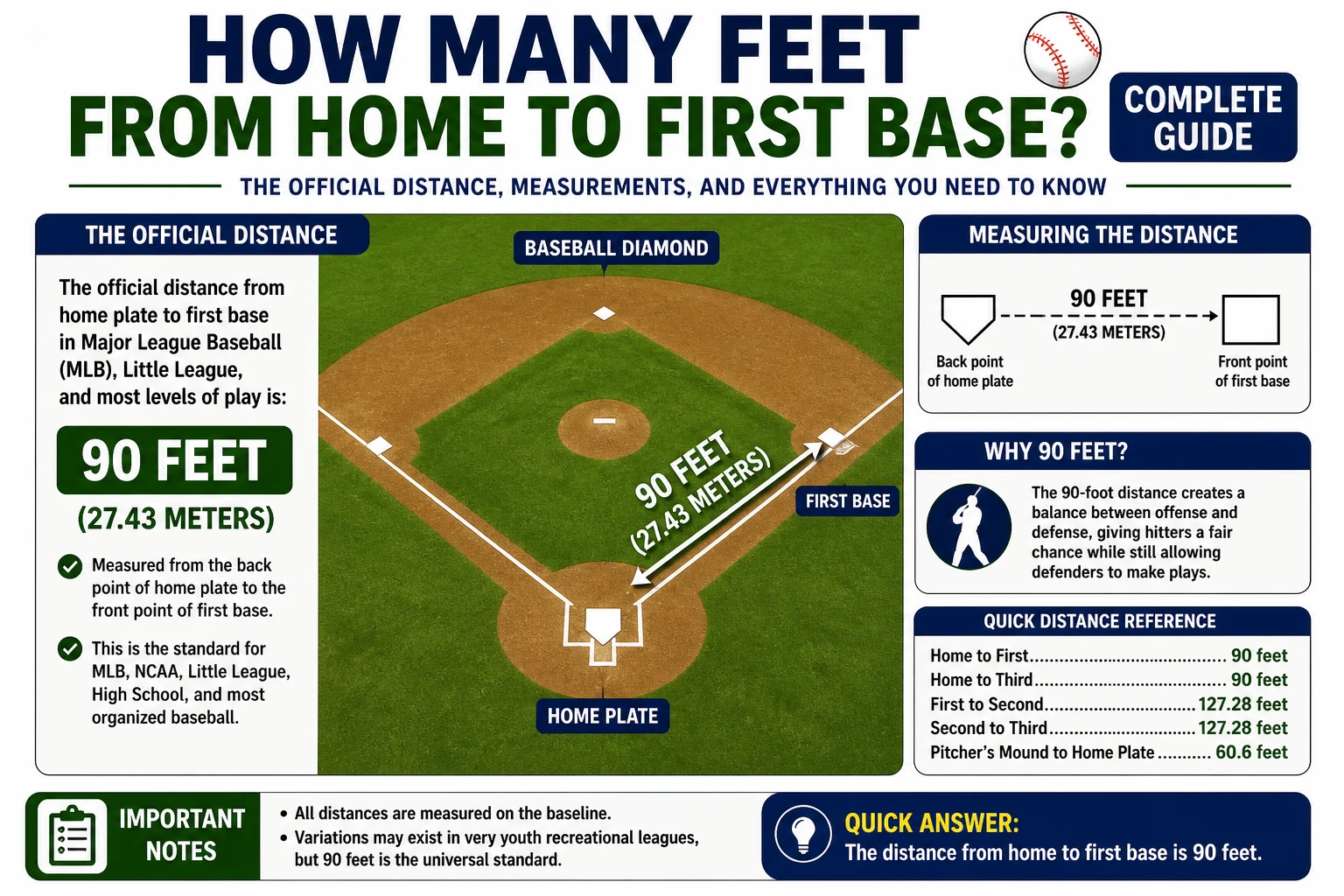
If you’ve ever watched or played baseball, you’ve probably wondered: how many feet from home to first base?
This distance is one of the most important measurements in the game. It affects running speed, game strategy, and overall field design.
Let’s break it down clearly so you understand not just the number—but what it means in real gameplay.
Quick Answer: Distance from Home to First Base
👉 The official distance from home plate to first base is:
- 90 feet in baseball
This measurement is standard across professional and most amateur leagues.
Official Baseball Field Dimensions Explained
To fully understand this distance, you need to know how a baseball field is designed.
Base Path Distance
The distance between each base is:
- 90 feet
This includes:
- Home to first
- First to second
- Second to third
- Third back to home
Diamond Shape Explained
A baseball field forms a square (diamond shape).
Each side of the square is 90 feet long.
Why Is the Distance 90 Feet?
The 90-foot distance has been used since the early days of professional baseball. It provides the perfect balance between:
- Speed and skill
- Offense and defense
- Reaction time for fielders
Too short, and hitters would always be safe.
Too long, and defense would dominate.
Home to First Base Measurement Details
Straight Line vs Base Path
The 90 feet is measured along the base path, not a straight diagonal line.
Players run along the foul line toward first base.
Running Distance
In real gameplay, a player may run slightly more than 90 feet because:
- They don’t run in a perfectly straight line
- They may adjust for the ball or base
But officially, the distance is still 90 feet.
Softball vs Baseball Distance Comparison
The distance changes depending on the sport.
| Sport | Distance |
|---|---|
| Baseball | 90 feet |
| Softball (fastpitch) | 60 feet |
| Little League | 60–70 feet |
So always confirm which version you’re referring to.
Real-World Examples
Let’s put 90 feet into perspective.
- About 30 yards
- Roughly half the length of a basketball court
- Takes about 3–4 seconds to sprint for most players
This shows how critical speed is in baseball.
Breakdown of the Baseball Diamond
Understanding the full field helps give context.
Home Plate to Second Base
This is a diagonal distance across the diamond.
It equals about:
- 127 feet 3⅜ inches
Distance Between Bases
All bases are equally spaced:
- 90 feet apart
Pitcher’s Mound Distance
From home plate to the pitcher’s mound:
- 60 feet 6 inches
This is another key measurement in the game.
Practical Uses of Knowing This Distance
Knowing how many feet from home to first base is useful for:
Players
- Improve sprint speed
- Practice base running
Coaches
- Design training drills
- Measure performance
Field Designers
- Build accurate baseball fields
- Ensure compliance with rules
Fans & Students
- Better understand the game
- Learn sports measurements
Common Mistakes to Avoid
1. Confusing Softball and Baseball
Softball uses shorter distances.
2. Thinking It’s a Straight Diagonal
The 90 feet is along the base path, not corner-to-corner.
3. Ignoring League Differences
Youth leagues often use shorter base paths.
4. Overestimating Running Distance
Players may run slightly more, but official distance stays fixed.
Expert Tips for Players and Coaches
- ✔ Practice sprinting 90 feet regularly
- ✔ Focus on explosive first steps
- ✔ Use timing drills to improve speed
- ✔ Teach proper running angles
- ✔ Always verify field dimensions before games
FAQs
1. How many feet from home to first base in baseball?
It is 90 feet in standard baseball.
2. Is the distance the same in softball?
No, softball typically uses 60 feet.
3. How long does it take to run to first base?
Most players take about 3–4 seconds.
4. What is the distance between all bases?
Each base is 90 feet apart in baseball.
5. Why is the distance exactly 90 feet?
It provides a balance between offense and defense in gameplay.
Conclusion
So, how many feet from home to first base?
👉 The official answer is 90 feet in baseball.
This distance is a core part of the game, shaping everything from player speed to field design.
Whether you’re a player, coach, or fan, understanding this measurement gives you a deeper appreciation of baseball and helps improve performance and knowledge of the sport.
Discover More Articles
How Many Feet of Fencing for 1 Acre? Complete Guide