
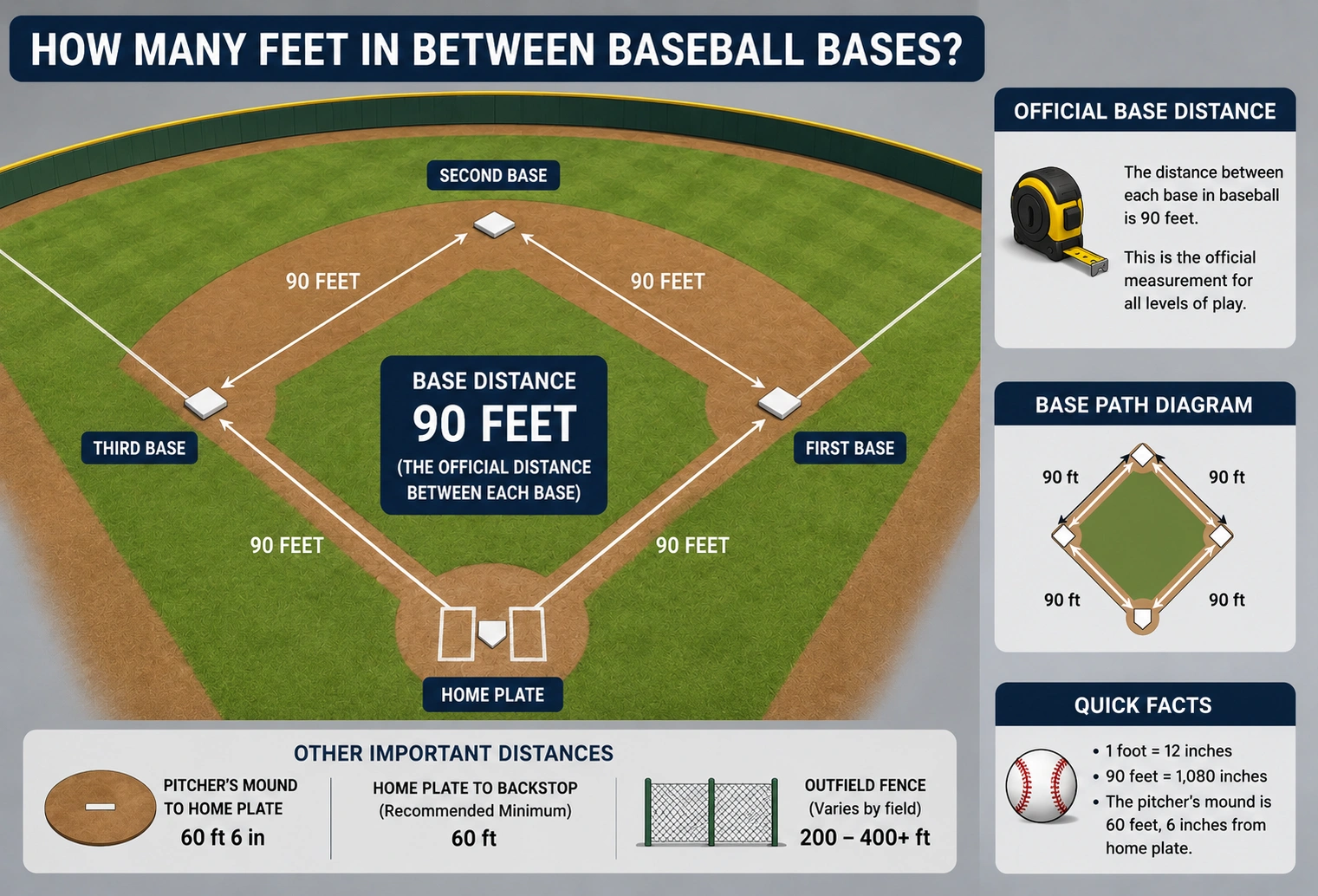
How many feet in between baseball bases? On a standard professional baseball diamond, the distance between each base is 90 feet.
That means:
- Home plate to first base = 90 feet
- First base to second base = 90 feet
- Second base to third base = 90 feet
- Third base to home plate = 90 feet
For youth baseball, the distance is often shorter and depends on the league and age group.
| Baseball Level | Approx. Base Distance |
|---|---|
| MLB / Professional | 90 ft |
| College baseball | 90 ft |
| High school baseball | 90 ft |
| Little League (standard) | 60 ft |
| Youth leagues | Varies by age and league |
How Many Feet Are Between Baseball Bases?
The standard distance between baseball bases is 90 feet.
This measurement applies to the four bases on a regulation professional baseball diamond.
The bases form a square, with each side measuring 90 feet.
So the distance is:
Home → First = 90 feet
First → Second = 90 feet
Second → Third = 90 feet
Third → Home = 90 feet
This means a runner who travels from first base to second base covers 90 feet.
Why Are Baseball Bases 90 Feet Apart?
The 90-foot distance became the standard because it provides a balance between hitting, fielding, throwing, and base running.
The distance gives defensive players enough time to make plays while still allowing fast runners to challenge the defense.
A shorter base path would generally make stolen bases and infield plays different, while a longer distance would give fielders more time to make throws.
The 90-foot layout has therefore become a defining part of standard baseball.
How Far Is It From Home Plate to First Base?
The distance from home plate to first base is 90 feet on a regulation baseball field.
This is one of the most important distances in the game because every batter who reaches base safely must travel this path.
The same 90-foot distance applies from:
- Home plate to first base
- First base to second base
- Second base to third base
- Third base to home plate
How Far Is It From First Base to Second Base?
First base to second base is 90 feet on a standard baseball diamond.
A runner trying to advance from first to second must cover 90 feet.
The distance can become especially important when a runner attempts to steal second base.
A quick runner may cover the distance in only a few seconds, so the catcher and middle infielders must react quickly.
How Far Is It From Second Base to Third Base?
The distance from second base to third base is also 90 feet.
Second base is positioned at the opposite point of the diamond from home plate.
A runner going from second to third travels another 90 feet.
Therefore:
Home → First → Second → Third
requires:
90 + 90 + 90 = 270 feet
before the runner reaches third base.
How Far Is It From Third Base to Home Plate?
The distance from third base to home plate is 90 feet.
If a runner successfully travels from third to home, that final 90-foot section completes the trip around the bases.
A complete trip around the bases is therefore:
90 × 4 = 360 feet
So a runner who circles all four bases travels 360 feet.
How Many Feet Is a Complete Trip Around the Bases?
A complete trip around a standard baseball diamond is:
360 feet
The calculation is:
90 feet × 4 sides = 360 feet
| Base Path | Distance |
|---|---|
| Home to First | 90 ft |
| First to Second | 90 ft |
| Second to Third | 90 ft |
| Third to Home | 90 ft |
| Complete circuit | 360 ft |
This is the theoretical base-path distance. In an actual game, a runner’s path may be slightly different because runners don’t necessarily follow a perfectly straight line between the bases.
How Many Feet Does a Baseball Player Run for a Home Run?
If a batter hits a home run and circles all four bases, the standard base-path distance is 360 feet.
That’s:
90 × 4 = 360 feet
However, the player’s actual running distance can be slightly different because of the way they round the bases.
The important distinction is between base-path distance and the actual distance covered by the runner.
Baseball Base Distance Compared With Other Sports
A 90-foot base path can be easier to understand through comparisons.
| Measurement | Distance |
|---|---|
| Baseball base path | 90 ft |
| Complete baseball circuit | 360 ft |
| 100-yard football field | 300 ft |
| Basketball court length | About 94 ft |
| 1/2 mile | 2,640 ft |
| 1 mile | 5,280 ft |
Interestingly, one side of a professional baseball diamond is approximately the same length as a regulation basketball court.
How Many Yards Are Between Baseball Bases?
Since 1 yard equals 3 feet, convert 90 feet to yards:
90 ÷ 3 = 30 yards
Therefore:
90 feet = 30 yards
So the distance between two standard baseball bases is 30 yards.
| Unit | Distance Between Bases |
|---|---|
| Feet | 90 ft |
| Yards | 30 yd |
| Inches | 1,080 in |
| Meters | 27.43 m |
How Many Meters Are Between Baseball Bases?
One foot equals approximately 0.3048 meters.
Therefore:
90 × 0.3048 = 27.432 meters
So the standard distance between baseball bases is:
27.43 meters
For practical purposes, you can say the bases are approximately 27.4 meters apart.
How Many Inches Are Between Baseball Bases?
Because one foot contains 12 inches:
90 × 12 = 1,080 inches
Therefore:
90 feet = 1,080 inches
This can be useful when measuring or laying out a baseball field.
Baseball Base Distance for Youth Players
Not every baseball diamond uses 90-foot base paths.
Younger players often play on smaller fields because shorter distances are more appropriate for their age, strength, speed, and throwing ability.
For example, standard Little League baseball commonly uses 60-foot base paths.
| Level | Base Distance |
|---|---|
| Professional | 90 ft |
| College | 90 ft |
| High School | 90 ft |
| Little League | 60 ft |
| Other youth leagues | Varies |
Always check the rules for the specific league when measuring a youth baseball field.
60 Feet vs. 90 Feet Baseball Bases
The difference between youth and regulation fields is significant.
A 60-foot base path is:
30 feet shorter than a 90-foot base path.
| Feature | 60-Foot Field | 90-Foot Field |
|---|---|---|
| Base distance | 60 ft | 90 ft |
| Base distance in yards | 20 yd | 30 yd |
| Complete base circuit | 240 ft | 360 ft |
| Typical use | Youth | Older/professional |
This difference affects how quickly runners can advance and how much time fielders have to complete plays.
How Far Is the Baseball Diamond?
A standard baseball diamond is shaped like a square.
Each side is 90 feet.
The perimeter is therefore:
90 + 90 + 90 + 90 = 360 feet
So the base paths create a square with:
- 90-foot sides
- 360-foot perimeter
The diagonal from home plate to second base is longer than 90 feet.
Using the square’s diagonal formula:
90 × √2 ≈ 127.28 feet
So the straight-line distance from home plate to second base is approximately 127.3 feet.
How Far Is First Base From Third Base?
First base and third base are opposite corners of the square.
The straight-line distance between them is therefore approximately:
90 × √2 = 127.28 feet
So first base is approximately 127.3 feet from third base in a straight line.
This is different from the distance between adjacent bases, which is exactly 90 feet.
| Measurement | Approximate Distance |
|---|---|
| Home to First | 90 ft |
| First to Second | 90 ft |
| Second to Third | 90 ft |
| Third to Home | 90 ft |
| Home to Second, straight line | 127.3 ft |
| First to Third, straight line | 127.3 ft |
How to Measure 90 Feet for a Baseball Field
If you’re laying out a baseball diamond, accurate measurements are important.
Start by establishing the location of home plate.
Then measure 90 feet from the appropriate reference point to establish first base.
Repeat the process for the other bases.
Because the diamond must be square, simply measuring four 90-foot sides isn’t always enough to guarantee a properly aligned field.
A field layout should also account for:
- Correct angles
- Base dimensions
- Foul lines
- Pitcher’s mound
- Batter’s box
- Backstop
- Local league rules
For an official field, use the applicable governing body’s field specifications rather than relying only on a general 90-foot measurement.
Common Mistakes About Baseball Base Distances
Mistake 1: Assuming Every Baseball Field Has 90-Foot Bases
Not every field does. Youth baseball commonly uses shorter base paths.
Mistake 2: Measuring From the Wrong Point
The official measurement is based on the prescribed field layout and base locations, not simply from any visible edge of a base.
Mistake 3: Confusing Base Distance With Field Size
The 90-foot measurement describes the base paths. It does not mean the entire baseball field is only 90 feet wide or long.
Mistake 4: Assuming a Home Run Is Exactly 360 Feet
The base-path distance around the diamond is 360 feet, but that is different from the distance of the ball traveling into the outfield.
Expert Tips for Understanding Baseball Measurements
Remember these key numbers:
- 90 feet = distance between regulation bases
- 30 yards = 90 feet
- 1,080 inches = 90 feet
- 27.43 meters = 90 feet
- 360 feet = complete base-path circuit
- 127.3 feet = approximate diagonal across the diamond
If you’re setting up a field, always confirm the requirements for the specific level of play.
FAQs
1. How many feet are between baseball bases?
On a standard professional baseball field, the bases are 90 feet apart.
2. How many feet are around all four baseball bases?
A complete trip around the four base paths is 360 feet, calculated as 90 × 4.
3. How far apart are Little League bases?
Standard Little League baseball commonly uses 60-foot base paths, although field specifications can vary by division and rules.
4. How many yards are between baseball bases?
A 90-foot base path equals 30 yards, because 90 ÷ 3 = 30.
5. How many meters are between baseball bases?
A 90-foot base path equals 27.432 meters, or approximately 27.4 meters.
Conclusion
So, how many feet in between baseball bases? On a standard regulation baseball diamond, the answer is 90 feet.
Each base is 90 feet from the next:
Home → First = 90 feet
First → Second = 90 feet
Second → Third = 90 feet
Third → Home = 90 feet
A complete trip around the bases is 360 feet, while 90 feet equals 30 yards, 1,080 inches, or approximately 27.43 meters.
Keep in mind that youth baseball fields often use shorter base paths, so always check the rules for the specific age group or league.
Discover More Articles
How Many Inches in 48 Feet? Exact Conversion Guide