
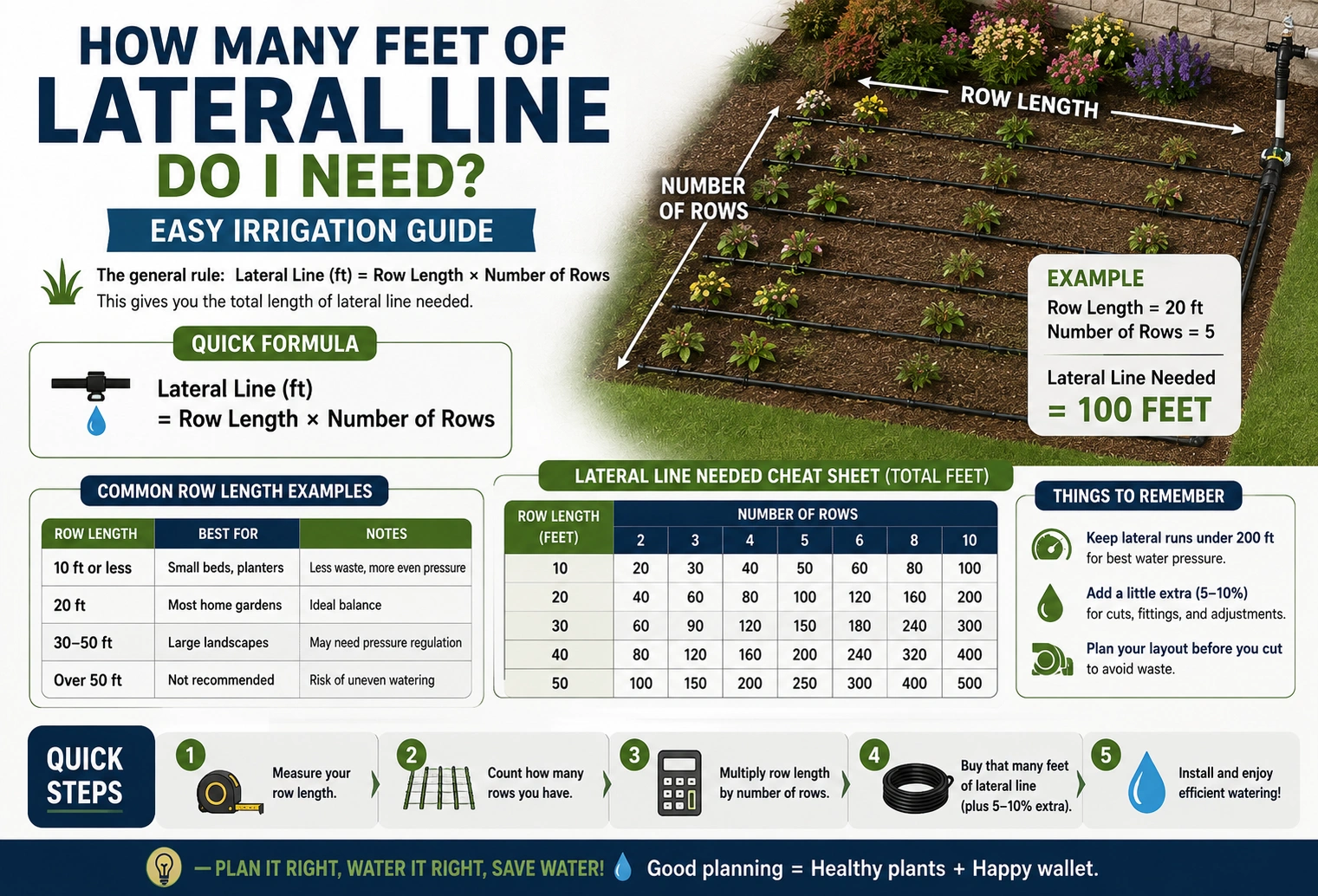
There is no single amount of lateral line that works for every property. The amount you need depends on the length and width of the area, the spacing between lines, and the type of irrigation system.
For a simple rectangular area, use:
Total lateral line = Number of lines × Length of each line
For example, if a garden is 50 feet long and needs 10 lateral lines, each 50 feet long:
10 × 50 = 500 feet
You would need 500 feet of lateral line before adding extra material for connections, turns, and waste.
| Area Setup | Number of Lines | Line Length | Total Lateral Line |
|---|---|---|---|
| Small garden | 5 | 50 ft | 250 ft |
| Medium garden | 10 | 50 ft | 500 ft |
| Larger garden | 20 | 50 ft | 1,000 ft |
| Field example | 40 | 100 ft | 4,000 ft |
What Is a Lateral Line?
A lateral line is the section of an irrigation system that carries water from a main or supply line toward sprinklers, drip emitters, or other outlets.
The exact design varies depending on the irrigation system.
In a drip irrigation setup, lateral lines are often smaller tubes or drip lines that run along plant rows.
In a sprinkler system, a lateral may carry water from the mainline to individual sprinkler heads.
The amount of lateral line required therefore depends on the layout rather than simply the total size of the property.
How Many Feet of Lateral Line Do I Need?
If you’re asking how many feet of lateral line do I need, start by determining:
- The length of the area being irrigated
- The width of the area
- The spacing between lateral lines
- The number of lines required
- The length of each line
- Any additional material needed for connections and adjustments
For a rectangular garden, the calculation is straightforward.
Suppose the growing area is:
40 feet long × 20 feet wide
If lateral lines are placed every 2 feet across the width:
20 ÷ 2 = 10 spaces
Depending on whether you place lines at the boundaries, you may need approximately 10 or 11 lines.
If each line runs the full 40-foot length:
10 × 40 = 400 feet
So the basic requirement would be approximately 400 feet of lateral line.
The exact count depends on the layout and manufacturer’s recommended spacing.
Simple Lateral Line Formula
The most useful formula is:
Total lateral line = Number of lateral lines × Length of each line
For example:
- 8 lines
- Each line is 60 feet long
Then:
8 × 60 = 480 feet
You need approximately 480 feet of lateral line.
If you want to account for extra material, add an allowance.
For example, with 10% extra:
480 × 1.10 = 528 feet
You would plan for approximately 528 feet.
How to Determine the Number of Lateral Lines
The number of lines is mainly determined by the width of the area and the spacing you choose.
A basic formula is:
Number of lines ≈ Area width ÷ Line spacing
For example, suppose the area is 30 feet wide and your design calls for 2-foot spacing:
30 ÷ 2 = 15
You would need roughly 15 lines, depending on the exact layout.
If each line is 50 feet long:
15 × 50 = 750 feet
Therefore, the basic requirement is approximately 750 feet of lateral line.
Lateral Line Calculation Examples
Here are several simple examples.
| Area Width | Line Length | Approx. Number of Lines | Total Line |
|---|---|---|---|
| 10 ft | 20 ft | 5 | 100 ft |
| 20 ft | 40 ft | 10 | 400 ft |
| 20 ft | 50 ft | 10 | 500 ft |
| 30 ft | 50 ft | 15 | 750 ft |
| 40 ft | 60 ft | 20 | 1,200 ft |
| 50 ft | 100 ft | 25 | 2,500 ft |
These are simplified examples. Actual irrigation designs may require different spacing based on soil, crop, emitter flow, sprinkler coverage, pressure, and manufacturer specifications.
How Much Lateral Line for a Garden?
For a garden, first measure the area where plants will actually be irrigated.
For example, imagine a garden measuring:
30 feet × 20 feet
If your lateral lines run along the 30-foot length and are spaced 2 feet apart across the 20-foot width, you could need around 10–11 lines.
If you use 10 lines:
10 × 30 = 300 feet
So you would need approximately 300 feet of lateral line.
If you add 10% for installation needs:
300 × 1.10 = 330 feet
A purchase quantity around 330 feet could provide some additional material, although actual requirements depend on the system layout.
How Much Lateral Line for a 100×100 Foot Area?
A 100×100-foot area contains:
100 × 100 = 10,000 square feet
But you cannot determine lateral line length from area alone.
You also need the spacing.
Suppose lines are spaced 2 feet apart and each line runs 100 feet:
100 ÷ 2 = 50 lines
Then:
50 × 100 = 5,000 feet
So the theoretical lateral-line requirement is approximately 5,000 feet.
If the spacing were 4 feet instead:
100 ÷ 4 = 25 lines
Then:
25 × 100 = 2,500 feet
This demonstrates why spacing has a major effect on total lateral line.
| Area | Spacing | Approx. Lines | Line Length | Total |
|---|---|---|---|---|
| 100 × 100 ft | 2 ft | 50 | 100 ft | 5,000 ft |
| 100 × 100 ft | 4 ft | 25 | 100 ft | 2,500 ft |
| 100 × 100 ft | 5 ft | 20 | 100 ft | 2,000 ft |
| 100 × 100 ft | 10 ft | 10 | 100 ft | 1,000 ft |
These examples are mathematical estimates rather than irrigation design recommendations.
Lateral Line Spacing and Coverage
Spacing is one of the most important factors in determining how much line you need.
Closer spacing generally means:
- More lateral lines
- More total tubing
- Potentially more uniform coverage
Wider spacing means:
- Fewer lateral lines
- Less tubing
- Potentially less coverage depending on the irrigation method
The correct spacing should be based on your irrigation equipment and what you are watering.
For drip irrigation, emitter spacing and soil characteristics are particularly important.
For sprinkler systems, sprinkler spacing and spray patterns are critical.
How Much Drip Line Do I Need?
Drip irrigation is often calculated by looking at the plant rows.
Suppose you have:
- 10 plant rows
- Each row is 40 feet long
Then:
10 × 40 = 400 feet
You would need approximately 400 feet of drip line.
If you have 20 rows:
20 × 40 = 800 feet
The calculation is simple because each row represents one lateral.
| Plant Rows | Row Length | Drip Line Needed |
|---|---|---|
| 5 | 40 ft | 200 ft |
| 10 | 40 ft | 400 ft |
| 15 | 40 ft | 600 ft |
| 20 | 40 ft | 800 ft |
| 25 | 40 ft | 1,000 ft |
This approach works well for straight, regularly spaced garden rows.
How Much Lateral Line for Raised Beds?
Raised beds can be easier to calculate because their dimensions are clearly defined.
Suppose you have four raised beds, each 4 feet wide and 20 feet long.
If you install two lateral lines along each bed:
4 beds × 2 lines = 8 lines
Each line is 20 feet:
8 × 20 = 160 feet
So you need approximately 160 feet of lateral line.
If you add 10% extra:
160 × 1.10 = 176 feet
You could plan for around 176 feet, depending on the available tubing length and connections.
What Affects the Amount of Lateral Line?
Several factors can change the amount of irrigation tubing required.
1. Area Dimensions
A longer or wider irrigation area generally requires more line.
2. Spacing
Closer lateral spacing increases the total amount of tubing.
3. Crop Spacing
Vegetables planted in rows may require a different layout from lawns or orchards.
4. Irrigation Method
Drip irrigation and sprinkler systems use different layouts.
5. Obstacles
Trees, buildings, paths, fences, and other obstacles can change the line route.
6. Terrain
Slopes can affect irrigation design and water distribution.
7. Water Pressure
Long lateral runs can experience pressure loss, which may limit how long a single line should be.
8. Flow Rate
The available flow rate determines how many emitters or sprinklers can operate effectively on one line.
Don’t Make Every Lateral Line Too Long
A common mistake is calculating the total amount of tubing correctly but making individual runs too long for the system.
A long line can experience pressure and flow changes.
For drip systems, this may result in:
- Uneven emitter output
- Poor watering at the end of the line
- Reduced performance
- Inconsistent plant growth
The maximum recommended lateral length depends on the tubing diameter, emitter flow rate, emitter spacing, water pressure, elevation changes, and manufacturer specifications.
Always check the specifications for your particular irrigation product.
Add Extra Material
Once you’ve calculated the basic amount of lateral line, consider adding some extra.
Extra material may be useful for:
- Connections
- Turns
- Routing around obstacles
- Repairs
- Cutting mistakes
- Future adjustments
For example, if your calculated requirement is 800 feet:
800 × 1.10 = 880 feet
A 10% allowance would give you approximately 880 feet.
| Calculated Requirement | 5% Extra | 10% Extra | 15% Extra |
|---|---|---|---|
| 200 ft | 210 ft | 220 ft | 230 ft |
| 400 ft | 420 ft | 440 ft | 460 ft |
| 600 ft | 630 ft | 660 ft | 690 ft |
| 800 ft | 840 ft | 880 ft | 920 ft |
| 1,000 ft | 1,050 ft | 1,100 ft | 1,150 ft |
| 2,000 ft | 2,100 ft | 2,200 ft | 2,300 ft |
The appropriate allowance depends on how complex the installation is.
Common Mistakes When Calculating Lateral Line
Mistake 1: Using Total Property Area
A 10,000-square-foot property does not automatically require a specific amount of lateral line.
You need the actual irrigated dimensions and layout.
Mistake 2: Ignoring Spacing
Two fields with the same area can require very different amounts of tubing if their lateral spacing differs.
Mistake 3: Forgetting Connections
The lateral lines need to connect to a mainline, header, manifold, or other irrigation component.
Mistake 4: Making Lines Too Long
The mathematically calculated length may not be suitable for one continuous run.
Mistake 5: Ignoring Pressure and Flow
A system needs sufficient pressure and flow to deliver water effectively throughout the irrigation zone.
Mistake 6: Buying Exactly the Calculated Amount
A small amount of extra material can help with installation adjustments and repairs.
Step-by-Step Lateral Line Calculation
Use this simple process:
Step 1: Measure the irrigated area.
Step 2: Decide how the lateral lines will run.
Step 3: Determine the recommended spacing.
Step 4: Calculate the approximate number of lines.
Step 5: Measure the length of each line.
Step 6: Multiply the number of lines by their length.
Step 7: Add an appropriate allowance for installation.
For example:
Area width = 40 feet
Spacing = 2 feet
Approximate lines = 40 ÷ 2 = 20
Line length = 60 feet
Total:
20 × 60 = 1,200 feet
With 10% extra:
1,200 × 1.10 = 1,320 feet
So you would plan for approximately 1,320 feet of lateral line, subject to the irrigation equipment’s design limits.
FAQs
1. How many feet of lateral line do I need?
It depends on the area size, line spacing, and irrigation layout. Use number of lines × length of each line to calculate the basic requirement.
2. How do I calculate lateral line length?
First determine how many lateral lines you need. Then multiply that number by the length of each line.
For example:
10 lines × 50 feet = 500 feet
3. How much drip line do I need for a garden?
Multiply the number of plant rows by the length of each row. For example, 20 rows that are 40 feet long require:
20 × 40 = 800 feet
4. Should I buy extra lateral line?
Usually, allowing some additional material can be helpful for connections, cutting, routing, and repairs. A 5–15% allowance may be useful depending on the complexity of the installation.
5. Can I make one lateral line as long as I want?
No. Maximum lateral length depends on the tubing, emitter or sprinkler type, flow rate, pressure, elevation, and manufacturer specifications. Very long runs can cause uneven water distribution.
Conclusion
So, how many feet of lateral line do I need? There is no universal answer because the required length depends on your irrigation area’s dimensions, spacing, crop layout, and irrigation equipment.
The basic calculation is:
Total lateral line = Number of lines × Length of each line
For example, 20 lines that are 50 feet long require:
20 × 50 = 1,000 feet
You can then add a reasonable allowance for connections, cutting, and installation.
For accurate irrigation planning, don’t rely on area alone. Consider line spacing, emitter or sprinkler flow, water pressure, maximum recommended run length, and the manufacturer’s specifications. These factors help ensure that the system delivers water evenly across the entire irrigated area.
Discover More Articles
How Many Feet in a Fathom of Water? Exact Guide