

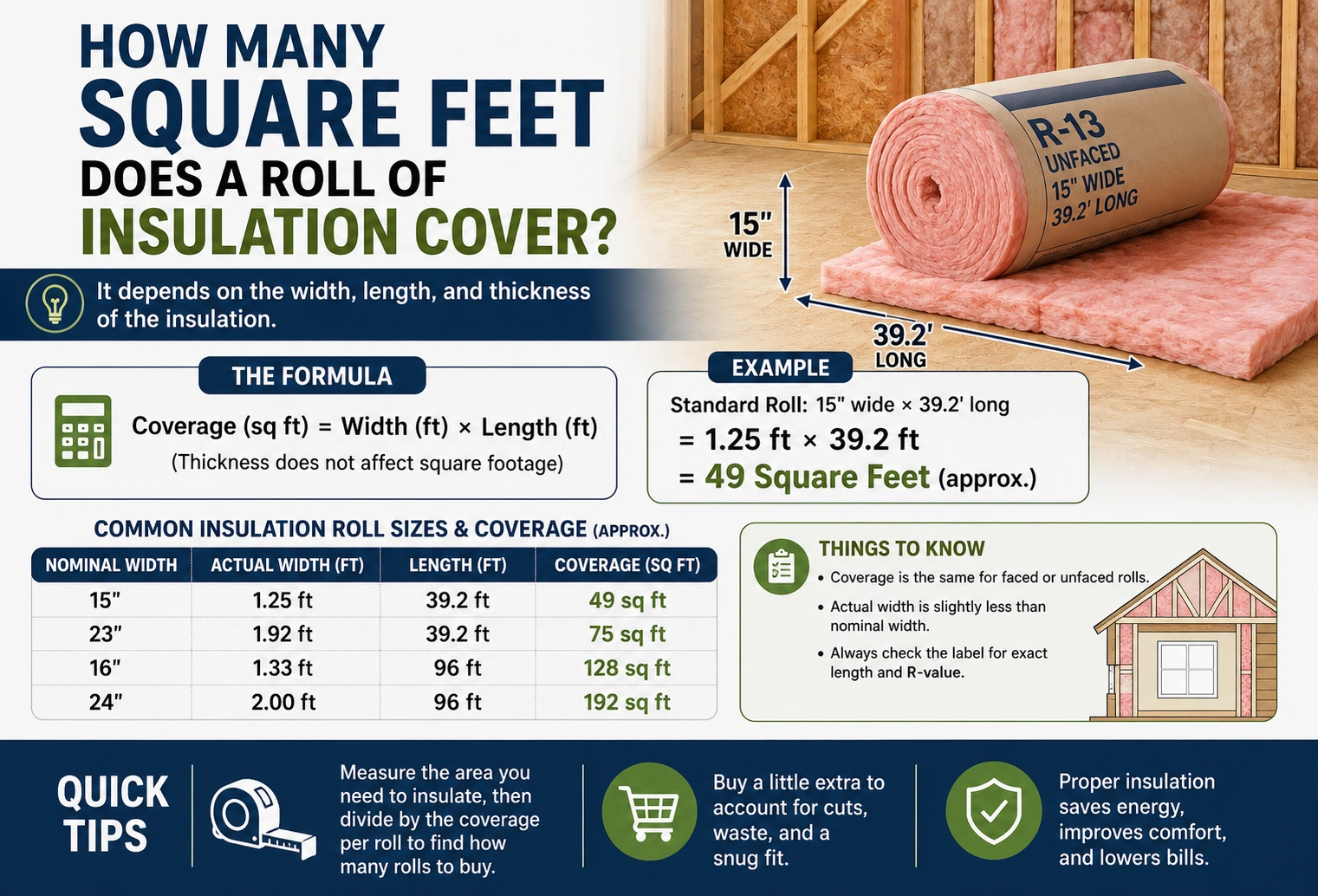
A roll of insulation can cover anywhere from about 25 to more than 100 square feet, depending on the insulation type, thickness, width, and manufacturer.
There is no standard square-foot coverage for every insulation roll. The exact coverage is normally printed on the product packaging or specification sheet.
For example, one roll might cover 40 square feet, while another larger roll could cover more than 100 square feet.
The easiest way to determine coverage is to check the roll’s listed length × width.
Quick Answer
Most insulation rolls cover roughly 25–100+ square feet per roll, but the actual coverage varies by product.
| Example Roll Size | Approx. Coverage |
|---|---|
| 16 ft × 2.5 ft | 40 sq ft |
| 20 ft × 3 ft | 60 sq ft |
| 25 ft × 3 ft | 75 sq ft |
| 30 ft × 3 ft | 90 sq ft |
| 40 ft × 3 ft | 120 sq ft |
| 50 ft × 3 ft | 150 sq ft |
These examples illustrate how roll dimensions determine coverage. Actual commercially available products vary.
How Do You Calculate Insulation Roll Coverage?
If you know the roll’s dimensions, calculating coverage is straightforward.
Use:
Coverage = Length × Width
For example, if a roll is 30 feet long and 3 feet wide:
30 × 3 = 90 square feet
That roll would cover 90 square feet if installed without overlap or waste.
If the roll is 25 feet long and 3 feet wide:
25 × 3 = 75 square feet
So its coverage would be 75 square feet.
Insulation Roll Coverage Comparison
Different products can have very different dimensions.
| Roll Length | Roll Width | Calculated Coverage |
| 10 ft | 2.5 ft | 25 sq ft |
| 15 ft | 2.5 ft | 37.5 sq ft |
| 20 ft | 3 ft | 60 sq ft |
| 25 ft | 3 ft | 75 sq ft |
| 30 ft | 3 ft | 90 sq ft |
| 40 ft | 3 ft | 120 sq ft |
| 50 ft | 3 ft | 150 sq ft |
Always use the manufacturer’s stated coverage when purchasing materials because packaged insulation may have dimensions or installation requirements that affect the usable coverage.
How Many Square Feet Does a Fiberglass Insulation Roll Cover?
Fiberglass insulation rolls come in many different sizes, so there is no single coverage figure.
A product designed for a particular wall cavity may have a narrower width, while insulation intended for an attic or ceiling may be much wider.
The roll’s coverage is determined primarily by its dimensions.
For example:
40 feet long × 3 feet wide = 120 square feet
Another roll measuring:
25 feet long × 2.5 feet wide = 62.5 square feet
Both are insulation rolls, but their coverage is different.
How Many Rolls of Insulation Do I Need?
To estimate the number of rolls required, first calculate the total area you need to insulate.
Then divide the project area by the coverage of one roll.
Use:
Number of Rolls = Total Area ÷ Coverage per Roll
For example, if your project covers 1,000 square feet and one roll covers 80 square feet:
1,000 ÷ 80 = 12.5
Because you cannot purchase half of a roll in most cases, you would need to round up to 13 rolls before accounting for waste.
Insulation Roll Calculation Example
Suppose you have an attic measuring 30 feet by 40 feet.
First calculate the area:
30 × 40 = 1,200 square feet
If one insulation roll covers 90 square feet:
1,200 ÷ 90 = 13.33
You would need at least 14 rolls based on the calculated coverage.
If you expect cutting waste or difficult areas, purchasing an additional amount may be appropriate.
How Much Extra Insulation Should You Buy?
It is usually wise to account for some material waste.
Insulation may need to be cut around:
- Electrical outlets
- Wiring
- Pipes
- Ductwork
- Windows
- Doors
- Framing
- Irregular wall sections
The amount of extra material needed depends on the project.
A simple rectangular area with few obstacles may require little additional material, while a complex attic or wall layout can create more waste.
A common planning approach is to add approximately 5–15% to the calculated material requirement, depending on the complexity of the installation.
For example, if you calculate that you need 1,000 square feet, a 10% allowance would be:
1,000 × 1.10 = 1,100 square feet
The actual recommended allowance should depend on the project and installation method.
Does Insulation Thickness Change Square-Foot Coverage?
Thickness does not necessarily change the physical area covered by a roll, but it can affect the product’s dimensions, packaging, and cost.
For example, two rolls may both be designed to cover a similar wall area but have different thicknesses and R-values.
The R-value describes the insulation’s resistance to heat flow. Higher R-values generally indicate greater resistance to heat transfer.
When buying insulation, therefore, do not compare products by square-foot coverage alone.
You should also consider:
- R-value
- Thickness
- Width
- Intended application
- Installation method
- Climate
- Building requirements
Does Roll Width Matter?
Yes.
Width is one of the dimensions used to calculate coverage.
For example, a 30-foot roll that is 2 feet wide covers:
30 × 2 = 60 square feet
A 30-foot roll that is 3 feet wide covers:
30 × 3 = 90 square feet
So the longer roll is not automatically the better option. Both length and width determine total coverage.
How Many Rolls of Insulation for 500 Square Feet?
The number of rolls depends on the coverage of each roll.
For example, if one roll covers 50 square feet:
500 ÷ 50 = 10 rolls
If one roll covers 100 square feet:
500 ÷ 100 = 5 rolls
| Roll Coverage | Rolls for 500 Sq Ft |
| 40 sq ft | 13 rolls |
| 50 sq ft | 10 rolls |
| 60 sq ft | 9 rolls |
| 75 sq ft | 7 rolls |
| 100 sq ft | 5 rolls |
| 120 sq ft | 5 rolls |
These calculations are rounded up to whole rolls and do not include additional waste.
How Many Rolls of Insulation for 1,000 Square Feet?
For a 1,000-square-foot project, the number of rolls depends on the product’s coverage.
| Coverage per Roll | Minimum Rolls for 1,000 Sq Ft |
| 40 sq ft | 25 |
| 50 sq ft | 20 |
| 60 sq ft | 17 |
| 75 sq ft | 14 |
| 80 sq ft | 13 |
| 90 sq ft | 12 |
| 100 sq ft | 10 |
| 120 sq ft | 9 |
| 150 sq ft | 7 |
For example, if each roll covers 80 square feet:
1,000 ÷ 80 = 12.5
You would need 13 rolls before adding a waste allowance.
Can One Roll of Insulation Cover a Whole Room?
Sometimes, but it depends on the room size and roll dimensions.
A small wall section may require only part of a roll, while a large room or attic could require several rolls.
For example, if a room has 300 square feet of wall area and each roll covers 100 square feet:
300 ÷ 100 = 3 rolls
You would need at least three rolls before considering cuts and waste.
Should You Use the Roll’s Advertised Coverage?
Yes. The manufacturer’s coverage specification is generally the best number to use when estimating how much material to purchase.
The packaging may provide information such as:
- Total square feet per package
- Roll dimensions
- R-value
- Thickness
- Recommended application
- Number of pieces or rolls
If the product lists a coverage area directly, use that figure rather than estimating from appearance.
Frequently Asked Questions
How many square feet does one roll of insulation cover?
There is no universal coverage amount. Depending on the product, one roll can cover roughly 25 to more than 100 square feet.
How do I know how much insulation one roll covers?
Check the manufacturer’s stated coverage on the packaging. If only dimensions are provided, multiply the roll’s length by its width.
How many rolls of insulation do I need for 1,000 square feet?
It depends on the coverage per roll. For example, a 100-square-foot roll requires 10 rolls for 1,000 square feet before accounting for waste.
How do I calculate insulation coverage?
Multiply the roll’s length by its width:
Length × Width = Square-Foot Coverage
Should I buy extra insulation?
Usually, some extra material is helpful because insulation may need to be cut around framing, wiring, pipes, windows, and other obstacles. A 5–15% allowance is a common planning range, depending on project complexity.
Does R-value affect how many square feet a roll covers?
Not directly. Coverage depends on the roll’s dimensions, while R-value describes thermal resistance. However, different R-values may come in different thicknesses and package sizes.
Does insulation width matter?
Yes. A wider roll covers more square feet when the length remains the same.
Can insulation rolls be cut?
Yes, many roll-type insulation products can be cut to fit the required space. However, installation should follow the manufacturer’s instructions and applicable building requirements.
Is roll insulation better than batt insulation?
Neither is universally better. Rolls can be convenient for long, continuous areas, while batts can be convenient for spaces with standard cavity dimensions. The best option depends on the application.
Conclusion
A roll of insulation can cover roughly 25 to more than 100 square feet, but there is no standard coverage amount for every roll.
The exact coverage depends on the product’s length and width. If those dimensions are known, use:
Coverage = Length × Width
For example, a 30-foot-long roll that is 3 feet wide covers:
30 × 3 = 90 square feet
To determine how many rolls you need, divide the total area of your project by the manufacturer’s coverage per roll and round up. It is also wise to account for some cutting waste, particularly for projects with irregular shapes, wiring, pipes, windows, or other obstacles.
For the most accurate estimate, check the insulation package for its stated square-foot coverage, R-value, thickness, and intended application before purchasing.
Discover More Articles
How Many Feet in a Fathom of Water? Exact Guide