
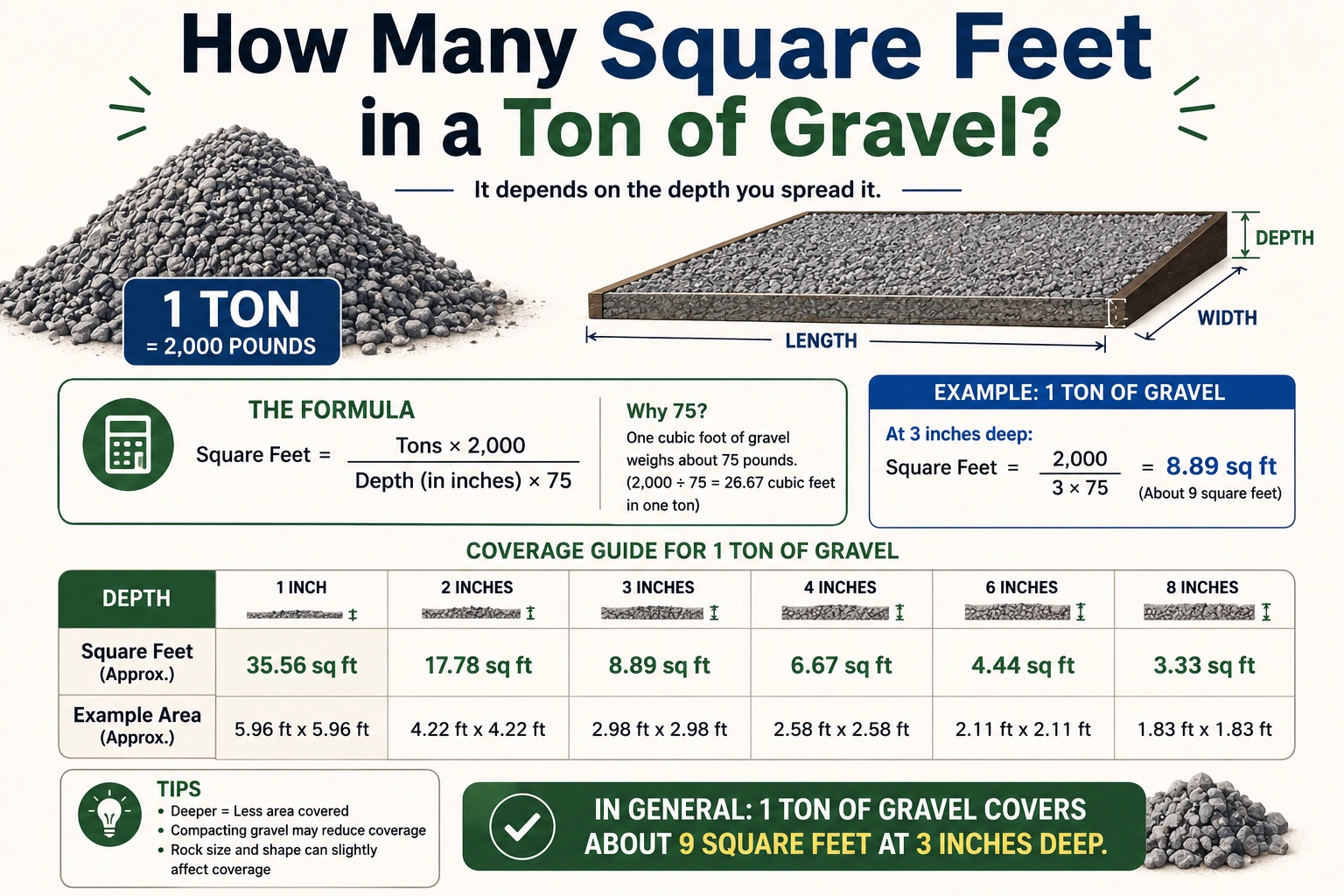
If you are planning a driveway, walkway, patio, or landscaping project, you may ask: how many square feet in a ton of gravel? Knowing gravel coverage helps you estimate costs, avoid waste, and order the correct amount of material.
The answer depends mainly on:
- Gravel depth
- Gravel size
- Gravel type
On average:
1 ton of gravel≈80 to 100 square feet at 2-inch depth
At shallower depths, gravel covers more area. At deeper depths, coverage decreases.
This guide explains gravel coverage formulas, depth calculations, project examples, and expert tips for accurate gravel estimates.
Understanding Gravel Coverage
Before calculating gravel needs, it helps to understand how coverage works.
What Does Gravel Coverage Mean?
Gravel coverage refers to the amount of surface area a certain quantity of gravel can cover at a specific depth.
Coverage is usually measured in:
- Square feet
- Cubic yards
- Tons
Why Depth Matters
Depth greatly affects gravel coverage.
For example:
- Thin layers cover more square feet
- Thick layers cover fewer square feet
A decorative pathway may only need 1–2 inches of gravel, while a driveway may require 4 inches or more.
How Many Square Feet in a Ton of Gravel?
The average ton of gravel typically covers:
| Gravel Depth | Approximate Coverage |
|---|---|
| 1 inch | 160–200 sq ft |
| 2 inches | 80–100 sq ft |
| 3 inches | 55–70 sq ft |
| 4 inches | 40–50 sq ft |
The most common estimate is:
1 ton≈100 sq ft at 2-inch depth
This estimate works for many landscaping projects.
Gravel Coverage Formula
Professionals use simple formulas to estimate gravel needs.
Standard Formula
To estimate gravel coverage:
Coverage=DepthVolume
Most gravel calculators also factor in gravel density.
Gravel Tonnage Formula
A common simplified formula is:
Tons Needed=2000Square Feet×Depth
This helps estimate how much gravel to order.
Example Calculation
Suppose you want to cover:
- 200 square feet
- At 2-inch depth
Approximate calculation:
200÷100=2 tons
You would need approximately:
- 2 tons of gravel
Gravel Coverage by Depth
Depth is the biggest factor affecting gravel coverage.
1-Inch Depth
At a shallow 1-inch layer:
1 ton≈160 to 200 sq ft
This works well for:
- Decorative landscaping
- Garden paths
2-Inch Depth
A 2-inch layer is common for:
- Walkways
- Patios
- Decorative areas
Coverage averages:
1 ton≈80 to 100 sq ft
3-Inch Depth
Driveways often use deeper gravel layers.
Coverage becomes:
1 ton≈55 to 70 sq ft
4-Inch Depth
Heavy-duty driveways may require:
1 ton≈40 to 50 sq ft
This supports heavier vehicles and improves durability.
Gravel Coverage Chart
Here is a quick reference chart.
| Tons of Gravel | 2-Inch Depth Coverage |
|---|---|
| 1 ton | 80–100 sq ft |
| 2 tons | 160–200 sq ft |
| 3 tons | 240–300 sq ft |
| 5 tons | 400–500 sq ft |
| 10 tons | 800–1,000 sq ft |
This chart simplifies project planning.
Factors That Affect Gravel Coverage
Several factors can change actual gravel coverage.
Gravel Size
Larger stones create more air gaps and may cover differently than smaller gravel.
Gravel Type
Different materials have different densities, including:
- Pea gravel
- Crushed stone
- River rock
- Limestone
Coverage may vary slightly.
Compaction
Compacted gravel settles over time.
This reduces final coverage depth.
Moisture Content
Wet gravel weighs more than dry gravel, which can affect tonnage estimates.
Common Gravel Project Examples
Gravel is used in many residential and commercial projects.
Driveways
Driveways usually require:
- 3–4 inches depth
This improves durability and drainage.
Walkways
Walkways often use:
- 2-inch depth
This provides stable walking surfaces.
Patios
Gravel patios commonly use decorative stone at shallow depths.
Landscaping Beds
Decorative landscaping may only require:
- 1 inch depth
This maximizes coverage area.
Common Gravel Calculation Mistakes
Incorrect estimates can waste time and money.
Ignoring Depth
Many people only measure square footage.
Depth is equally important.
Forgetting Compaction
Gravel settles after installation.
Professionals often order extra material.
Ordering Too Little Gravel
It is better to order slightly more gravel than not enough.
Extra gravel helps with:
- Settling
- Repairs
- Uneven surfaces
Expert Tips for Gravel Projects
Professionals recommend careful planning before installation.
Add Extra Material
Order approximately:
- 5–10% extra gravel
This accounts for settling and waste.
Use Landscape Fabric
Fabric beneath gravel helps:
- Prevent weeds
- Improve drainage
- Reduce gravel sinking
Measure Carefully
Accurate measurements improve material estimates and reduce costs.
Real-World Example
Suppose you want to cover a driveway measuring:
- 20 feet long
- 10 feet wide
Total area:
20×10=200 sq ft
At 2-inch depth:
200÷100≈2 tons
You would need approximately:
- 2 tons of gravel
FAQs
1. How many square feet does one ton of gravel cover?
One ton typically covers 80–100 square feet at 2-inch depth.
2. How deep should gravel be for a driveway?
Most driveways need 3–4 inches of gravel.
3. Does gravel size affect coverage?
Yes. Larger stones may cover differently because of air gaps.
4. How much gravel do I need for 200 square feet?
At 2-inch depth, you typically need about 2 tons.
5. Should I order extra gravel?
Yes. Professionals recommend ordering 5–10% extra for settling and waste.
Conclusion
Understanding how many square feet in a ton of gravel helps homeowners and contractors plan landscaping and construction projects more accurately. On average:
1 ton of gravel≈80 to 100 sq ft at 2-inch depth
However, actual coverage depends on:
- Gravel depth
- Gravel type
- Stone size
- Compaction
Using proper calculations and accurate measurements ensures you order enough gravel while avoiding unnecessary waste and extra costs.
Discover More Articles
How Many Gallons of Soil in 2 Cubic Feet? Guide