

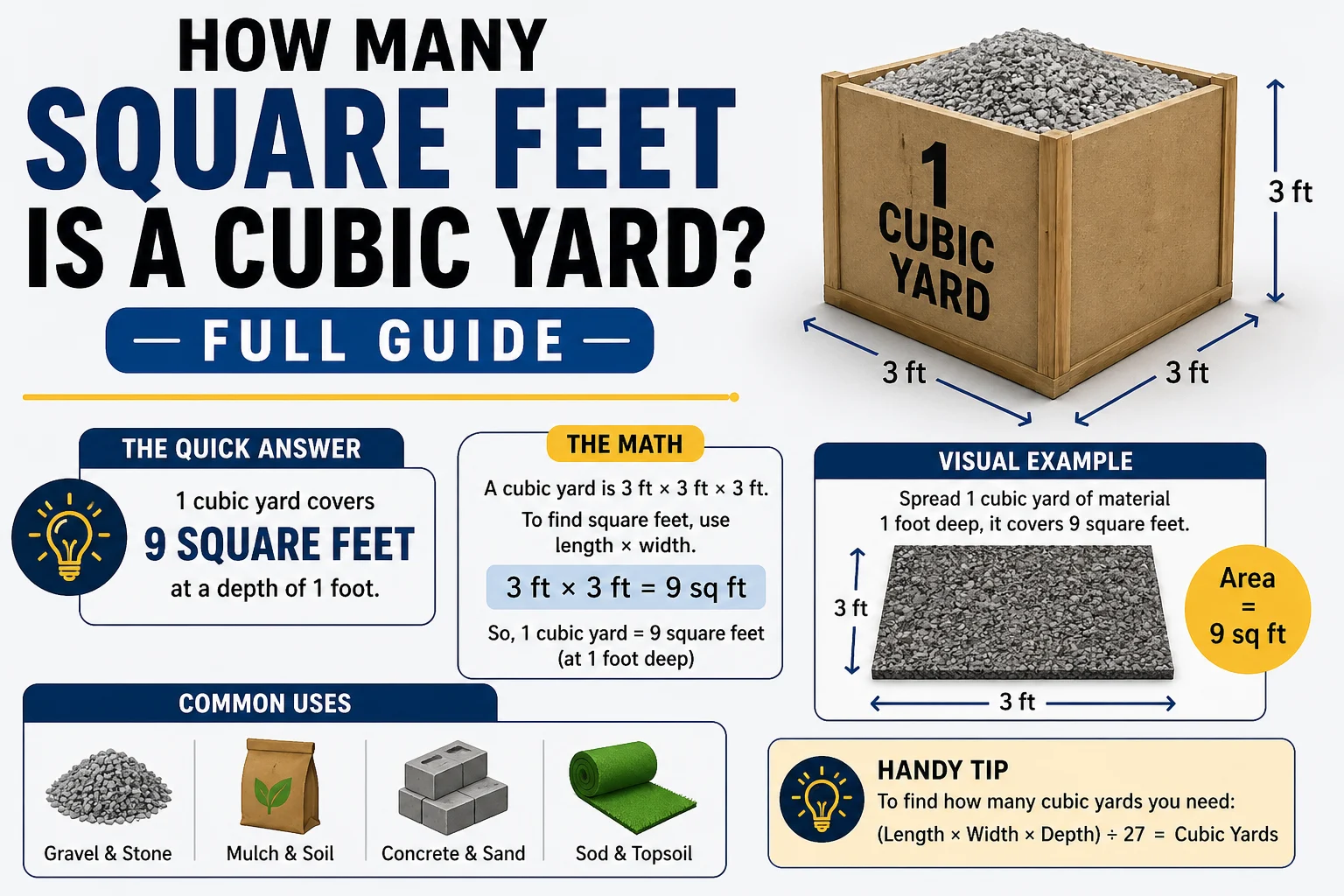
If you are planning a landscaping project, ordering soil, gravel, or concrete, you may have asked yourself: how many square feet is a cubic yard? This is one of the most common questions in construction and gardening, but the answer is not as straightforward as it may seem.
A cubic yard measures volume, while square feet measure area. Because of this difference, you cannot directly convert one into the other without knowing the depth or thickness of the material. In this guide, we will break everything down in a simple and practical way so you can confidently calculate materials for any project.
Understanding the Basics of a Cubic Yard
Before answering how many square feet is a cubic yard, it is important to understand what a cubic yard actually is.
What is a cubic yard?
A cubic yard is a unit of volume used mainly in construction and landscaping. It represents a cube that is:
- 3 feet long
- 3 feet wide
- 3 feet high
This means:
1 cubic yard = 27 cubic feet
This is the foundation of all conversions related to cubic yards.
How cubic yards measure volume
Volume tells us how much space a material occupies. For example:
- Soil fills a space
- Gravel occupies volume in a driveway
- Concrete fills molds or forms
But square feet only measure surface area, not how deep something is.
How Many Square Feet Is a Cubic Yard? Explained
Here is the most important truth:
👉 You cannot convert a cubic yard directly into square feet without knowing depth.
This is because:
- Square feet = length × width (area)
- Cubic yards = length × width × height (volume)
Why you cannot directly convert volume to area
Think of it like this:
- A cubic yard of soil could spread over a large flat area if it is thin
- Or it could cover a small area if it is thick
So the question “how many square feet is a cubic yard” always depends on how deep the material is spread.
The missing factor: depth or thickness
To solve this, we use:
Area = Volume ÷ Depth
This is the key formula used in construction and landscaping.
Cubic Yard to Square Feet Formula (Simple Method)
Let’s break it down in a practical way.
Step-by-step formula
- Start with 1 cubic yard
- Convert to cubic feet:
1 cubic yard = 27 cubic feet - Divide by depth (in feet)
Formula:
Square feet = 27 ÷ depth (in feet)
Real-world example
Let’s say you have 1 cubic yard of soil and want to spread it 3 inches deep.
Step 1: Convert inches to feet
- 3 inches = 0.25 feet
Step 2: Apply formula
- 27 ÷ 0.25 = 108 square feet
So:
👉 1 cubic yard covers 108 square feet at 3-inch depth
Common Conversion Examples (With Depth)
To make things easier, here are real-world coverage examples.
1 cubic yard at 1-inch depth
- 1 inch = 0.083 feet
- 27 ÷ 0.083 = 324 square feet
👉 Very thin layer, large coverage
1 cubic yard at 3-inch depth
- 3 inches = 0.25 feet
- 27 ÷ 0.25 = 108 square feet
👉 Common for mulch and garden beds
1 cubic yard at 6-inch depth
- 6 inches = 0.5 feet
- 27 ÷ 0.5 = 54 square feet
👉 Used for deeper soil or base layers
Coverage Chart for Landscaping Materials
Here is a simple reference table you can use anytime:
| Depth | Coverage (1 Cubic Yard) |
|---|---|
| 1 inch | 324 sq ft |
| 2 inches | 162 sq ft |
| 3 inches | 108 sq ft |
| 4 inches | 81 sq ft |
| 6 inches | 54 sq ft |
| 12 inches (1 ft) | 27 sq ft |
Material examples:
- Mulch: 2–3 inches
- Topsoil: 3–6 inches
- Gravel base: 4–12 inches
- Concrete slab: varies by structure
Why This Conversion Matters in Real Life
Understanding how many square feet is a cubic yard is not just math—it directly affects your project success.
Landscaping projects
When buying:
- Soil
- Mulch
- Sand
You need to avoid overbuying or underbuying.
Construction and concrete work
Concrete is always measured in cubic yards. But forms are measured in square feet. So contractors must convert correctly.
Cost estimation benefits
Accurate conversion helps you:
- Avoid waste
- Control budget
- Order correct material quantities
- Save time on project delays
Common Mistakes People Make
Many beginners make simple but costly mistakes.
1. Confusing volume with area
A cubic yard is not a flat measurement. It has height, which changes everything.
2. Ignoring depth measurement
Without depth, conversion is impossible.
3. Miscalculating project needs
Even small errors in depth can lead to:
- Extra material costs
- Project delays
- Uneven surfaces
Expert Tips for Accurate Measurement
Here are practical tips used by professionals:
Always measure depth first
Before ordering materials, decide:
- How thick should the layer be?
Use consistent units
Convert everything into feet before calculating.
Add extra buffer
Always order:
- 5–10% extra material for safety
Final Thoughts on Cubic Yard Coverage
So, how many square feet is a cubic yard?
The simple answer is: it depends on the depth.
A cubic yard equals:
- 324 sq ft at 1 inch depth
- 108 sq ft at 3 inches depth
- 54 sq ft at 6 inches depth
Understanding this relationship helps you plan landscaping, construction, and DIY projects with confidence. Instead of guessing, you can now calculate exactly how much material you need and avoid costly mistakes.
9. FAQs
1. How many square feet is a cubic yard at 2 inches?
A cubic yard covers about 162 square feet at 2 inches depth.
2. Why can’t you directly convert cubic yards to square feet?
Because cubic yards measure volume and square feet measure area, you need depth to convert.
3. How many cubic feet are in a cubic yard?
There are 27 cubic feet in 1 cubic yard.
4. How much area does 1 cubic yard of mulch cover?
At a typical 3-inch depth, it covers about 108 square feet.
5. What is the easiest way to calculate coverage?
Use this formula:
Square feet = 27 ÷ depth (in feet)
10. Conclusion
Understanding how many square feet is a cubic yard is essential for anyone working with landscaping or construction materials. While there is no fixed number, the key is knowing the depth of your material.
Once you understand the simple formula and examples, you can confidently plan any project, estimate costs accurately, and avoid material waste. Whether you’re spreading mulch in a garden or pouring concrete for a driveway, this knowledge ensures better results every time.
Discover more Articles
How Many Square Feet Are There in an Acre? Complete Guide