
If you’re planning to fence your land, one of the first questions you’ll ask is: how many feet of fencing for 1 acre?
This is an important question because fencing costs depend directly on the total length of the boundary—not the total area.
In this guide, you’ll learn the exact fence length needed, how it changes with shape, and how to calculate it easily for your land.
Quick Answer: Fencing Needed for 1 Acre
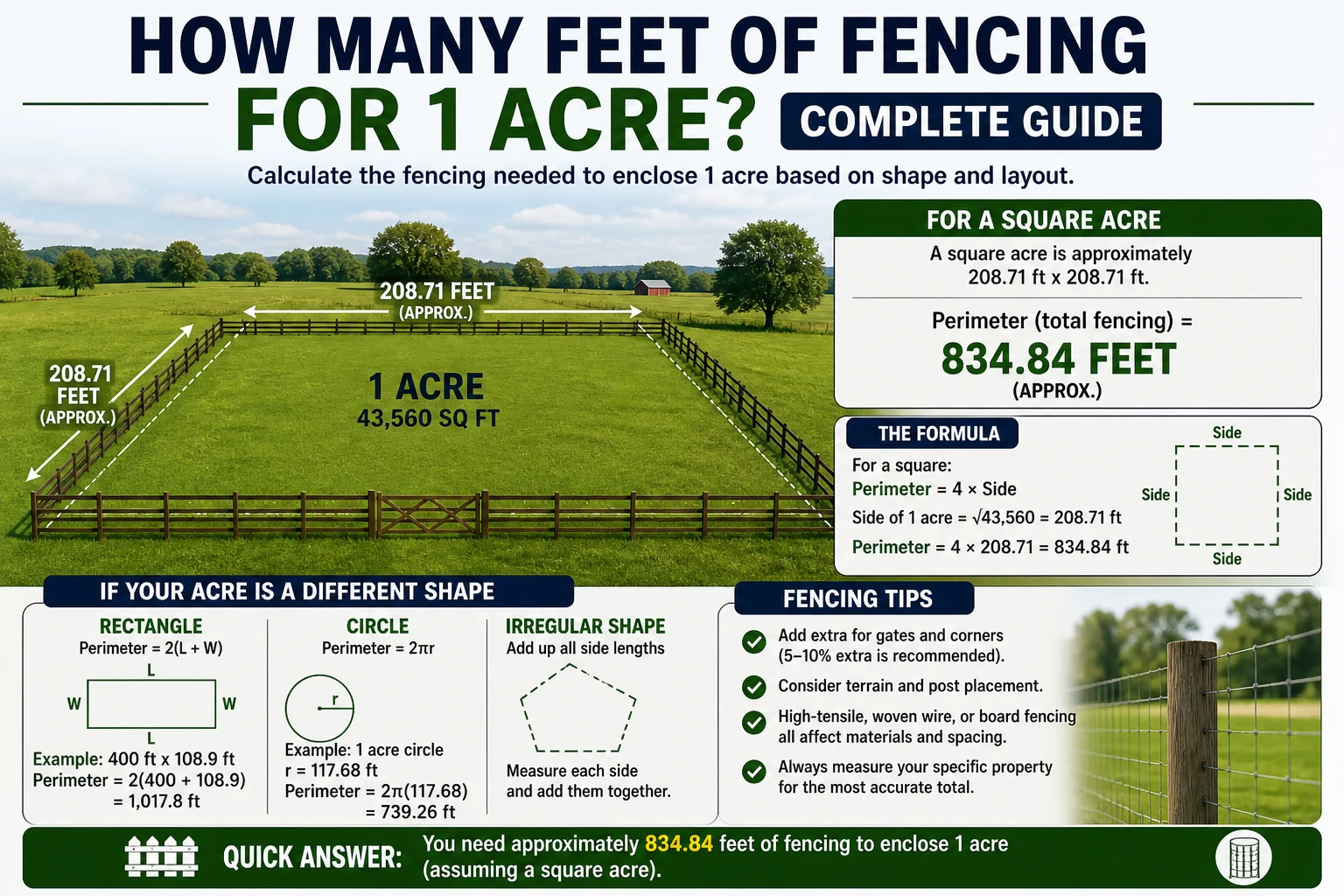
👉 You need about 835 feet of fencing for a 1-acre square plot.
This is based on a perfect square shape, which is the most efficient layout.
Understanding Acre and Perimeter
Before calculating fencing, you need to understand one key concept.
Area vs Boundary
- Acre = total land area (43,560 sq ft)
- Fence = boundary (perimeter)
So fencing depends on the shape of your land, not just the size.
How to Calculate Fence Length for 1 Acre
Square Layout (Most Efficient)
A square acre looks like this:
- Each side ≈ 208.7 feet
Perimeter formula:
Perimeter=4×Side Length
👉 4 × 208.7 ≈ 835 feet
Rectangular Layouts
Different shapes increase the perimeter.
Here are common examples:
208 × 208 ft (Square Plot)
This is the most efficient shape. It requires the least fencing, about 835 feet total.
100 × 435 ft Plot
This layout is long and narrow. It increases the boundary length, requiring about 1,070 feet of fencing.
150 × 290 ft Plot
This is a balanced rectangular shape. It needs around 880 feet of fencing.
1 Acre Fence Length Examples
Here’s a quick comparison:
| Layout Type | Dimensions (ft) | Fence Needed |
|---|---|---|
| Square | 208 × 208 | ~835 ft |
| Narrow Rectangle | 100 × 435 | ~1,070 ft |
| Balanced Rectangle | 150 × 290 | ~880 ft |
👉 Notice: More stretched shapes require more fencing
Why Shape Affects Fence Length
Even though all these plots are 1 acre, their perimeters differ.
Key Insight
- Square = least fencing
- Rectangle = more fencing
- Irregular shapes = most fencing
This is important for cost planning.
Factors That Affect Fencing Length
Beyond shape, other factors matter too.
1. Land Shape
Irregular boundaries increase total length.
2. Terrain
Hills and slopes may require extra fencing.
3. Gates and Openings
You may need:
- Driveway gates
- Walk-through gates
These change total material needs.
Cost Considerations
Fence cost depends on length.
Example
If fencing costs $10 per foot:
- 835 ft = $8,350
- 1,070 ft = $10,700
👉 Shape alone can change cost significantly.
Common Mistakes
Ignoring Shape
Assuming all 1-acre plots need the same fencing.
Not Measuring Properly
Always measure your actual land.
Forgetting Gates
Gates reduce fencing slightly but add cost.
Tips for Accurate Fence Planning
Measure Your Land
Use a tape, GPS tool, or property map.
Choose Efficient Shape
If possible, keep boundaries compact.
Add Extra Margin
Always plan for 5–10% extra fencing.
Real-Life Scenarios
Farm Land
Often rectangular → more fencing required
Residential Plot
Closer to square → less fencing needed
Irregular Land
May need custom fencing → highest cost
Visualizing Fence Length
To understand 835 feet:
- About 2.5 football fields (end-to-end length)
- Around 278 steps (3 ft per step)
This helps you imagine the scale.
9. FAQs
1. How many feet of fencing for 1 acre exactly?
About 835 feet for a square acre.
2. Does shape affect fencing length?
Yes, longer and irregular shapes require more fencing.
3. What is the cheapest shape to fence?
A square shape requires the least fencing.
4. How do I calculate fencing for my land?
Measure each side and add them together.
5. Should I buy extra fencing material?
Yes, always add 5–10% extra for safety.
10. Conclusion
So, how many feet of fencing for 1 acre?
👉 Around 835 feet for a square plot
But remember, the actual fencing required depends on your land’s shape. Long or irregular plots can need significantly more fencing.
To get accurate results:
- Measure your land carefully
- Choose efficient layouts when possible
- Plan for extra materials
With the right approach, you can save money and avoid costly mistakes while fencing your property.
Discover More Articles
How Many Feet from Home to First Base? Complete Guide