

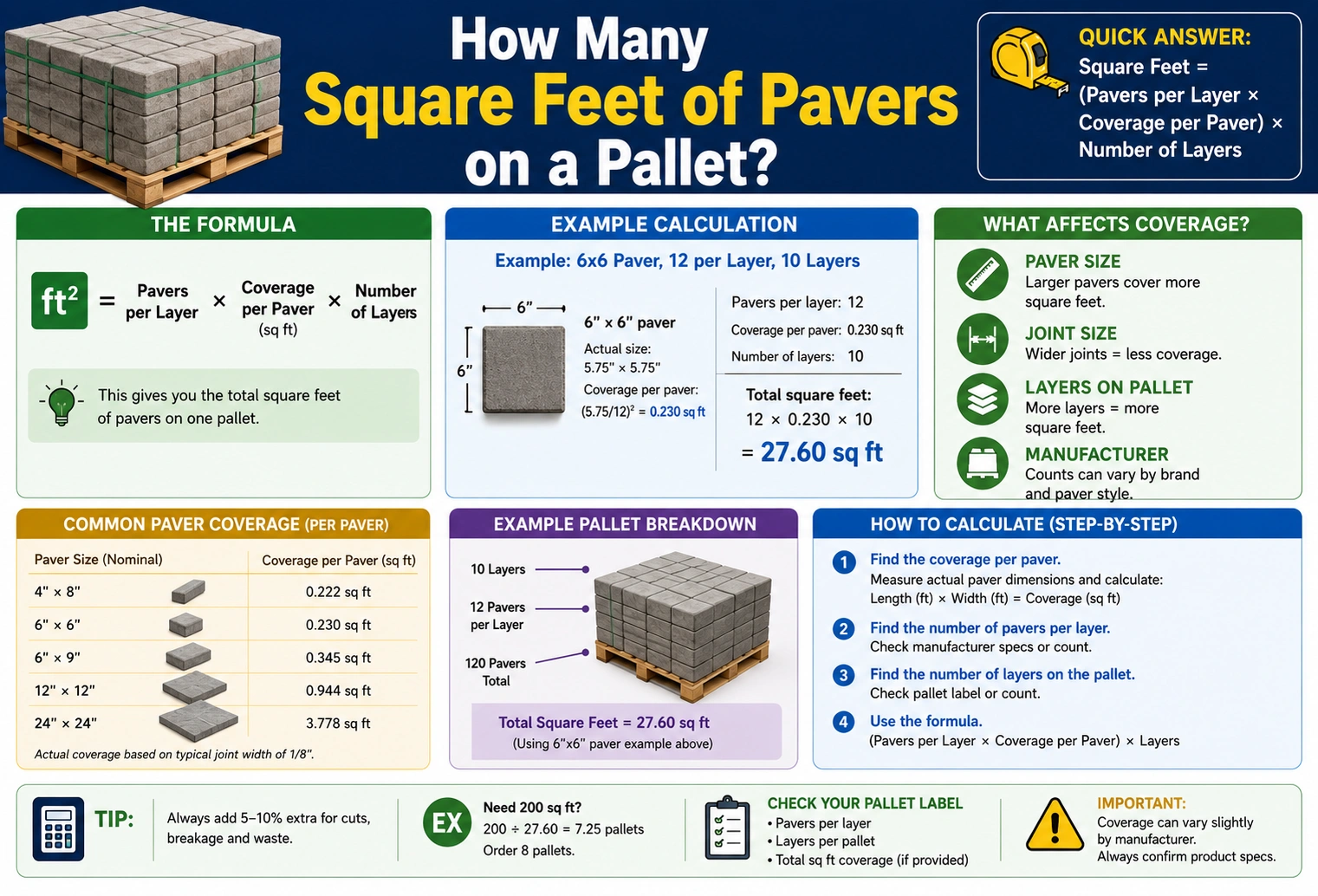
If you’re planning a patio, driveway, walkway, or other landscaping project, one of the first questions you’ll ask is how many square feet of pavers on a pallet. Knowing the coverage of a pallet helps you estimate material costs, transportation needs, and the number of pallets required for your project.
The answer is that there isn’t a single standard pallet size for pavers. Coverage depends on the manufacturer, paver dimensions, thickness, and packaging.
However, most pallets of concrete or brick pavers cover between 80 and 160 square feet, with many common pallets covering 100 to 120 square feet.
In this guide, you’ll learn average pallet coverage, how to calculate the number of pallets you need, and tips to avoid ordering too few or too many pavers.
Quick Answer
| Paver Type | Average Coverage Per Pallet |
|---|---|
| Small Concrete Pavers | 90–120 sq ft |
| Large Concrete Pavers | 100–160 sq ft |
| Brick Pavers | 90–120 sq ft |
| Natural Stone Pavers | 70–110 sq ft |
| Typical Average | 100–120 sq ft |
Answer: A pallet of pavers generally covers 80 to 160 square feet, with 100–120 square feet being the most common range.
Does Every Pallet Cover the Same Area?
No. Manufacturers package pavers differently based on:
- Paver dimensions
- Thickness
- Weight limits
- Material type
- Shipping requirements
- Product design
For this reason, two pallets may look similar but cover very different areas.
Always check the manufacturer’s product specifications before purchasing.
Average Paver Coverage by Pallet Type
Different paver materials are packaged differently.
| Paver Material | Typical Coverage |
|---|---|
| Concrete Pavers | 100–120 sq ft |
| Interlocking Pavers | 90–120 sq ft |
| Large Slab Pavers | 120–160 sq ft |
| Clay Brick Pavers | 90–110 sq ft |
| Natural Stone Pavers | 70–110 sq ft |
| Permeable Pavers | 80–120 sq ft |
These values are averages and may vary by brand.
How to Calculate Paver Coverage
To determine how many pallets you’ll need, follow these simple steps.
Step 1: Measure Your Project
Multiply the length by the width.
Example:
20 ft × 15 ft = 300 square feet
Step 2: Check the Pallet Coverage
Suppose each pallet covers 100 square feet.
Step 3: Divide the Total Area
300 ÷ 100 = 3 pallets
In this example, you’ll need approximately 3 pallets before accounting for waste.
Why You Should Buy Extra Pavers
Professionals usually recommend purchasing 5–10% more pavers than your calculated area.
Extra material helps cover:
- Cutting around edges
- Broken pavers
- Installation mistakes
- Future repairs
- Color matching if replacements are needed
For intricate laying patterns such as herringbone or diagonal designs, you may want to allow up to 10–15% extra.
Factors That Affect Coverage
Several factors determine how much area a pallet can cover.
Paver Size
Larger pavers typically cover more area per piece, though fewer pieces fit on a pallet due to weight.
Thickness
Thicker pavers weigh more, so manufacturers often package fewer of them per pallet.
Material
Natural stone generally has more variation in shape and thickness than concrete pavers, affecting coverage.
Packaging
Different manufacturers use different pallet configurations and quantities.
Project Layout
Curves, borders, and decorative patterns usually increase material waste.
How Many Pallets Do You Need?
Here are rough estimates based on a pallet covering 100 square feet.
| Project Size | Pallets Needed |
|---|---|
| 100 sq ft | 1 pallet |
| 200 sq ft | 2 pallets |
| 300 sq ft | 3 pallets |
| 400 sq ft | 4 pallets |
| 500 sq ft | 5 pallets |
| 600 sq ft | 6 pallets |
Always round up and include extra material for waste.
Real-World Project Examples
Backyard Patio
Patio size:
12 ft × 12 ft
Area:
144 square feet
If each pallet covers 100 square feet:
You’ll need 2 pallets.
Walkway
Walkway dimensions:
4 ft × 25 ft
Area:
100 square feet
One average pallet is typically enough.
Driveway
Driveway dimensions:
20 ft × 30 ft
Area:
600 square feet
You’ll likely need 6–7 pallets, depending on pallet coverage and waste allowance.
Typical Paver Weights
Pallet weight is another important consideration for delivery and installation.
| Paver Type | Approximate Pallet Weight |
|---|---|
| Concrete Pavers | 2,500–3,500 lbs |
| Brick Pavers | 2,000–3,000 lbs |
| Natural Stone | 3,000–4,000 lbs |
Make sure your delivery location can accommodate the weight.
Buying Tips
Before purchasing pavers:
- Measure your project accurately.
- Confirm the exact coverage listed by the manufacturer.
- Buy all pallets at the same time to reduce color variation.
- Order extra material for cuts and future repairs.
- Check delivery access for heavy pallets.
Common Mistakes
Assuming Every Pallet Covers the Same Area
Coverage varies significantly by manufacturer and paver type.
Forgetting Waste
Ordering the exact square footage can leave you short during installation.
Ignoring Pattern Layout
Decorative patterns often require additional cutting and extra pavers.
Not Verifying Product Specifications
Always check the product label for the exact square-foot coverage per pallet.
Expert Tips
- Add 5–10% extra for standard installations.
- Increase waste allowance for diagonal or herringbone patterns.
- Store leftover pavers for future repairs.
- Use the same production batch when possible for consistent color.
- Consult your supplier if mixing different paver sizes.
Quick Coverage Reference
| Coverage Per Pallet | Typical Use |
|---|---|
| 80 sq ft | Thick or specialty pavers |
| 100 sq ft | Most standard patios |
| 120 sq ft | Common concrete pavers |
| 160 sq ft | Large-format pavers |
9. Frequently Asked Questions
1. How many square feet of pavers are on a pallet?
Most pallets cover 80 to 160 square feet, with 100–120 square feet being the most common range.
2. How many pallets do I need for a 300-square-foot patio?
If each pallet covers 100 square feet, you’ll need 3 pallets, plus extra for waste.
3. Do all manufacturers package the same number of pavers?
No. Coverage varies based on paver size, thickness, material, and manufacturer.
4. Should I buy extra pavers?
Yes. It’s recommended to purchase 5–10% extra to account for cuts, breakage, and future repairs.
5. How heavy is a pallet of pavers?
Most pallets weigh between 2,000 and 4,000 pounds, depending on the material and number of pavers.
10. Conclusion
If you’re wondering how many square feet of pavers on a pallet, the answer depends on the type and manufacturer of the pavers. In general, a pallet covers between 80 and 160 square feet, while 100 to 120 square feet is the most common range for standard concrete pavers.
Before purchasing, always verify the manufacturer’s listed coverage, calculate your project’s total square footage, and order an additional 5–10% for cutting, waste, and future repairs. Taking these steps will help ensure your patio, walkway, or driveway project stays on schedule and has enough material for a professional-looking finish.
Discover More Articles
How Many Feet Wide Is a Tennis Court for Singles?