
If you’re planning a landscaping project, one of the first questions you’ll ask is how many square feet does a ton of rock cover. The answer depends primarily on the size of the rock and the depth at which it’s spread.
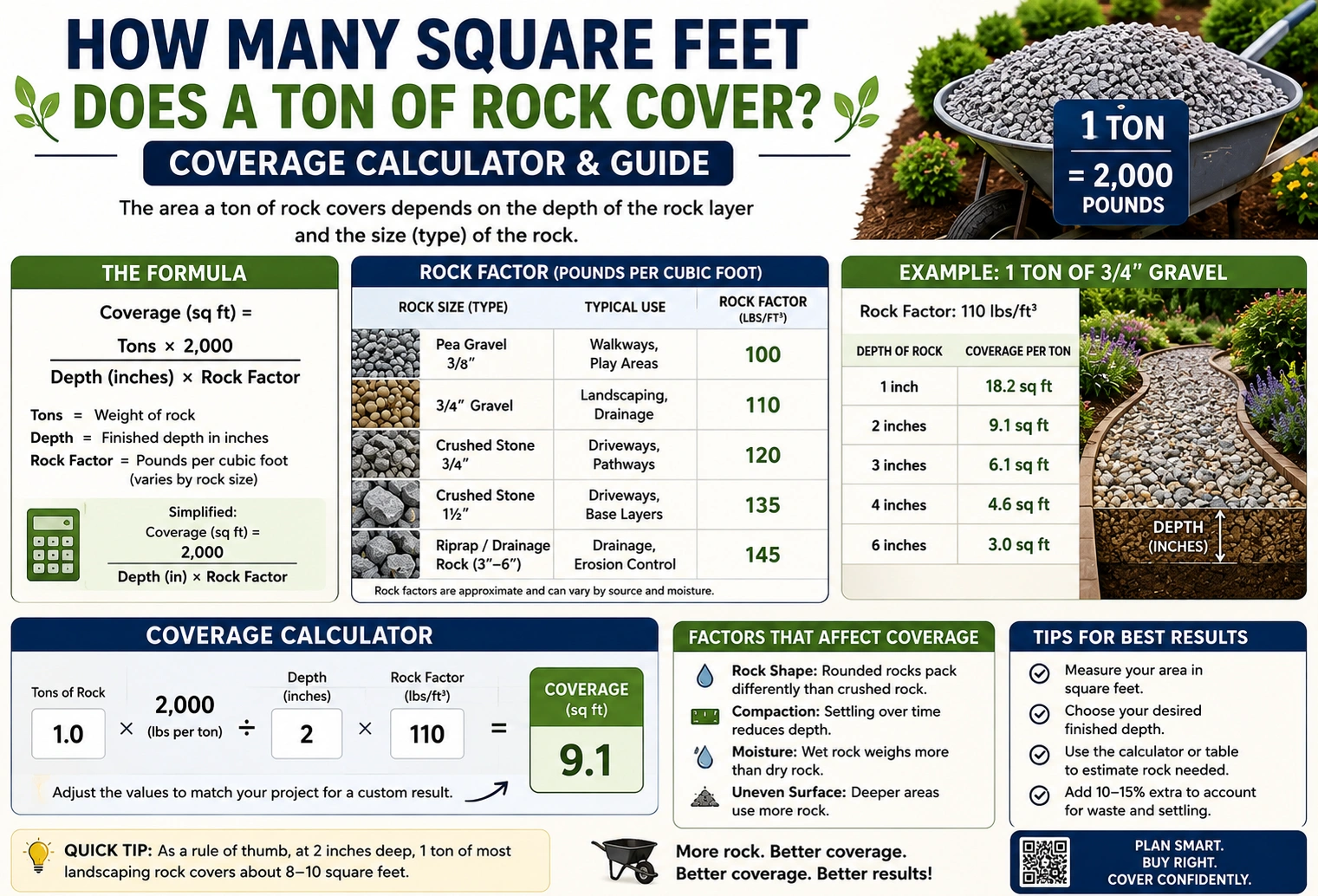
As a general guideline, one ton of landscaping rock covers approximately 80 to 120 square feet at a depth of 2 inches. If you spread the rock more thinly, it will cover a larger area. If you install it more deeply for better weed control or decorative purposes, the coverage area decreases.
Understanding rock coverage helps you estimate material costs, avoid purchasing too much or too little stone, and complete your landscaping project more efficiently.
In this guide, you’ll learn how coverage varies with depth, how to calculate the amount of rock you need, and which factors influence the final coverage area.
Quick Answer
For most landscaping projects:
| Rock Depth | Approximate Coverage Per Ton |
|---|---|
| 1 inch | 160–240 sq ft |
| 2 inches | 80–120 sq ft |
| 3 inches | 55–80 sq ft |
| 4 inches | 40–60 sq ft |
A commonly used estimate is:
1 ton of rock covers about 100 square feet at a depth of 2 inches.
Actual coverage varies depending on the type, shape, and density of the rock.
Why Does Coverage Vary?
Although one ton always weighs 2,000 pounds, it does not always cover the same amount of ground.
Coverage depends on:
- Rock size
- Rock type
- Installation depth
- Shape of the stones
- Compaction after installation
Larger decorative rocks leave more air gaps between stones, while smaller crushed rock packs together more tightly.
Rock Coverage by Installation Depth
Depth is the biggest factor affecting coverage.
1-Inch Depth
A one-inch layer is commonly used for decorative applications where the existing ground is already stable.
Approximate coverage:
160–240 square feet per ton
Suitable for:
- Decorative borders
- Flower beds
- Low-traffic landscaping
- Accent areas
2-Inch Depth
Two inches is the most common recommendation for residential landscaping.
Approximate coverage:
80–120 square feet per ton
This depth provides:
- Better weed suppression
- Improved appearance
- Good ground coverage
- Reduced shifting
Many landscaping professionals use 100 square feet per ton as a quick estimating rule.
3-Inch Depth
A thicker layer is often recommended for areas receiving moderate foot traffic or where better weed control is desired.
Approximate coverage:
55–80 square feet per ton
Ideal for:
- Walkways
- Garden paths
- Sloped areas
- Decorative rock beds
4-Inch Depth
Heavy-duty applications require even more material.
Approximate coverage:
40–60 square feet per ton
Common uses include:
- Drainage projects
- Erosion control
- Driveway bases
- Heavy landscaping
Rock Coverage Chart
The following chart provides a quick reference for estimating coverage.
| Rock Depth | Coverage Per Ton |
| 1 inch | 160–240 sq ft |
| 2 inches | 80–120 sq ft |
| 3 inches | 55–80 sq ft |
| 4 inches | 40–60 sq ft |
Use this table as a starting point, then adjust based on the specific rock product recommended by your supplier.
How to Calculate Rock Coverage
Estimating the amount of rock you need is straightforward once you know the area to be covered.
Step 1: Measure the Area
Multiply the length by the width.
For example:
- Length: 20 feet
- Width: 10 feet
Area:
20 × 10 = 200 square feet
Step 2: Choose the Installation Depth
For decorative landscaping, many homeowners choose a 2-inch depth, which balances appearance, weed suppression, and cost.
Step 3: Estimate Tons Needed
Using the common estimate of 100 square feet per ton at 2 inches:
200 ÷ 100 = 2 tons
In this example, approximately 2 tons of landscaping rock would be required.
Factors That Affect Rock Coverage
Several factors influence how much area one ton of rock can cover.
Rock Size
Larger stones occupy more space and create air gaps, affecting how evenly they spread across a surface.
Rock Shape
Rounded river rock and irregular crushed stone settle differently, which can slightly change coverage.
Material Density
Granite, limestone, lava rock, marble chips, and other materials have different densities, meaning equal weights may occupy different volumes.
Ground Conditions
Uneven terrain, slopes, and existing vegetation may require additional rock to achieve consistent coverage.
Compaction
Over time, some rock types settle into the soil, reducing their effective coverage and occasionally requiring additional material to maintain the desired depth.
Types of Landscaping Rock
The type of rock you choose affects not only the appearance of your landscape but also the coverage, drainage, and maintenance requirements.
Pea Gravel
Pea gravel consists of small, rounded stones that are comfortable to walk on.
Best for:
- Garden paths
- Patios
- Play areas
- Decorative landscaping
Because the stones are small, they pack closely together and provide consistent coverage.
River Rock
River rock features smooth, rounded stones in various sizes.
Common uses include:
- Dry creek beds
- Garden borders
- Water features
- Decorative flower beds
Larger river rock generally covers fewer square feet per ton because the stones occupy more volume.
Crushed Stone
Crushed stone has angular edges that lock together well.
It’s commonly used for:
- Driveways
- Walkways
- Base material
- Drainage systems
Because it compacts tightly, crushed stone often provides predictable coverage.
Lava Rock
Lava rock is much lighter than many natural stones.
Advantages include:
- Lightweight
- Excellent drainage
- Long-lasting color
- Decorative appearance
Since it weighs less per cubic foot than granite or limestone, coverage estimates may differ from traditional landscaping rock.
Marble Chips
Marble chips create a bright, decorative finish around gardens and landscape features.
They’re popular for:
- Accent beds
- Modern landscaping
- Around shrubs
- Decorative borders
Because marble is denser than some other materials, consult your supplier for product-specific coverage information.
Coverage Examples
Here are a few practical examples using the common estimate of 100 square feet per ton at a 2-inch depth.
Example 1
Landscape bed size:
- 10 ft × 10 ft
Area:
100 square feet
Rock required:
Approximately 1 ton
Example 2
Landscape bed size:
- 20 ft × 10 ft
Area:
200 square feet
Rock required:
Approximately 2 tons
Example 3
Landscape bed size:
- 30 ft × 15 ft
Area:
450 square feet
Rock required:
Approximately 4.5 to 5 tons
Ordering slightly more material helps account for uneven ground and settling.
Estimating Rock Costs
Knowing the required tonnage also helps estimate your landscaping budget.
For example:
| Area | Approximate Tons Needed (2-inch Depth) |
|---|---|
| 100 sq ft | 1 ton |
| 200 sq ft | 2 tons |
| 300 sq ft | 3 tons |
| 500 sq ft | 5 tons |
| 1,000 sq ft | 10 tons |
Keep in mind that delivery charges, local pricing, and the type of rock can significantly affect the total project cost.
Benefits of Using Landscaping Rock
Many homeowners choose decorative rock instead of organic mulch because it offers several long-term advantages.
Low Maintenance
Unlike wood mulch, rock does not decompose or require annual replacement.
Excellent Drainage
Most decorative rocks allow water to pass through easily, helping reduce puddles and improve drainage.
Weed Suppression
When installed over landscape fabric at the recommended depth, rock helps reduce weed growth.
Long Lifespan
Decorative stone can last for decades with minimal maintenance.
Attractive Appearance
Available in a wide range of colors, sizes, and textures, landscaping rock complements many landscape styles.
Common Mistakes When Estimating Rock Coverage
Ignoring Installation Depth
Many homeowners estimate only the surface area without considering depth.
A thicker layer requires substantially more material.
Ordering Exactly the Calculated Amount
It’s generally recommended to order 5–10% extra to account for uneven terrain, settling, and minor installation losses.
Confusing Tons with Cubic Yards
Rock is often sold by weight (tons), while mulch and soil are frequently sold by volume (cubic yards).
Be sure you’re using the correct unit when placing an order.
Forgetting Landscape Fabric
Installing landscape fabric beneath decorative rock can improve weed control and help prevent the stone from mixing with the soil over time.
Not Accounting for Irregular Shapes
Curved flower beds, circular gardens, and winding pathways require more careful measurements than simple rectangles.
Divide complex areas into smaller shapes to improve accuracy.
Expert Landscaping Tips
Measure Carefully
Double-check all measurements before calculating square footage or ordering materials.
Choose the Right Depth
A 2-inch depth works well for most decorative landscaping projects, while 3–4 inches may be more suitable for drainage areas or heavy-use paths.
Ask About Rock Density
Coverage can vary depending on whether you’re purchasing granite, limestone, river rock, lava rock, or another material.
Buy Slightly More Than Needed
Having a small amount of extra rock is usually better than running short in the middle of installation.
Consult Your Supplier
Most landscape suppliers provide product-specific coverage recommendations because density and stone size vary between materials.
Frequently Asked Questions
How many square feet does one ton of rock cover?
One ton of landscaping rock typically covers 80–120 square feet at a depth of 2 inches, with 100 square feet being a common planning estimate.
How much rock do I need for 200 square feet?
At a 2-inch depth, you’ll generally need about 2 tons of landscaping rock.
Does larger rock cover more area?
Not necessarily. Larger stones create more air gaps and may require additional material to achieve consistent coverage.
Is 2 inches deep enough for landscaping rock?
Yes. A 2-inch layer is suitable for most decorative landscaping applications and provides good coverage and weed suppression.
Should I install landscape fabric under rock?
In many cases, yes. Landscape fabric can improve weed control, reduce soil mixing, and help maintain a cleaner appearance over time.
Conclusion
If you’re wondering how many square feet does a ton of rock cover, a practical rule of thumb is that one ton covers approximately 100 square feet at a 2-inch depth. Depending on the rock size, shape, and installation depth, actual coverage typically ranges from 80 to 120 square feet for most residential landscaping projects.
By measuring your project area accurately, selecting the appropriate installation depth, and considering the type of rock you’re using, you can estimate material needs with confidence. Whether you’re creating a decorative flower bed, building a garden path, or installing drainage stone, understanding how many square feet a ton of rock covers helps you avoid waste, control costs, and achieve a professional-looking landscape.
Discover More Articles
How Many Square Feet Is a 3 Bedroom 2 Bath House?