

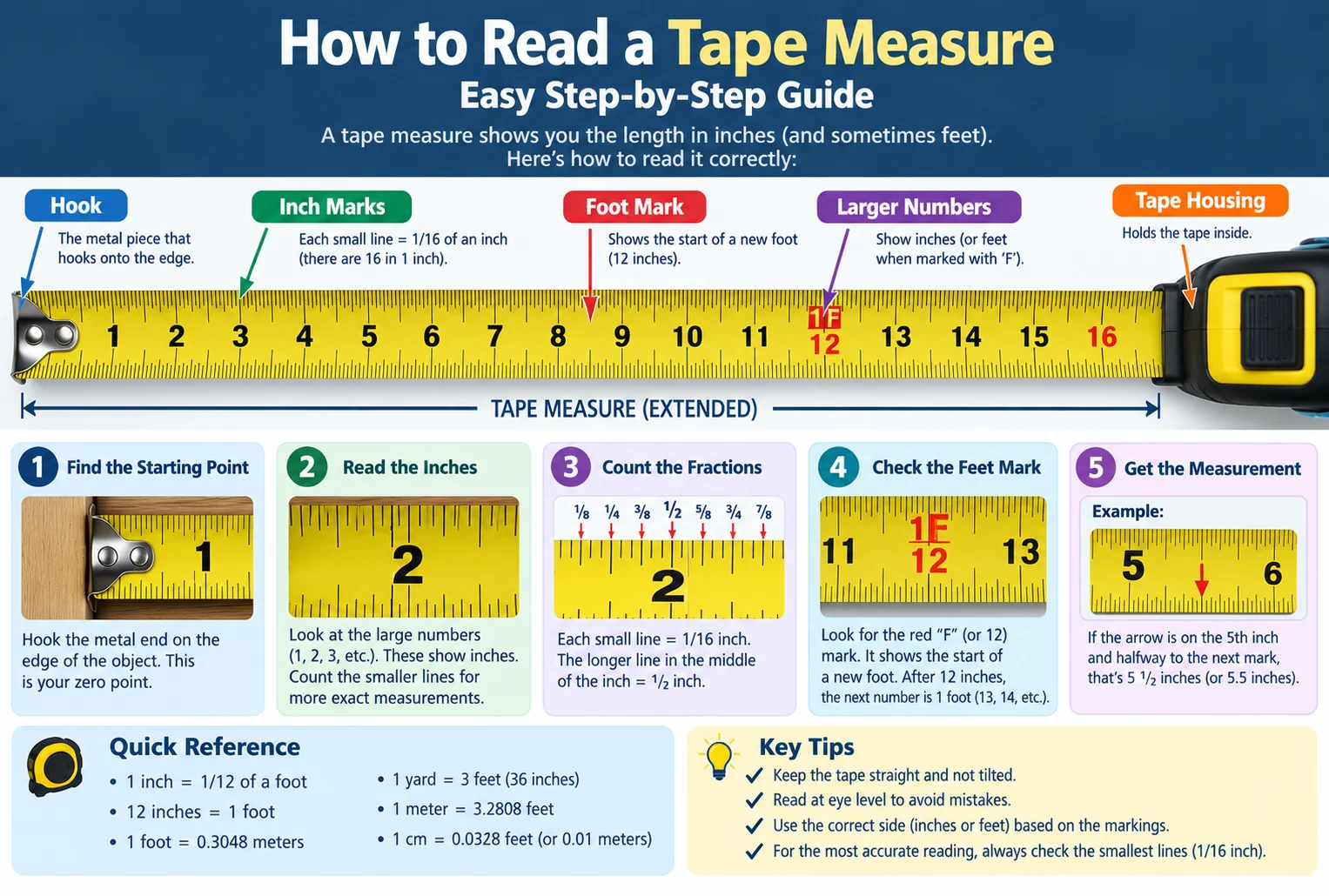
Learning how to read a tape measure is an essential skill for DIY projects, home improvement, woodworking, construction, sewing, and everyday measurements. Although a tape measure may look complicated at first, its markings follow a simple pattern.
Once you understand the numbers, longer lines, shorter lines, feet markings, and fractions of an inch, you can quickly read measurements accurately.
Quick Answer
To read a standard tape measure, first find the numbered inch measurement. Then identify the smaller lines between the inch numbers.
Most standard tape measures divide 1 inch into 16 equal parts, so the smallest common markings represent 1/16 inch.
For example:
- A long line halfway between 1 and 2 inches = 1 1/2 inches
- A line one-quarter of the way between them = 1 1/4 inches
- A line one-eighth of the way between them = 1 1/8 inches
- The smallest common line = 1/16 inch
To measure an object, place the hook at one end, extend the blade to the other end, and read the mark that lines up with the object’s edge.
What Is a Tape Measure?
A tape measure is a flexible measuring tool used to determine length, width, height, and distance. A typical retractable tape measure has a metal blade marked with measurements and a spring-loaded case.
Most tape measures used for construction and household projects show inches and feet. Some also include centimeters and millimeters on the reverse side or along another edge of the blade.
The basic parts include:
| Part | Purpose |
|---|---|
| Blade | Flexible strip containing measurement markings |
| Hook | Grabs or rests against the end of an object |
| Case | Holds the blade and internal mechanism |
| Lock | Keeps the blade extended |
| Inch markings | Show measurements in inches |
| Foot markings | Identify each 12-inch interval |
Understanding these parts makes the tape measure easier to use correctly.
Understanding the Numbers on a Tape Measure
The large numbers on a typical U.S. tape measure represent whole inches.
For example, the numbers might appear as:
1 — 2 — 3 — 4 — 5 — 6 — 7 — 8
Each number represents another inch.
If the edge of an object reaches the number 6, the measurement is 6 inches.
If it reaches a smaller line between 6 and 7, you need to identify which fraction of an inch that line represents.
How the Small Lines Work
The smaller lines between the numbered inches divide the inch into fractions.
A common tape measure divides each inch into 16 sections.
That means the smallest divisions are:
1/16 inch
The pattern can be understood like this:
| Position Within 1 Inch | Measurement |
|---|---|
| First major point | 0 in |
| 1st small division | 1/16 in |
| 2nd | 1/8 in |
| 3rd | 3/16 in |
| 4th | 1/4 in |
| 5th | 5/16 in |
| 6th | 3/8 in |
| 7th | 7/16 in |
| 8th | 1/2 in |
| 9th | 9/16 in |
| 10th | 5/8 in |
| 11th | 11/16 in |
| 12th | 3/4 in |
| 13th | 13/16 in |
| 14th | 7/8 in |
| 15th | 15/16 in |
| 16th | 1 in |
Not every tape measure uses exactly the same visual design, but this is the common 1/16-inch system.
How to Identify the Different Lines
The length of a line often helps you determine its value.
On many standard tape measures:
- The longest line represents a whole inch.
- The next prominent line often represents 1/2 inch.
- Other medium-length lines commonly represent 1/4 and 3/4 inch.
- Smaller lines represent 1/8, 3/8, 5/8, and 7/8 inch.
- The shortest lines commonly represent 1/16-inch increments.
However, the exact line lengths and visual design can vary between manufacturers, so always use the numerical pattern rather than relying only on line length.
How to Read Half-Inch Measurements
The 1/2-inch mark is directly halfway between two whole-inch numbers.
For example, halfway between 4 and 5 inches is:
4 1/2 inches
Halfway between 7 and 8 inches is:
7 1/2 inches
| Tape Measure Position | Reading |
|---|---|
| Between 1 and 2 | 1 1/2 in |
| Between 4 and 5 | 4 1/2 in |
| Between 7 and 8 | 7 1/2 in |
| Between 10 and 11 | 10 1/2 in |
The half-inch line is usually one of the easiest smaller markings to recognize.
How to Read Quarter-Inch Measurements
An inch contains four quarter-inch sections.
The quarter-inch marks occur at:
1/4 inch, 1/2 inch, and 3/4 inch
For example, between 3 and 4 inches:
- First quarter = 3 1/4 inches
- Halfway = 3 1/2 inches
- Third quarter = 3 3/4 inches
- Next whole number = 4 inches
The quarter-inch marks are useful for many woodworking, crafting, and home-improvement measurements.
How to Read Eighth-Inch Measurements
If your tape measure uses 1/8-inch markings, each inch contains eight sections.
The common eighth-inch measurements are:
1/8, 1/4, 3/8, 1/2, 5/8, 3/4, and 7/8 inch
For example, a mark three small eighths beyond 5 inches is:
5 3/8 inches
Understanding eighths becomes much easier when you remember that:
2/8 = 1/4
and
4/8 = 1/2
How to Read Sixteenth-Inch Measurements
Many tape measures use 1/16-inch increments for more precise measurements.
There are 16 sixteenths in one inch:
1 inch = 16/16 inch
Some fractions can be simplified.
| Sixteenths | Simplified Measurement |
|---|---|
| 2/16 | 1/8 |
| 4/16 | 1/4 |
| 6/16 | 3/8 |
| 8/16 | 1/2 |
| 10/16 | 5/8 |
| 12/16 | 3/4 |
| 14/16 | 7/8 |
| 16/16 | 1 |
For example, if the blade reaches the sixth-smallest division after 4 inches, the measurement is 4 3/8 inches, because 6/16 simplifies to 3/8.
How to Read Feet on a Tape Measure
Most construction tape measures include feet as well as inches.
Because:
1 foot = 12 inches
a measurement of 24 inches is:
2 feet
A measurement of 36 inches is:
3 feet
Some tape measures display a special marking at every 12-inch interval to make feet easier to identify.
| Inches | Feet |
|---|---|
| 12 in | 1 ft |
| 24 in | 2 ft |
| 36 in | 3 ft |
| 48 in | 4 ft |
| 60 in | 5 ft |
| 72 in | 6 ft |
| 84 in | 7 ft |
| 96 in | 8 ft |
| 120 in | 10 ft |
How to Read Feet and Inches Together
Longer measurements are commonly written as feet and inches.
For example:
5 feet 7 inches
means:
5 ft + 7 in
Since 1 foot contains 12 inches, 5 feet equals 60 inches.
Therefore:
60 + 7 = 67 inches
So:
5 ft 7 in = 67 inches
This is useful when measuring rooms, walls, doors, furniture, lumber, and other large objects.
How to Measure Something With a Tape Measure
Follow these steps when measuring an object.
Step 1: Find the Starting Point
Place the metal hook at the beginning of the object you are measuring.
For example, when measuring a board, place the hook against one end.
Step 2: Extend the Blade
Pull the tape measure across the object until it reaches the opposite end.
Keep the blade reasonably straight rather than allowing it to bend or curve.
Step 3: Lock the Blade
If you need both hands, use the tape measure’s locking mechanism to keep the blade in position.
Step 4: Find the Ending Point
Look at the measurement where the opposite edge of the object meets the blade.
Step 5: Read the Fraction
If the object does not end exactly on a whole inch, identify the smaller line closest to its edge.
For example, if the edge falls at the eighth-inch mark after 8 inches, the measurement is:
8 1/8 inches
How to Read a Tape Measure Example
Suppose you are measuring a piece of wood and the end reaches the third small division after 12 inches.
If the tape uses sixteenth-inch markings, the measurement is:
12 3/16 inches
If it reaches the halfway mark after 12 inches, it is:
12 1/2 inches
If it reaches the quarter-inch mark after 12 inches, it is:
12 1/4 inches
The key is to identify the whole-inch number first and then determine the fraction.
Common Tape Measure Fractions
These are the fractions you are most likely to encounter.
| Fraction | Decimal |
|---|---|
| 1/16 in | 0.0625 in |
| 1/8 in | 0.125 in |
| 3/16 in | 0.1875 in |
| 1/4 in | 0.25 in |
| 5/16 in | 0.3125 in |
| 3/8 in | 0.375 in |
| 7/16 in | 0.4375 in |
| 1/2 in | 0.5 in |
| 9/16 in | 0.5625 in |
| 5/8 in | 0.625 in |
| 11/16 in | 0.6875 in |
| 3/4 in | 0.75 in |
| 13/16 in | 0.8125 in |
| 7/8 in | 0.875 in |
| 15/16 in | 0.9375 in |
You do not necessarily need to memorize every decimal value. For most physical measurements, recognizing the fraction directly is easier.
What Do the Numbers in Red Mean on a Tape Measure?
Some tape measures use red numbers or markings for specific intervals. The exact meaning varies by manufacturer and model.
For example, some construction tape measures highlight certain measurements, such as every 16 inches, because 16-inch spacing is commonly used for wall studs.
Do not assume every red marking has the same meaning. Check the manufacturer’s markings or instructions if a particular symbol is unclear.
What Are the Black Diamonds on a Tape Measure?
Some construction tape measures have small black diamond markings at certain intervals.
These may indicate common construction spacing, particularly for trusses or other framing applications.
The exact spacing and meaning can vary depending on the tape measure, so these markings should not automatically be treated as universal measurement standards.
For ordinary measuring, focus on the numbered inches and fractional markings unless you specifically need the special construction markings.
What Are the Small Symbols on a Tape Measure?
Tape measures can include various symbols, colors, diamonds, arrows, and other markings.
Their meaning depends on the manufacturer.
Common purposes include:
- Stud-spacing references
- Construction layout references
- Foot indicators
- Special measurement intervals
- Product or certification markings
If you are unsure about a symbol, use the printed numbers and standard fraction markings for your measurement rather than guessing.
How to Read a Metric Tape Measure
Some tape measures include metric measurements such as centimeters and millimeters.
The metric side usually shows larger numbers for centimeters, while smaller divisions represent millimeters.
Remember:
1 centimeter = 10 millimeters
So, if a measurement reaches 25 centimeters and 4 millimeters, it can be written as:
25.4 cm
The metric system does not use fractions such as 1/4 or 3/8 inch in the same way as an inch-based tape measure.
Inches vs. Centimeters on a Tape Measure
Some tape measures have both systems printed on the blade.
| Measurement System | Main Unit | Smaller Common Division |
|---|---|---|
| U.S. customary | Inch | Fraction of an inch |
| Metric | Centimeter | Millimeter |
If you need to work in inches, use the inch scale. If you need metric measurements, use the centimeter and millimeter scale.
Avoid accidentally reading one side while thinking you are using the other.
How to Read a Tape Measure Accurately
Small mistakes can create problems when cutting wood, installing flooring, hanging cabinets, or completing other projects.
Use these techniques for better accuracy:
- Keep the blade straight.
- Make sure the hook is positioned correctly.
- Read the exact line at the object’s edge.
- Look directly at the measurement rather than viewing it from an angle.
- Use the same unit throughout the project.
- Double-check important measurements before cutting.
- Write down measurements immediately when working on multiple pieces.
The traditional advice “measure twice, cut once” is especially useful for construction and woodworking.
Common Mistakes When Reading a Tape Measure
Counting the Lines Incorrectly
One of the most common beginner mistakes is assuming every small line represents 1/8 inch or 1/4 inch.
Check how the inch is divided before reading the measurement.
Confusing 1/2 and 1/4 Inch
The half-inch mark is directly in the middle of two whole-inch numbers.
The quarter-inch marks are halfway between the whole-inch mark and the half-inch mark.
Forgetting the Whole Number
A measurement should include both the whole inches and the fraction.
For example, do not write just 3/8 inch if the measurement actually reaches 9 3/8 inches.
Measuring at an Angle
If the blade is not straight, the measurement may not accurately represent the shortest distance between the two points.
Ignoring the Hook
The metal hook is designed to help establish the starting point. Make sure it is positioned correctly before reading the other end.
How to Read a Tape Measure for DIY Projects
Tape measures are useful for many household projects.
| Project | What You May Measure |
|---|---|
| Hanging pictures | Wall distance and spacing |
| Installing shelves | Shelf length and wall width |
| Flooring | Room length and width |
| Furniture | Height, width, and depth |
| Woodworking | Board length and cut locations |
| Curtains | Window width and height |
| Door installation | Door and opening dimensions |
| Gardening | Garden beds and outdoor areas |
For larger projects, record measurements in a consistent format such as 8 ft 4 in or 100 1/2 in.
Frequently Asked Questions
How many inches are in a foot on a tape measure?
There are 12 inches in 1 foot. A tape measure typically marks each inch individually and may highlight every 12-inch interval as a foot.
What is the smallest line on a standard tape measure?
Many standard tape measures use 1/16-inch increments, making 1/16 inch the smallest common division. However, some specialized tape measures may use finer or different markings.
How do I know if a line is 1/2 inch?
The 1/2-inch mark is exactly halfway between two whole-inch numbers.
What does 1/4 inch look like on a tape measure?
The 1/4-inch mark is one-quarter of the way between two whole-inch numbers. It is also halfway between the whole-inch mark and the 1/2-inch mark.
How do I read 3/8 inch on a tape measure?
On a tape divided into sixteenths, 3/8 inch equals 6/16 inch. Count six of the smallest divisions after the whole-inch mark.
How do I read 5/8 inch?
On a sixteenth-inch tape, 5/8 equals 10/16 inch. Count ten of the smallest divisions after the whole-inch mark.
What does 1 foot look like on a tape measure?
One foot equals 12 inches. Look for the 12-inch point, which is often specially marked on construction tape measures.
Can I use a tape measure to measure centimeters?
Yes. If your tape measure has a metric scale, you can measure in centimeters and millimeters. Check which side of the blade contains the metric markings.
Final Thoughts
Learning how to read a tape measure becomes much easier once you understand how each inch is divided. Start by identifying the whole-inch numbers, then learn to recognize the 1/2, 1/4, 1/8, and 1/16-inch markings.
For longer measurements, remember that 12 inches equal 1 foot. When precision matters, identify the smallest appropriate marking rather than estimating the measurement.
With a little practice, you can quickly and accurately read a tape measure for woodworking, construction, home improvement, crafts, and everyday measuring tasks.
Discover More Articles
How Many Feet of Lights for an 8-Foot Tree?