
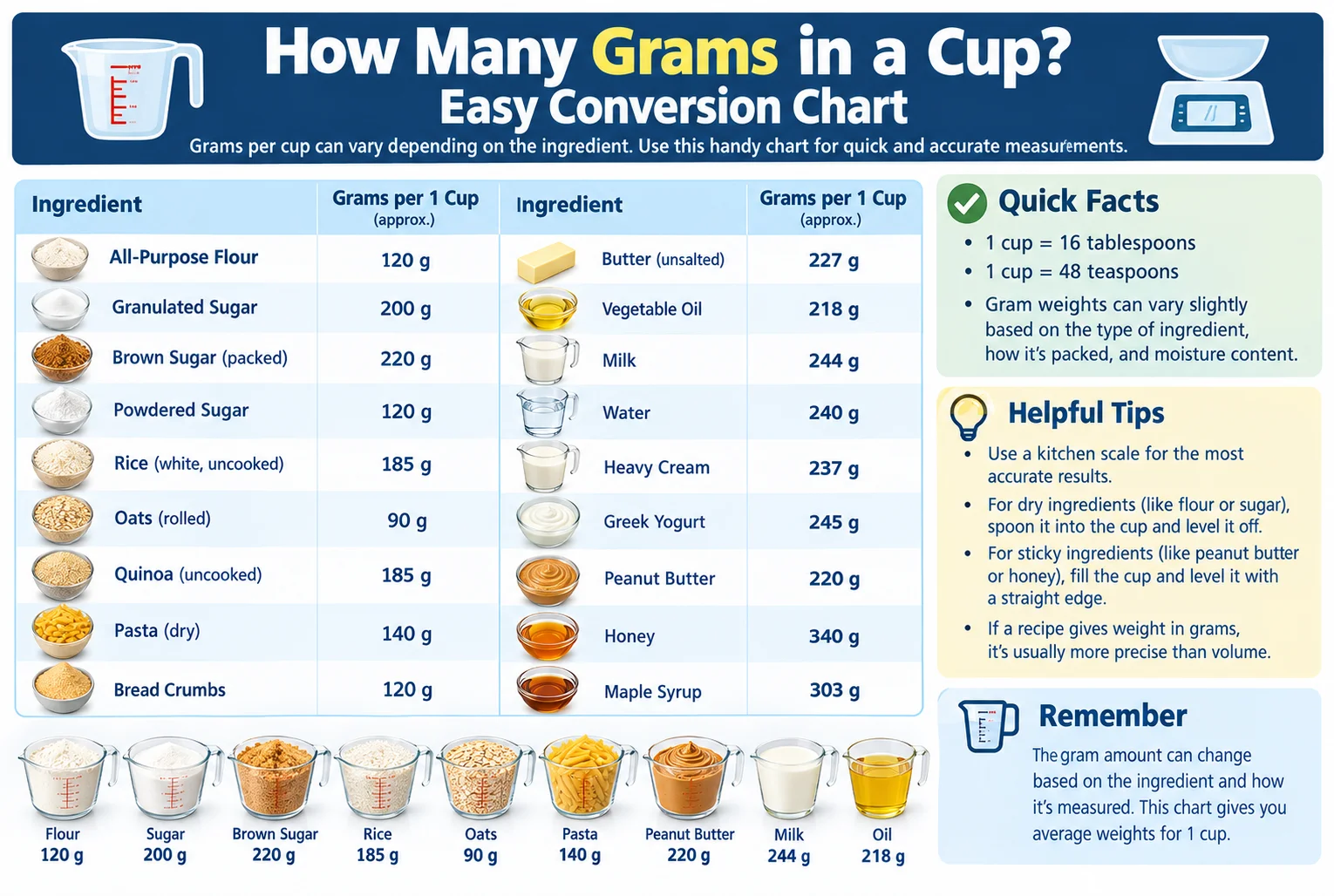
If you’re following a recipe that uses cups but your kitchen scale measures grams, knowing how to convert between the two can make cooking and baking easier. However, there is no single gram equivalent for every cup because different ingredients have different densities.
Quick Answer: How Many Grams Are in a Cup?
One U.S. customary cup holds approximately 240 milliliters, but its weight in grams depends on the ingredient.
For example, one U.S. cup weighs approximately:
- All-purpose flour: 120 grams
- Granulated sugar: 200 grams
- Packed brown sugar: 220 grams
- Water: 240 grams
- Butter: 227 grams
- Uncooked white rice: 185 grams
These are practical estimates. The exact weight can vary with the ingredient, brand, packing method, and measuring technique.
| Ingredient | Approximate Grams per U.S. Cup |
|---|---|
| All-purpose flour | 120 g |
| Granulated sugar | 200 g |
| Powdered sugar | 120 g |
| Packed brown sugar | 220 g |
| Butter | 227 g |
| Water | 240 g |
| Milk | 245 g |
| Uncooked white rice | 185 g |
| Rolled oats | 90 g |
| Honey | 340 g |
Important: These values are estimates for common cooking measurements. For precise baking, use the recipe’s specified gram weight whenever available.
Why Do Grams per Cup Vary?
A cup measures volume, while a gram measures mass. These units describe different properties, which is why the conversion depends on the ingredient.
A cup of flour contains more air between particles than a cup of packed brown sugar. Butter is denser than flour, and honey is denser than water. As a result, the same cup volume can produce very different weights.
The measuring method also matters. Scooping flour directly from a bag can compact it, while spooning flour into a measuring cup and leveling the top usually produces a lighter, more consistent measurement.
For reliable results, follow the measuring method specified by your recipe.
Cups to Grams Conversion Chart
The following chart gives approximate weights for common ingredients. Use it as a practical reference rather than a universal conversion table.
| Ingredient | ¼ Cup | ½ Cup | 1 Cup | 2 Cups |
|---|---|---|---|---|
| All-purpose flour | 30 g | 60 g | 120 g | 240 g |
| Granulated sugar | 50 g | 100 g | 200 g | 400 g |
| Powdered sugar | 30 g | 60 g | 120 g | 240 g |
| Packed brown sugar | 55 g | 110 g | 220 g | 440 g |
| Butter | 57 g | 113 g | 227 g | 454 g |
| Water | 60 g | 120 g | 240 g | 480 g |
| Milk | 61 g | 123 g | 245 g | 490 g |
| Rolled oats | 23 g | 45 g | 90 g | 180 g |
| Uncooked white rice | 46 g | 93 g | 185 g | 370 g |
| Honey | 85 g | 170 g | 340 g | 680 g |
Weights are rounded, so multiplying a rounded quarter-cup value may not always match the rounded full-cup value exactly.
How Many Grams Are in a Cup of Flour?
One U.S. cup of all-purpose flour weighs approximately 120 grams when measured using a common spoon-and-level method.
Flour measurements can vary considerably depending on how the flour is added to the cup. Scooping directly from the bag can pack in more flour, potentially making a recipe too dry.
| Flour Type | Approximate Grams per U.S. Cup |
|---|---|
| All-purpose flour | 120 g |
| Bread flour | 120–130 g |
| Whole-wheat flour | 120–130 g |
| Cake flour | 110–120 g |
| Self-rising flour | 120–125 g |
These ranges are general estimates, not fixed standards for every brand.
For best results, weigh flour with a digital kitchen scale. If using cups, lightly spoon the flour into the cup and level it without pressing it down.
How Many Grams Are in a Cup of Sugar?
Sugar weight varies by type because crystal size and packing affect how much fits into a cup.
| Sugar Type | Approximate Grams per U.S. Cup |
|---|---|
| Granulated white sugar | 200 g |
| Packed brown sugar | 220 g |
| Powdered sugar | 120 g |
| Raw or turbinado sugar | 180–220 g |
Brown sugar is usually measured firmly packed, while powdered sugar is often measured after loosening it and removing large lumps. Follow the specific instructions in your recipe.
How Many Grams Are in a Cup of Butter?
One U.S. cup of butter weighs approximately 227 grams.
Butter is relatively easy to measure because many packages include tablespoon and cup markings. In the United States, one standard stick of butter typically weighs 113.4 grams, so two sticks are approximately one cup.
| Butter Measurement | Approximate Weight |
|---|---|
| 1 tablespoon | 14 g |
| ¼ cup | 57 g |
| ½ cup | 113 g |
| 1 cup | 227 g |
| 2 cups | 454 g |
These conversions are useful for cakes, cookies, pastries, and other recipes.
How Many Grams Are in a Cup of Water or Milk?
Water is a particularly simple example because one milliliter of water weighs approximately one gram under ordinary conditions.
A U.S. cup holds about 236.6 milliliters under the U.S. customary definition, which corresponds to approximately 237 grams of water. Many cooking charts round a cup to 240 milliliters and 240 grams.
Milk weighs slightly more than the same volume of water because its density is a little higher.
| Liquid | Approximate Grams per U.S. Cup |
|---|---|
| Water | 237–240 g |
| Whole milk | 240–245 g |
| Vegetable oil | 218–220 g |
| Honey | 335–340 g |
| Maple syrup | 315–325 g |
For a precise conversion, use the volume standard and ingredient density specified by the recipe or product.
How to Convert Cups to Grams
To convert cups to grams, you need the ingredient’s approximate weight per cup.
Formula:
Grams = Cups × Grams per Cup
For example, if one cup of all-purpose flour weighs approximately 120 grams:
2 cups × 120 g = 240 g
Therefore, two cups of all-purpose flour weigh approximately 240 grams.
Here are a few more examples:
| Ingredient | Amount | Calculation | Approximate Weight |
|---|---|---|---|
| All-purpose flour | 1½ cups | 1.5 × 120 g | 180 g |
| Granulated sugar | 2 cups | 2 × 200 g | 400 g |
| Butter | ½ cup | 0.5 × 227 g | 113.5 g |
| Water | 3 cups | 3 × 240 g | 720 g |
| Rolled oats | 2 cups | 2 × 90 g | 180 g |
Always use the conversion for the ingredient you are measuring rather than applying one gram value to every cup.
How Many Grams Are in Different Cup Measurements?
The following chart shows common cup fractions and their milliliter equivalents for U.S. customary cups. The gram weight still depends on the ingredient.
| Cup Measurement | Approximate Milliliters |
|---|---|
| ⅛ cup | 30 mL |
| ¼ cup | 59 mL |
| ⅓ cup | 79 mL |
| ½ cup | 118 mL |
| ⅔ cup | 158 mL |
| ¾ cup | 177 mL |
| 1 cup | 237 mL |
| 1½ cups | 355 mL |
| 2 cups | 473 mL |
| 4 cups | 946 mL |
Some recipes and measuring tools use a rounded 240 mL cup. Metric cups are also commonly defined as 250 mL in some countries. Check the recipe’s measurement system when accuracy matters.
Tips for Accurate Cup-to-Gram Measurements
- Use a digital kitchen scale: Weighing ingredients is generally more accurate than measuring by volume.
- Check the ingredient type: One cup of flour does not weigh the same as one cup of sugar.
- Follow packing instructions: Brown sugar is often packed, while flour is usually spooned and leveled.
- Use the correct cup standard: A U.S. cup and a 250 mL metric cup are different volumes.
- Avoid estimating for precision baking: Small measurement differences can affect texture, rise, and consistency.
- Tare the scale: Place your container on the scale and reset it to zero before adding an ingredient.
Common Conversion Mistakes
Assuming Every Cup Equals 240 Grams
A cup is a volume measurement, not a fixed weight. Water weighs close to 240 grams in a rounded 240 mL cup, but flour, sugar, butter, and other ingredients have different weights.
Confusing U.S. Cups With Metric Cups
A U.S. customary cup is about 236.6 mL, while a metric cup is often 250 mL. Using the wrong standard can change the amount in a recipe.
Packing Ingredients Incorrectly
Packing flour tightly or failing to pack brown sugar when required can alter the measured quantity.
Using Fluid Ounces as Weight Ounces
Fluid ounces measure volume, while grams measure mass. Converting liquid volume into grams requires the liquid’s density; the conversion is not universally one-to-one.
FAQs
1. How many grams are in 1 cup?
It depends on the ingredient. One U.S. cup of water weighs approximately 237–240 grams, while one cup of all-purpose flour weighs about 120 grams and one cup of granulated sugar about 200 grams.
2. How many grams are in 2 cups?
The answer depends on what you’re measuring. Two U.S. cups of all-purpose flour weigh approximately 240 grams, while two cups of granulated sugar weigh about 400 grams.
3. How many grams are in a cup of all-purpose flour?
One U.S. cup of all-purpose flour weighs approximately 120 grams when measured using a common spoon-and-level method.
4. How many grams are in a cup of sugar?
One U.S. cup of granulated white sugar weighs approximately 200 grams. Packed brown sugar weighs about 220 grams per cup.
5. Is 1 cup always 250 grams?
No. A cup measures volume, and its weight depends on the ingredient. Also, the cup itself may hold about 237 mL under the U.S. customary standard or 250 mL under a common metric standard.
6. How can I convert cups to grams without a scale?
Use an ingredient-specific conversion chart and a standardized measuring cup. Keep in mind that this method is less precise than weighing ingredients, especially for flour and other dry baking ingredients.
7. How many grams are in a cup of rice?
One U.S. cup of uncooked white rice weighs approximately 185 grams, although the exact amount depends on the rice variety and how it is measured.
8. Why do baking recipes use grams instead of cups?
Grams provide a consistent measure of ingredient mass. Cups can produce different weights depending on how an ingredient is scooped, packed, or leveled, so weighing is often preferred for precise baking.
Conclusion
There is no single gram equivalent for every cup. A U.S. cup of all-purpose flour weighs about 120 grams, granulated sugar about 200 grams, butter about 227 grams, and water about 237–240 grams.
For the most accurate cooking and baking results, use an ingredient-specific conversion chart or weigh ingredients with a digital kitchen scale.
Discover More Articles
How Many Feet of Lights for an 8-Foot Tree?