
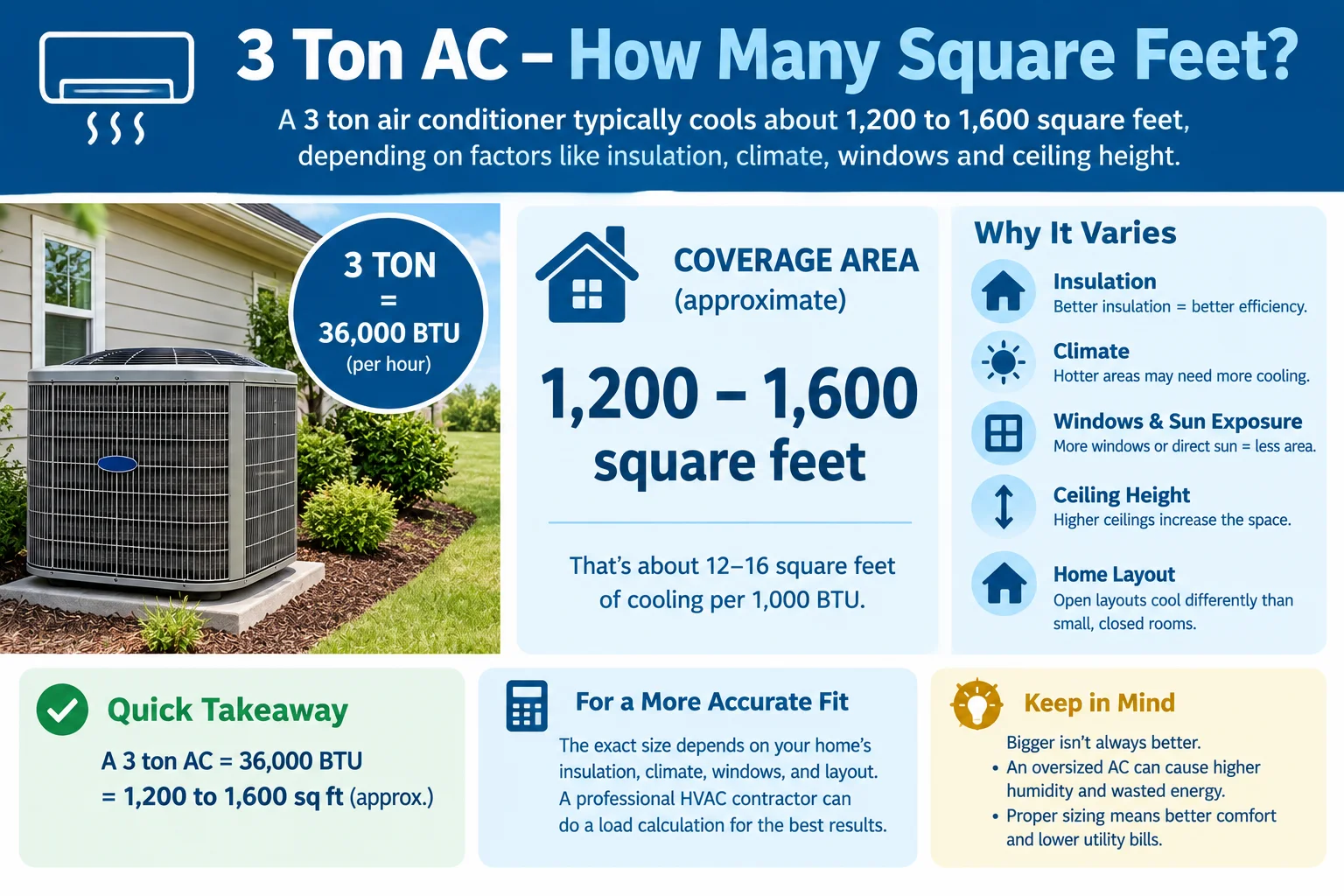
A 3-ton air conditioner can typically cool approximately 1,500 to 2,000 square feet, although the appropriate coverage depends on your climate, insulation, windows, ceiling height, and home’s layout. In hotter climates or poorly insulated homes, the same unit may need to serve a smaller area.
Choosing the correct AC size helps maintain comfortable indoor temperatures, manage humidity, and avoid unnecessary energy use.
Quick Answer
A 3-ton AC typically covers around 1,500–2,000 square feet under common residential conditions. This is a preliminary estimate, not a guaranteed coverage range.
A 3-ton air conditioner provides a nominal cooling capacity of 36,000 BTU per hour.
| Measurement | Value |
|---|---|
| AC capacity | 3 tons |
| Cooling capacity | 36,000 BTU/h |
| Approximate coverage | 1,500–2,000 sq ft |
| Metric area equivalent | About 139–186 m² |
| Best sizing method | Professional cooling-load calculation |
A home with strong insulation, efficient windows, and moderate outdoor temperatures may require less cooling than a similar-sized home exposed to intense sunlight or extreme heat.
What Does a 3-Ton AC Mean?
The term “ton” in air conditioning refers to cooling capacity, not the physical weight of the unit. It comes from the historical amount of heat required to melt one ton of ice over 24 hours.
In modern HVAC sizing, one ton of cooling equals 12,000 BTU per hour.
Therefore:
3 tons × 12,000 BTU/h = 36,000 BTU/h
This means a 3-ton AC is rated to remove approximately 36,000 British thermal units of heat per hour under its specified rating conditions.
The rating helps compare equipment capacity, but it does not tell you exactly how many square feet a unit can cool in every building. Two homes with the same floor area can have substantially different cooling requirements.
3-Ton AC Square-Foot Coverage Chart
The following table provides preliminary estimates for different home sizes and conditions. These figures are planning guidelines rather than official equipment-sizing recommendations.
| Home Size | Is a 3-Ton AC a Possible Fit? | Important Consideration |
|---|---|---|
| 1,000 sq ft | Possibly oversized | A smaller unit may be sufficient |
| 1,200 sq ft | Possibly oversized | Check the home’s cooling load |
| 1,500 sq ft | Often worth considering | Climate and insulation matter |
| 1,750 sq ft | Within the typical estimate | Check windows, layout, and heat gain |
| 2,000 sq ft | May be suitable | A load calculation is important |
| 2,250 sq ft | May be undersized in some homes | Lower heat gain may make a difference |
| 2,500 sq ft | Often requires more capacity | Confirm with a professional calculation |
| 3,000 sq ft | Usually beyond the basic estimate | A larger or zoned system may be needed |
These examples assume a typical residential building. They do not account for every climate, building type, or design condition.
For example, a well-insulated 2,000-square-foot home in a mild climate may have a lower cooling load than a poorly insulated 1,500-square-foot home in an extremely hot region.
Factors That Affect a 3-Ton AC’s Coverage
Square footage is useful for an initial estimate, but several other factors determine whether a 3-ton unit can cool a space effectively.
1. Climate and Outdoor Temperature
Climate is one of the biggest influences on AC sizing. Homes in hot regions experience greater heat gain and may require more cooling capacity than homes in milder climates.
High outdoor temperatures also affect the operating conditions and performance of air conditioning equipment. Always consider the manufacturer’s rated performance for your climate.
2. Insulation Quality
Good insulation slows the transfer of heat through walls, ceilings, and roofs. This helps reduce the cooling load.
A well-insulated home may be able to maintain comfortable temperatures with less capacity than a similar home with poorly insulated walls or an uninsulated attic.
Air leaks around doors, windows, and other openings can also increase the cooling load.
3. Windows and Sunlight
Large windows can allow substantial heat into a home, particularly when they face the afternoon sun.
The type of glass, window coverings, external shading, and window orientation all affect heat gain. A room with large, unshaded windows may need more cooling than an otherwise similar room with shaded, efficient windows.
4. Ceiling Height
Floor area does not account for the full volume of indoor space.
For example, a 1,800-square-foot home with 8-foot ceilings has a different indoor volume from the same floor area with 12-foot ceilings. Higher ceilings can increase the amount of air and surrounding surfaces that need to be cooled, although the actual effect depends on the building and airflow.
5. Number of Occupants and Appliances
People, cooking equipment, computers, lighting, and other appliances generate heat.
A kitchen, busy office, or room with several computers may have a greater cooling requirement than a lightly occupied bedroom of the same size.
6. Home Layout and Airflow
An AC system must distribute cool air throughout the areas it serves. Long duct runs, poorly designed ducts, closed-off rooms, and insufficient airflow can affect comfort.
An open-plan home may distribute air differently from a house with many separate rooms. In some cases, zoning or adjustments to the ductwork may be more useful than simply increasing AC capacity.
Is a 3-Ton AC Enough for a 2,000-Square-Foot House?
A 3-ton AC may be appropriate for a 2,000-square-foot house, but square footage alone cannot confirm that it is the correct size.
The answer depends on the amount of heat entering the home and the system’s ability to distribute cool air.
A 3-ton unit may be a reasonable candidate when the home has:
- Effective wall and attic insulation
- Energy-efficient windows
- Limited air leakage
- Appropriate ceiling heights
- Properly designed ductwork
- A cooling load within the unit’s rated capacity
A 3-ton system may struggle if the house has poor insulation, significant afternoon sun exposure, unusually high ceilings, or substantial air leakage. Conversely, it may be oversized for a well-shaded, highly efficient home in a mild climate.
The best way to confirm the size is to have the cooling load calculated, typically using an HVAC Manual J calculation for residential buildings. This considers the home’s construction, location, windows, orientation, occupancy, and other heat-gain factors.
Signs Your AC Is Too Large or Too Small
Incorrect AC sizing can affect comfort, humidity control, and energy consumption.
| Sign | Possible Explanation |
|---|---|
| Rooms remain warm during hot weather | Insufficient capacity, airflow problems, or excessive heat gain |
| AC runs almost continuously | High cooling load, undersizing, poor airflow, or extreme weather |
| AC turns on and off frequently | Possible oversizing, thermostat issues, or other system problems |
| Indoor humidity remains high | Short cycling, incorrect sizing, or a drainage/maintenance issue |
| Some rooms are colder than others | Ductwork, balancing, insulation, or airflow problems |
| Energy bills are unexpectedly high | Poor efficiency, maintenance issues, incorrect sizing, or high cooling demand |
These signs do not automatically mean that the AC tonnage is wrong. Dirty filters, refrigerant problems, blocked vents, duct leaks, and thermostat settings can produce similar symptoms.
If the system is not performing as expected, have the equipment and airflow checked before deciding to replace it with a different size.
How to Choose the Right AC Size
Follow these steps when determining whether a 3-ton AC is suitable for your home.
Step 1: Measure the Conditioned Area
Measure the length and width of each room that the AC will serve. For a rectangular room:
Area = Length × Width
Add the areas of the rooms included in the cooling system. Exclude areas that are not conditioned by that system, such as a detached garage.
Step 2: Assess the Building
Consider insulation, window size, sun exposure, ceiling height, air leakage, and the home’s layout. These features help explain why two homes with the same square footage may need different equipment.
Step 3: Consider the Local Climate
A home in a hot, humid region may have different cooling and moisture-removal requirements from a home in a dry or mild region. Equipment performance and design conditions should match the installation location.
Step 4: Check the Equipment Specifications
Review the manufacturer’s cooling-capacity information, efficiency ratings, and operating conditions. The nominal 3-ton rating is a useful starting point, but actual performance can vary with system design and conditions.
Step 5: Request a Cooling-Load Calculation
For a reliable recommendation, ask a qualified HVAC professional to calculate the building’s cooling load. The calculation can help determine the required capacity and identify whether one system, multiple systems, or zoning is appropriate.
Avoid selecting an AC solely from a square-foot chart. A properly sized system is more likely to provide consistent comfort and humidity control.
FAQs
1. How many square feet can a 3-ton AC cool?
A 3-ton AC can often cool approximately 1,500–2,000 square feet in typical residential conditions. The exact area depends on climate, insulation, windows, ceiling height, and the building’s cooling load.
2. How many BTUs are in a 3-ton AC?
A 3-ton air conditioner has a nominal capacity of 36,000 BTU per hour. This comes from multiplying 3 tons by 12,000 BTU/h per ton.
3. Is a 3-ton AC enough for 1,500 square feet?
It may be sufficient and could be oversized in some homes. A professional cooling-load calculation is the best way to determine the required capacity.
4. Can a 3-ton AC cool 2,500 square feet?
It may be insufficient for a 2,500-square-foot home under many conditions, but the answer depends on the building’s heat gain and local climate. Do not assume a larger unit is necessary without calculating the load.
5. Is a 3-ton AC more powerful than a 2-ton AC?
Yes. A 3-ton unit has a nominal capacity of 36,000 BTU/h, compared with 24,000 BTU/h for a 2-ton unit. That is 50% more nominal cooling capacity, although actual performance depends on the equipment and operating conditions.
6. Does a 3-ton AC use more electricity than a 2-ton AC?
A 3-ton unit can use more electricity when operating at comparable efficiency and conditions because it provides more cooling capacity. Actual energy consumption depends on efficiency, runtime, outdoor temperature, maintenance, and the home’s cooling demand.
7. Can an oversized 3-ton AC cause problems?
An oversized system may cool the thermostat area quickly and shut off before running long enough to remove sufficient moisture. This can contribute to short cycling, uneven temperatures, and reduced humidity control. Variable-capacity equipment and system design can affect these outcomes.
8. How do I know if my home needs a 3-ton AC?
Start with the home’s square footage, but also consider insulation, windows, ceiling height, climate, and airflow. A qualified HVAC professional can perform a load calculation to determine whether a 3-ton system is appropriate.
Conclusion
A 3-ton AC can typically cool around 1,500–2,000 square feet, equivalent to approximately 139–186 square meters, under common residential conditions. Its nominal cooling capacity is 36,000 BTU per hour.
However, this range is only a starting estimate. Climate, insulation, windows, ceiling height, and airflow all affect the amount of cooling a home needs. For the most reliable result, choose the system based on a professional cooling-load calculation rather than square footage alone.
Discover More Articles
How Many Feet of Christmas Lights for a 6-Foot Tree?