
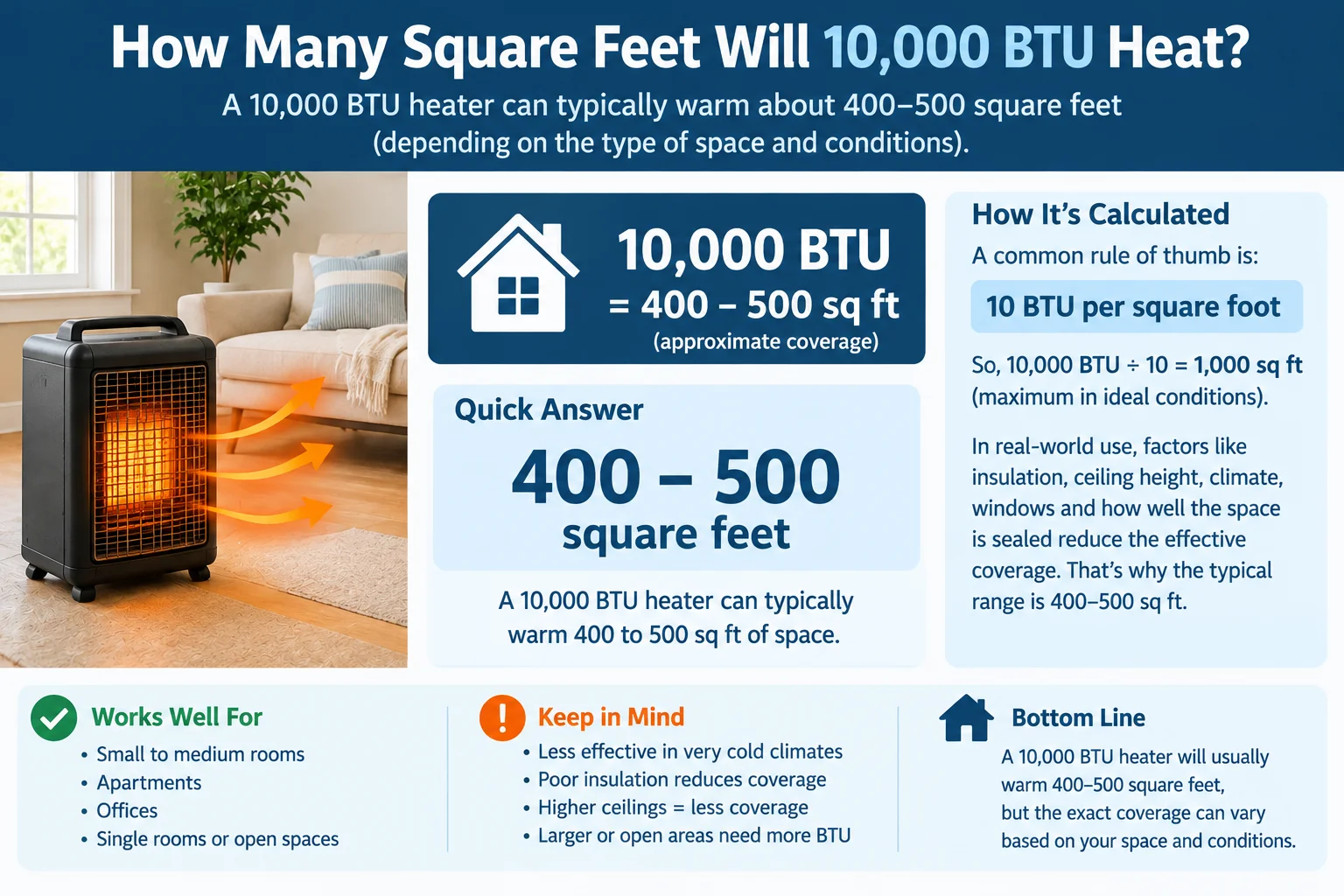
A 10,000 BTU heater can provide enough heat for a small to medium-sized room, but the exact area depends on insulation, outdoor temperatures, ceiling height, windows, and the room’s overall heat loss. Choosing the right heater size helps keep your space comfortable without wasting energy.
As a general estimate, a 10,000 BTU-per-hour heater can heat approximately 300–500 square feet under many typical conditions. In a well-insulated room in a mild climate, it may cover more space. In a poorly insulated room or a very cold climate, it may heat a smaller area.
Quick Answer: How Many Square Feet Will 10,000 BTU Heat?
A 10,000 BTU/hour heater may heat approximately 300–500 square feet, depending on the room and climate.
| Room Conditions | Approximate Area a 10,000 BTU/Hour Heater May Heat |
|---|---|
| Well-insulated room in a mild climate | 400–500+ sq ft |
| Average insulation and moderate weather | 300–500 sq ft |
| Poor insulation or drafty windows | 200–300 sq ft |
| Very cold climate or high heat loss | Potentially less than 200–300 sq ft |
These figures are preliminary estimates, not guaranteed coverage ratings. A heater’s actual capacity should be matched to the room’s heating requirements and the manufacturer’s guidance.
Important: BTU measures energy, while BTU per hour (BTU/h) describes a heating rate. Most space-heater ratings of 10,000 BTU refer to approximately 10,000 BTU per hour.
How to Calculate the Heating Area for 10,000 BTU
One simple way to estimate the room size is to divide the heater’s hourly output by the estimated heating requirement per square foot.
The formula is:
Heated area = Heater output in BTU/hour ÷ Heating requirement per square foot
For example, if you use a preliminary estimate of 20 BTU per hour per square foot:
10,000 ÷ 20 = 500 square feet.
This means a 10,000 BTU/hour heater may be suitable for a 500-square-foot room under those assumed conditions.
However, 20 BTU per square foot is only a rule of thumb. Actual heating requirements can be substantially higher or lower, so a proper heating-load calculation is more reliable.
Example Calculations
| Estimated Heating Requirement | Calculation | Estimated Coverage |
|---|---|---|
| 15 BTU/hour per sq ft | 10,000 ÷ 15 | 667 sq ft |
| 20 BTU/hour per sq ft | 10,000 ÷ 20 | 500 sq ft |
| 25 BTU/hour per sq ft | 10,000 ÷ 25 | 400 sq ft |
| 30 BTU/hour per sq ft | 10,000 ÷ 30 | 333 sq ft |
| 40 BTU/hour per sq ft | 10,000 ÷ 40 | 250 sq ft |
The heating requirements in this table are illustrative assumptions, not universal standards. Use them to understand how heat loss affects coverage rather than as a substitute for a professional heating calculation.
What Room Sizes Can a 10,000 BTU Heater Heat?
The following examples show how a 10,000 BTU/hour heater compares with common room sizes.
| Room Dimensions | Total Area | Is 10,000 BTU/Hour Potentially Enough? |
|---|---|---|
| 10 × 10 ft | 100 sq ft | Usually more than sufficient under typical conditions |
| 10 × 15 ft | 150 sq ft | Likely sufficient in many conditions |
| 12 × 15 ft | 180 sq ft | Often sufficient, depending on heat loss |
| 15 × 20 ft | 300 sq ft | May be sufficient with suitable insulation |
| 20 × 20 ft | 400 sq ft | Could work in moderate conditions |
| 20 × 25 ft | 500 sq ft | Depends heavily on insulation and climate |
| 25 × 25 ft | 625 sq ft | May be insufficient in many conditions |
| 20 × 30 ft | 600 sq ft | Requires careful evaluation of heating needs |
These examples assume a single room with a reasonably typical ceiling height. Open layouts, adjoining rooms, large windows, high ceilings, and air leaks can change the result considerably.
What Factors Affect How Much Area 10,000 BTU Can Heat?
Several factors determine whether a 10,000 BTU/hour heater can maintain a comfortable temperature.
1. Insulation Quality
Insulation slows heat transfer through walls, ceilings, and floors. A well-insulated room retains warmth longer, allowing the heater to maintain the desired temperature more easily.
A poorly insulated room loses heat faster. Even a relatively powerful heater may struggle to keep it warm when outdoor temperatures drop.
2. Outdoor Temperature and Climate
A room in a mild climate generally needs less heating than a similarly sized room in a region with freezing winter temperatures.
For example, a 400-square-foot room may be comfortable with a 10,000 BTU/hour heater during mild weather but require additional heating capacity in severe cold.
3. Ceiling Height
Room area alone does not tell the whole story. A room with a 10-foot ceiling contains more air than a room of the same floor area with an 8-foot ceiling.
| Room Dimensions | Ceiling Height | Room Volume |
|---|---|---|
| 20 × 20 ft | 8 ft | 3,200 cubic ft |
| 20 × 20 ft | 10 ft | 4,000 cubic ft |
| 20 × 20 ft | 12 ft | 4,800 cubic ft |
Higher ceilings can increase heating demand, especially in spaces where warm air collects near the ceiling.
4. Windows and Doors
Large windows, exterior doors, and air leaks can increase heat loss. Older or poorly sealed windows may allow cold air to enter and warm air to escape.
Weatherstripping, properly sealed gaps, and suitable window coverings can help reduce heat loss, although they cannot replace adequate heating capacity.
5. Room Layout
A closed room is generally easier to estimate than a large open-plan area connected to hallways or other rooms. Heat can spread into adjoining spaces, increasing the area the heater must serve.
6. Heater Efficiency and Type
A heater’s rated output, efficiency, and installation all matter. A product rated at 10,000 BTU/hour may specify input capacity rather than useful heat output, particularly for some fuel-burning appliances.
Check whether the manufacturer lists BTU input, heating output, or a recommended room size. Do not assume every 10,000 BTU appliance delivers the same amount of usable heat.
Is 10,000 BTU Enough for a Bedroom?
For many ordinary bedrooms, a 10,000 BTU/hour heater may provide more than enough capacity. However, the right size depends on the room’s area, insulation, and climate.
| Bedroom Size | General Assessment |
|---|---|
| 100–150 sq ft | Often more capacity than necessary |
| 150–250 sq ft | May be suitable, depending on conditions |
| 250–350 sq ft | Can work in many moderately insulated rooms |
| 350–500 sq ft | Requires more attention to heat loss |
| Over 500 sq ft | May need additional capacity in colder conditions |
Do not automatically select the largest heater available. Oversized heaters may cause uncomfortable temperature swings or cycle frequently, depending on the appliance and its controls.
For a bedroom, also consider noise, thermostat control, clearances, and whether the heater is approved for unattended operation. Follow the manufacturer’s instructions, particularly when using a portable electric or fuel-burning heater.
Is 10,000 BTU Enough for a Living Room?
A 10,000 BTU/hour heater can be suitable for some living rooms, particularly those measuring around 300–400 square feet with reasonable insulation. Larger rooms may require more capacity.
Consider a living room measuring 20 × 20 feet.
- Length: 20 feet
- Width: 20 feet
- Area: 20 × 20 = 400 square feet
- Heater output: 10,000 BTU/hour
Using the illustrative assumption of 25 BTU/hour per square foot:
400 × 25 = 10,000 BTU/hour.
Under that assumption, the heater’s rated output matches the estimated demand. If the room has poor insulation or a high ceiling, however, the actual heating requirement may be greater.
How Does 10,000 BTU Compare With Other Heater Sizes?
Comparing heater capacities can help you identify an appropriate starting point for your room.
The following estimates use an illustrative heating requirement of 20 BTU/hour per square foot. They are not product-specific coverage ratings.
| Heater Capacity | Estimated Coverage at 20 BTU/hour per sq ft |
|---|---|
| 4,000 BTU/hour | 200 sq ft |
| 5,000 BTU/hour | 250 sq ft |
| 8,000 BTU/hour | 400 sq ft |
| 10,000 BTU/hour | 500 sq ft |
| 12,000 BTU/hour | 600 sq ft |
| 15,000 BTU/hour | 750 sq ft |
| 20,000 BTU/hour | 1,000 sq ft |
Actual coverage can differ significantly because the required heating output depends on the building and local weather. Manufacturer ratings and a room-specific heat-loss calculation should take priority over this comparison.
How to Choose the Right Heater for Your Room
Use these steps to make a more reliable decision.
- Measure the room. Multiply its length by its width to calculate square footage.
- Check the ceiling height. High ceilings may increase the heating load.
- Assess insulation and drafts. Consider exterior walls, windows, doors, and the room’s overall condition.
- Consider the coldest expected weather. Choose capacity for the conditions in which you need reliable heating.
- Check the appliance rating. Confirm whether the stated BTU figure refers to input or useful heating output.
- Follow the manufacturer’s room-size guidance. Use a professional heating-load calculation if the room is large, unusually shaped, or poorly insulated.
For permanent heating systems, a qualified HVAC professional can calculate the heat loss and recommend suitable equipment. This is especially useful for homes with multiple rooms or significant temperature differences.
Safety Tips for Using a 10,000 BTU Heater
Choosing the correct capacity is only one part of heating a room safely.
- Keep portable heaters away from curtains, bedding, furniture, and other combustible materials.
- Follow the manufacturer’s clearance requirements.
- Use electric portable heaters according to their instructions and avoid unsafe extension-cord arrangements.
- Never use an outdoor-only fuel-burning heater indoors.
- Fuel-burning heaters must be specifically approved for the intended indoor application and installed or operated according to their instructions.
- Maintain adequate ventilation where required, and install carbon monoxide alarms where fuel-burning appliances are used.
- Do not block air intakes, exhaust outlets, or vents.
- Turn off portable heaters when required by the manufacturer’s instructions, especially before leaving the room or going to sleep.
A fuel-burning heater that is unsuitable for indoor use can create a serious carbon monoxide risk. If you are unsure whether a model is approved for indoor heating, verify the product documentation before using it.
Frequently Asked Questions
1. How many square feet will a 10,000 BTU heater heat?
A 10,000 BTU/hour heater may heat approximately 300–500 square feet under typical conditions. The actual area depends on insulation, climate, ceiling height, and the appliance’s useful heat output.
2. Can a 10,000 BTU heater heat 500 square feet?
Yes, it may be able to heat 500 square feet if the room has a relatively low heating demand. Poor insulation, cold outdoor temperatures, and high ceilings may make 10,000 BTU/hour insufficient.
3. Will 10,000 BTU heat a 1,000-square-foot room?
It may not provide enough heat for a 1,000-square-foot room in many climates. At an illustrative requirement of 20 BTU/hour per square foot, that area would need about 20,000 BTU/hour. A room-specific heat-loss calculation is needed for a reliable estimate.
4. Is 10,000 BTU enough for a 300-square-foot room?
It may be sufficient for a 300-square-foot room under many conditions. Whether it can maintain a comfortable temperature depends on the room’s insulation, ceiling height, windows, and outdoor temperature.
5. Does a 10,000 BTU heater use a lot of electricity?
Not necessarily, but BTU capacity alone does not tell you an appliance’s electricity consumption. For an electric heater, check its wattage and operating time. Fuel-burning heaters have different energy-use calculations.
6. What is the difference between BTU and BTU per hour?
A BTU is a unit of heat energy. BTU per hour describes the rate at which a heater supplies heat. Room-heating capacity is usually discussed in BTU/hour.
7. Can one 10,000 BTU heater heat several rooms?
It depends on the layout and how freely air circulates between the rooms. A heater intended for one room may not distribute heat effectively through a home with closed doors, separate spaces, or long hallways.
8. How do I know if my heater is too small?
If it runs continuously but cannot maintain the desired temperature during normal operating conditions, the room may have excessive heat loss or the heater may be undersized. Check drafts, insulation, filters or vents where applicable, and the appliance’s installation before deciding that a larger unit is needed.
Conclusion
A 10,000 BTU/hour heater can generally be considered for a space of around 300–500 square feet, but the right coverage depends on the room’s heating demand. A well-insulated room may need less heat, while a drafty room or one in a very cold climate may need considerably more.
Measure the space, account for insulation and ceiling height, and check the manufacturer’s useful heat-output rating. For the most dependable result, use a heating-load calculation instead of relying on square footage alone.
Discover More Articles
How Many Feet of Christmas Lights for a 6-Foot Tree?