

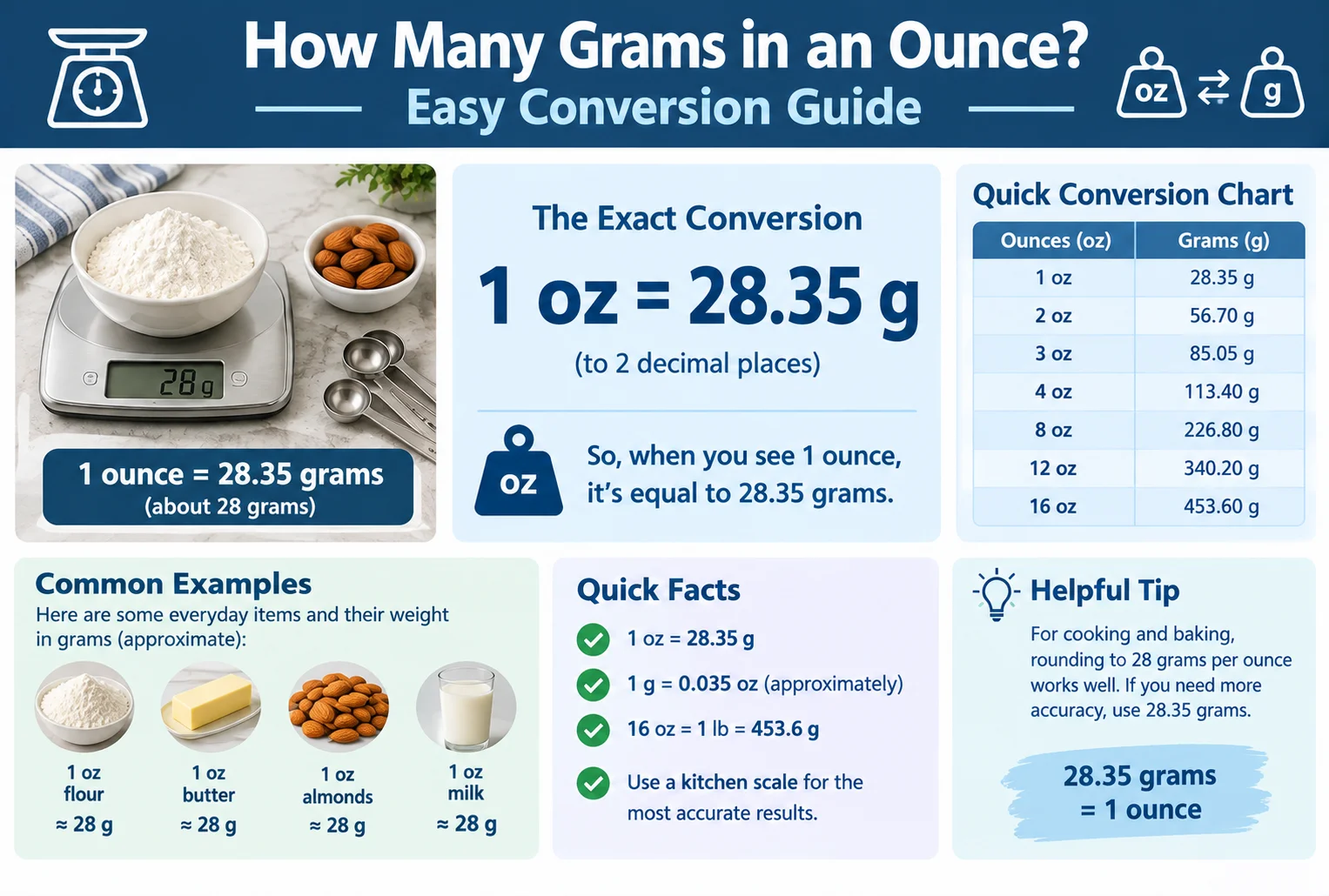
If you’re wondering how many grams are in an ounce, the answer depends on the type of ounce being measured. For ordinary weight measurements used in the United States, 1 ounce equals approximately 28.35 grams. This conversion is useful when following recipes, weighing ingredients, comparing products, or switching between the imperial and metric systems.
Quick Answer
1 standard ounce = 28.3495 grams, usually rounded to 28.35 grams.
Here are a few common conversions:
| Ounces (oz) | Grams (g) |
|---|---|
| 0.5 oz | 14.17 g |
| 1 oz | 28.35 g |
| 2 oz | 56.70 g |
| 3 oz | 85.05 g |
| 4 oz | 113.40 g |
| 5 oz | 141.75 g |
| 8 oz | 226.80 g |
| 10 oz | 283.50 g |
| 16 oz | 453.59 g |
For most everyday weight conversions, multiply the number of ounces by 28.3495 to find the equivalent weight in grams.
Understanding Ounces and Grams
Ounces and grams are units used to measure mass or weight in everyday situations. However, they belong to different measurement systems.
An ounce is commonly used in the United States and other places that use customary or imperial-style measurements. Grams are part of the metric system, which is widely used around the world.
A gram is a relatively small unit of mass. For example, a small paper clip may weigh around one gram, although the actual weight varies by design and material. An ounce is larger, equivalent to a little more than 28 grams.
The standard ounce used for most everyday weight measurements is called the avoirdupois ounce. It is commonly used for food, household goods, packaged products, and other items.
Understanding the difference between these units helps you measure accurately, especially when recipes or product labels use different measurement systems.
Ounces to Grams Conversion Chart
Use this chart to convert common ounce measurements into grams without performing the calculation yourself.
| Ounces | Grams | Common Use |
|---|---|---|
| 0.25 oz | 7.09 g | Small ingredient portions |
| 0.5 oz | 14.17 g | Half-ounce portions |
| 0.75 oz | 21.26 g | Small food servings |
| 1 oz | 28.35 g | Small packaged items |
| 1.5 oz | 42.52 g | Ingredient portions |
| 2 oz | 56.70 g | Small food portions |
| 3 oz | 85.05 g | Recipe ingredients |
| 4 oz | 113.40 g | Quarter-pound portions |
| 5 oz | 141.75 g | Food servings |
| 6 oz | 170.10 g | Meat or other ingredients |
| 8 oz | 226.80 g | Half-pound portions |
| 10 oz | 283.50 g | Packaged food |
| 12 oz | 340.19 g | Beverage or food packages |
| 16 oz | 453.59 g | One pound |
| 24 oz | 680.39 g | Larger packages |
| 32 oz | 907.18 g | Two-pound portions |
These values are rounded to two decimal places. Small differences may appear when a calculator or digital scale displays more decimal places.
Remember that the chart converts ounces by weight, not fluid ounces. Fluid ounces measure volume, so their conversion to grams depends on the substance being measured.
How to Convert Ounces to Grams
Converting ounces to grams is straightforward once you know the conversion factor.
The formula is:
Grams = Ounces × 28.3495
To use the formula, multiply the ounce measurement by 28.3495. You can round the answer to two decimal places for most everyday purposes.
Example 1: Convert 2 Ounces to Grams
Suppose a recipe requires 2 ounces of an ingredient.
Calculation:
2 × 28.3495 = 56.699 grams
Answer: 2 ounces equals approximately 56.70 grams.
Example 2: Convert 4 Ounces to Grams
If a package lists a weight of 4 ounces, multiply 4 by the conversion factor.
Calculation:
4 × 28.3495 = 113.398 grams
Answer: 4 ounces equals approximately 113.40 grams.
Example 3: Convert 8 Ounces to Grams
For an 8-ounce item:
8 × 28.3495 = 226.796 grams
Answer: 8 ounces equals approximately 226.80 grams.
Example 4: Convert 12 Ounces to Grams
For a 12-ounce package:
12 × 28.3495 = 340.194 grams
Answer: 12 ounces equals approximately 340.19 grams.
Example 5: Convert 16 Ounces to Grams
Sixteen ounces equal one pound in the standard U.S. customary weight system.
Calculation:
16 × 28.3495 = 453.592 grams
Answer: 16 ounces equals approximately 453.59 grams, or one pound.
Common Ounce Measurements in Grams
Some ounce measurements appear frequently in recipes, food packages, and everyday shopping. Knowing their gram equivalents makes it easier to estimate portions and compare labels.
| Measurement | Equivalent in Grams |
|---|---|
| 1/8 ounce | 3.54 g |
| 1/4 ounce | 7.09 g |
| 1/2 ounce | 14.17 g |
| 3/4 ounce | 21.26 g |
| 1 ounce | 28.35 g |
| 2 ounces | 56.70 g |
| 4 ounces | 113.40 g |
| 6 ounces | 170.10 g |
| 8 ounces | 226.80 g |
| 12 ounces | 340.19 g |
| 16 ounces | 453.59 g |
For example, if an international recipe calls for 6 ounces of an ingredient, you can use approximately 170 grams on a digital kitchen scale.
When precision matters, such as in baking, use the unrounded conversion or follow a reliable recipe’s specified metric measurement.
Ounces vs. Fluid Ounces
One of the most common measurement mistakes is treating ounces and fluid ounces as interchangeable. Although they sound similar, they measure different things.
- Ounces (oz) measure mass or weight.
- Fluid ounces (fl oz) measure volume.
One standard U.S. avoirdupois ounce equals approximately 28.35 grams. A U.S. fluid ounce, however, equals approximately 29.57 milliliters.
Grams measure mass, while milliliters measure volume. Converting a fluid ounce directly into grams requires knowing the substance’s density.
Weight Ounces and Fluid Ounces Compared
| Measurement | What It Measures | Standard Conversion |
|---|---|---|
| 1 ounce (oz) | Mass or weight | 28.35 g |
| 1 U.S. fluid ounce (fl oz) | Volume | 29.57 mL |
| 1 U.S. fluid ounce of water | Volume and approximate mass | About 29.57 g under ordinary conditions |
| 1 U.S. fluid ounce of cooking oil | Volume and approximate mass | Varies with oil density |
| 1 U.S. fluid ounce of honey | Volume and approximate mass | Weighs more than the same volume of water |
The water example is an approximation: a U.S. fluid ounce of water has a mass close to 29.57 grams under typical conditions. Other liquids may weigh more or less because their densities differ.
For cooking, always check whether a recipe specifies ounces by weight or fluid ounces by volume.
Everyday Uses for Ounce-to-Gram Conversion
Converting ounces to grams can be helpful in several everyday situations.
Cooking and Baking
Recipes from the United States often list ingredients in ounces, while many international recipes use grams. Converting measurements helps you follow recipes accurately.
For example:
- 2 ounces of flour by weight equals approximately 56.70 grams.
- 4 ounces of butter by weight equals approximately 113.40 grams.
- 8 ounces of cheese by weight equals approximately 226.80 grams.
These examples refer to weight, not volume. The number of grams in a cup of flour, sugar, or another ingredient varies according to its density and how it is packed.
Comparing Food Packages
Food products may display weights in ounces or grams depending on the country and manufacturer. Converting between the units helps you compare package sizes.
For example, a 12-ounce package weighs approximately 340.19 grams, while a 16-ounce package weighs approximately 453.59 grams.
| Package Weight | Approximate Metric Weight |
|---|---|
| 4 oz | 113.40 g |
| 8 oz | 226.80 g |
| 12 oz | 340.19 g |
| 16 oz | 453.59 g |
| 20 oz | 566.99 g |
| 24 oz | 680.39 g |
Measuring Small Items
Small household items, craft materials, and accessories may be listed in ounces. Converting their weights to grams makes comparisons easier when using a metric scale.
A digital scale that supports grams is especially useful for measuring small quantities accurately.
Tracking Food Portions
People who track their food intake may encounter serving sizes listed in ounces. Converting those measurements to grams helps them use kitchen scales or nutrition-tracking tools that rely on metric units.
For consistent results, weigh the food in the form specified by the nutrition information, such as raw or cooked.
How to Measure Grams Accurately
A digital kitchen scale is usually the easiest way to measure grams.
Follow these steps:
- Place the scale on a flat, stable surface.
- Switch the unit setting to grams.
- Put an empty bowl or container on the scale.
- Press the tare button to reset the display to zero.
- Add the ingredient until you reach the desired gram measurement.
For example, if you need 113.40 grams, add the ingredient until the scale reaches approximately that amount. If your scale only displays whole grams, aim for 113 grams for a practical approximation.
Avoid estimating small quantities by sight when accuracy matters. A scale generally provides more consistent measurements than comparing an ingredient with an everyday object.
Common Conversion Mistakes
Even though the ounce-to-gram formula is simple, a few mistakes can lead to inaccurate results.
Confusing Ounces With Fluid Ounces
A weight ounce and a fluid ounce are not equivalent units. Use 28.3495 grams per ounce for ordinary weight conversions. For fluid ounces, convert volume first and consider the density of the substance if you need grams.
Rounding Too Early
If you round 1 ounce to 28 grams before multiplying, the result may differ slightly for larger amounts. For better accuracy, use 28.3495 in your calculations and round only the final answer.
Mixing Up Ounces and Pounds
There are 16 standard U.S. customary ounces in one pound. Therefore, 16 ounces equal approximately 453.59 grams—not 16 grams or 500 grams.
Assuming Every Ingredient Has the Same Volume-to-Weight Ratio
A cup of flour does not weigh the same as a cup of water because the substances have different densities. When converting recipe volumes into grams, use an ingredient-specific conversion.
FAQs
1. How many grams are in one ounce?
One standard avoirdupois ounce equals approximately 28.35 grams. The more precise value is 28.349523125 grams.
2. Is 28 grams the same as one ounce?
Not exactly. One ounce equals approximately 28.35 grams. Twenty-eight grams is a commonly used rounded estimate, but the exact conversion is slightly higher.
3. How many grams are in 2 ounces?
Two standard ounces equal approximately 56.70 grams.
4. How many grams are in 4 ounces?
Four standard ounces equal approximately 113.40 grams.
5. How many grams are in 8 ounces?
Eight standard ounces equal approximately 226.80 grams, which is half a pound.
6. How many grams are in 16 ounces?
Sixteen standard ounces equal approximately 453.59 grams. This is also equal to one pound.
7. How do I convert grams to ounces?
Divide the number of grams by 28.3495.
For example:
100 ÷ 28.3495 ≈ 3.53 ounces.
Therefore, 100 grams is approximately 3.53 ounces.
8. Are ounces and grams used to measure the same thing?
Both can measure mass in ordinary use, but they belong to different measurement systems. Ounces are part of the customary system, while grams belong to the metric system.
9. How many grams are in a fluid ounce?
A U.S. fluid ounce measures volume and equals approximately 29.57 milliliters. Its weight in grams depends on the substance. One U.S. fluid ounce of water weighs approximately 29.57 grams under ordinary conditions.
10. Is an ounce heavier than a gram?
Yes. One standard ounce equals approximately 28.35 grams, so an ounce represents a much larger mass than a single gram.
Conclusion
One standard ounce equals 28.35 grams. To convert ounces to grams, multiply the ounce value by 28.3495. This simple formula helps when cooking, comparing product weights, measuring portions, and using recipes from different countries.
Remember to distinguish weight ounces from fluid ounces, since volume-to-weight conversions depend on the substance being measured. With the conversion chart and formula above, you can quickly find the gram equivalent of almost any common ounce measurement.
Discover More Articles
How Many mL in an Ounce? Easy Conversion Guide