
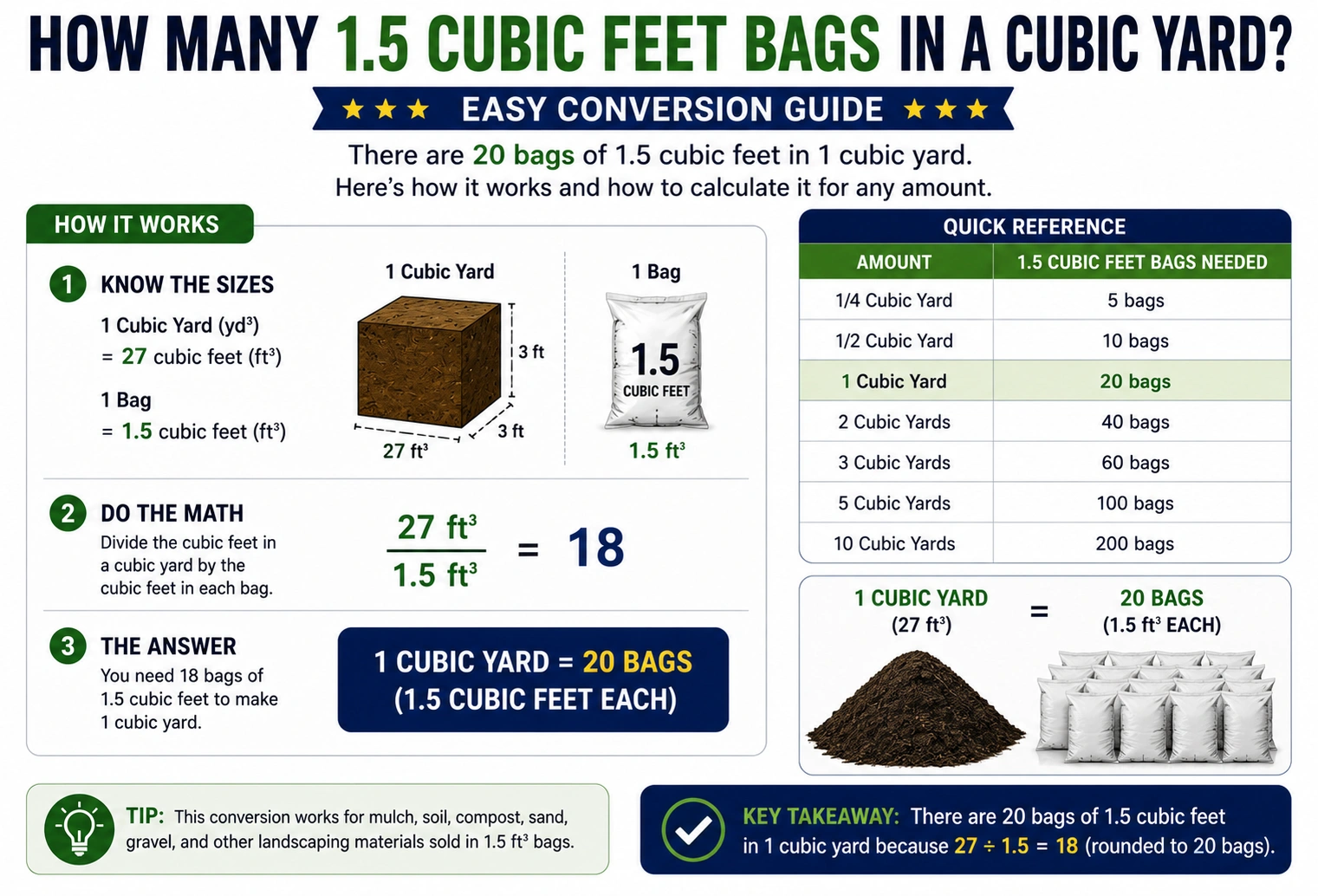
If you’re buying mulch, topsoil, compost, or decorative stone, you may wonder how many 1.5 cubic feet in a yard. This is one of the most common landscaping questions because bulk materials are usually sold by the cubic yard, while home improvement stores often sell them in 1.5-cubic-foot bags.
The answer is:
- 1 cubic yard = 27 cubic feet
- 27 ÷ 1.5 = 18
Therefore, one cubic yard equals 18 bags of 1.5 cubic feet each.
Knowing this conversion helps you estimate material costs, compare bagged and bulk products, and avoid buying too much or too little.
Quick Answer
| Measurement | Equivalent |
|---|---|
| 1 Cubic Yard | 27 Cubic Feet |
| One Bag | 1.5 Cubic Feet |
| Bags per Cubic Yard | 18 Bags |
Answer: One cubic yard is equal to 18 bags of 1.5 cubic feet each.
Understanding Cubic Feet and Cubic Yards
Before calculating, it’s helpful to understand these volume measurements.
What Is a Cubic Foot?
A cubic foot is a unit of volume measuring:
- 1 foot long
- 1 foot wide
- 1 foot high
A 1.5-cubic-foot bag contains one and a half times this volume.
What Is a Cubic Yard?
A cubic yard measures:
- 3 feet long
- 3 feet wide
- 3 feet high
Since:
3 × 3 × 3 = 27 cubic feet
Therefore:
1 cubic yard = 27 cubic feet
How to Calculate 1.5 Cubic Foot Bags per Yard
The calculation is simple.
Step 1
Know the conversion:
1 cubic yard = 27 cubic feet
Step 2
Divide by the bag size:
27 ÷ 1.5
Step 3
Calculate:
= 18
Final Answer
1 cubic yard = 18 bags of 1.5 cubic feet
Conversion Formula
Use this formula:
Number of Bags = 27 ÷ Bag Size (Cubic Feet)
For 1.5-cubic-foot bags:
27 ÷ 1.5 = 18 bags
This formula also works for other bag sizes.
Bag Size Conversion Chart
| Bag Size | Bags per Cubic Yard |
|---|---|
| 0.5 cu ft | 54 bags |
| 0.75 cu ft | 36 bags |
| 1 cu ft | 27 bags |
| 1.5 cu ft | 18 bags |
| 2 cu ft | 13.5 bags |
| 3 cu ft | 9 bags |
If your calculation results in a fraction of a bag, round up to ensure you have enough material.
Common Landscaping Materials Sold in 1.5-Cubic-Foot Bags
Many landscaping products are available in 1.5-cubic-foot bags, including:
- Hardwood mulch
- Pine bark mulch
- Garden soil
- Compost
- Decorative bark
- Soil conditioner
- Wood chips
- Playground mulch
These bags are convenient for homeowners handling smaller landscaping projects.
Real-World Examples
Example 1: Mulch
You need 2 cubic yards of mulch.
Calculation:
2 × 18 = 36 bags
Example 2: Compost
A raised garden bed requires 1 cubic yard.
You’ll need:
18 bags of 1.5 cubic feet
Example 3: Landscaping Around Trees
A project calls for 3 cubic yards of mulch.
Calculation:
3 × 18 = 54 bags
Example 4: Flower Beds
A homeowner needs ½ cubic yard.
Calculation:
18 ÷ 2 = 9 bags
Why This Conversion Matters
Knowing how many 1.5-cubic-foot bags equal a cubic yard helps you:
- Estimate landscaping costs
- Compare bulk vs. bagged materials
- Plan transportation
- Avoid running short during installation
- Reduce leftover materials
- Save time and money
Bulk deliveries are often less expensive for large projects, while bagged products are easier to transport and store.
Bulk vs. Bagged Materials
| Bagged Material | Bulk Material |
|---|---|
| Easy to transport | Better for large projects |
| Clean packaging | Lower cost per cubic yard |
| Ideal for small jobs | Requires delivery |
| Less waste for minor repairs | Faster for covering large areas |
For projects requiring several cubic yards, buying in bulk is often more economical.
Common Conversion Mistakes
Forgetting That One Yard Equals 27 Cubic Feet
Always remember:
1 cubic yard = 27 cubic feet
Using the Wrong Bag Size
Check the bag label carefully. Not all bags contain 1.5 cubic feet.
Not Rounding Up
If your calculation results in 18.4 bags, purchase 19 bags.
Confusing Square Feet and Cubic Feet
- Square feet measure area.
- Cubic feet measure volume.
For mulch, soil, and compost, always use cubic measurements.
Expert Tips
- Measure your project area accurately before purchasing materials.
- Buy an extra bag for small touch-ups or settling.
- Compare the price per cubic foot when choosing between bagged and bulk products.
- Keep unopened bags in a dry location until needed.
- Use online coverage calculators if you know the desired mulch depth.
Quick Reference Table
| Cubic Yards | 1.5 Cubic Foot Bags |
|---|---|
| 0.5 | 9 |
| 1 | 18 |
| 1.5 | 27 |
| 2 | 36 |
| 3 | 54 |
| 4 | 72 |
| 5 | 90 |
9. Frequently Asked Questions
1. How many 1.5 cubic foot bags are in a cubic yard?
There are 18 bags of 1.5 cubic feet in 1 cubic yard.
2. How do you calculate bags per cubic yard?
Divide 27 cubic feet by the size of each bag.
Example:
27 ÷ 1.5 = 18 bags
3. Is buying bulk cheaper than buying bags?
For large landscaping projects, buying by the cubic yard is often more cost-effective than purchasing multiple bags.
4. How many 1.5-cubic-foot bags do I need for 2 cubic yards?
Multiply:
2 × 18 = 36 bags
5. Can I mix different bag sizes?
Yes, but convert each bag size into cubic feet first to ensure you purchase the correct total volume.
10. Conclusion
If you’re wondering how many 1.5 cubic feet in a yard, the answer is 18 bags. Since one cubic yard equals 27 cubic feet, dividing by the 1.5-cubic-foot bag size gives you 18 bags per cubic yard.
This simple conversion makes it easier to estimate mulch, soil, compost, or other landscaping materials for your project. Whether you’re refreshing flower beds, building raised gardens, or covering large areas with mulch, knowing that 1 cubic yard equals 18 bags of 1.5 cubic feet helps you buy the right amount of material and avoid unnecessary expenses.
Discover More Articles
How Many Feet Apart Should Fence Posts Be?