
If you’re wondering how many BTU furnace you need for 1,400 square feet, there isn’t one furnace size that works for every home.
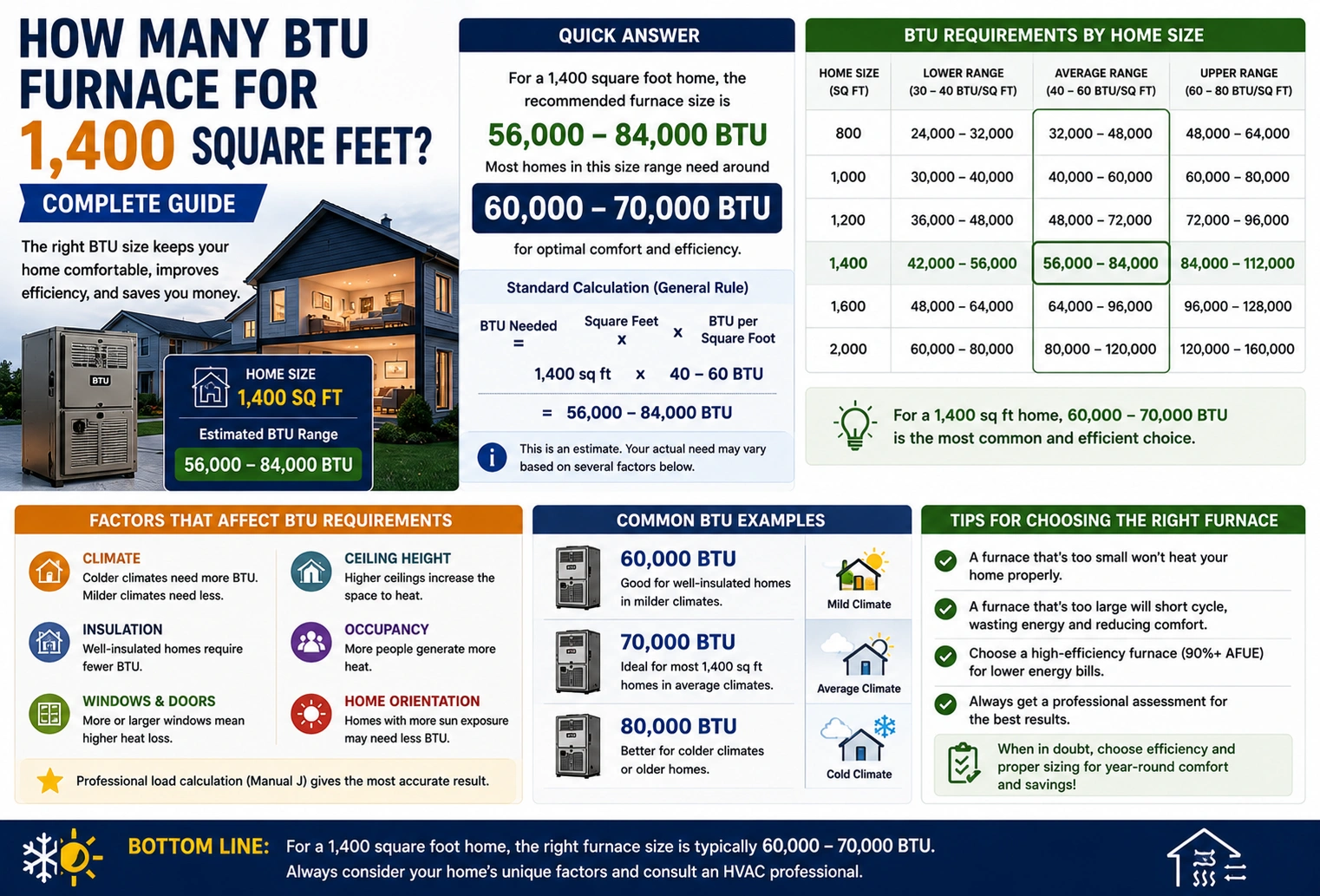
A rough residential heating estimate might put a 1,400-square-foot home somewhere around 42,000 to 84,000 BTU per hour, depending heavily on climate, insulation, windows, ceiling height, home construction, and desired indoor temperature.
For many reasonably insulated homes in moderate climates, a furnace in the 50,000–70,000 BTU range may be a starting point for consideration.
However, square footage alone should not be used to select the final furnace size.
A proper heating-load calculation, such as a Manual J calculation, is a much better way to determine the required heating capacity.
Quick Answer
For a 1,400-square-foot home, a rough estimate can look like this:
| Heating Requirement | Approximate BTU/Hour |
|---|---|
| 30 BTU/sq ft | 42,000 BTU |
| 40 BTU/sq ft | 56,000 BTU |
| 50 BTU/sq ft | 70,000 BTU |
| 60 BTU/sq ft | 84,000 BTU |
These are rough estimates, not sizing recommendations.
A 1,400-square-foot house in a mild climate with excellent insulation could need substantially less heating capacity than a poorly insulated house in a very cold climate.
What BTU Furnace Size Is Typical for 1,400 Square Feet?
A common mistake is assuming that every 1,400-square-foot house needs the same furnace.
It doesn’t.
Two houses with exactly the same floor area can have very different heating requirements.
For example, one might have:
- Excellent insulation
- Energy-efficient windows
- Low ceilings
- A newer building envelope
- Little air leakage
Another 1,400-square-foot home might have:
- Older insulation
- Drafty windows
- High ceilings
- Significant air leakage
- Poorly insulated walls
The second house can require substantially more heating capacity.
For this reason, a 50,000 BTU furnace could be appropriate in one 1,400-square-foot home while another may require considerably more.
What Does BTU Mean?
BTU stands for British thermal unit.
In HVAC equipment, a furnace’s BTU rating describes its heating capacity.
For example, a furnace labeled 60,000 BTU has a rated input capacity of 60,000 BTUs per hour.
However, the amount of heat actually delivered into the home depends on the furnace’s efficiency.
For example, a 60,000-BTU furnace with an 80% AFUE rating would provide approximately:
60,000 × 0.80 = 48,000 BTU/hour
of useful heat under the rating conditions.
A high-efficiency furnace can therefore deliver more usable heat from the same input rating.
Why Square Footage Alone Isn’t Enough
Square footage tells you how much floor area needs to be heated, but it doesn’t tell you how quickly the home loses heat.
Heating demand is influenced by the building envelope and outdoor conditions.
Important factors include:
Climate
Colder locations generally require more heating capacity.
Insulation
Better insulation reduces heat loss.
Windows
Large, old, or inefficient windows can increase heat loss.
Ceiling Height
A home with 10-foot ceilings has more interior volume than one with 8-foot ceilings covering the same floor area.
Air Leakage
Drafts around doors, windows, walls, and other openings can increase heating requirements.
Sun Exposure
Solar heat gain can affect how much heating is needed in different rooms.
Desired Indoor Temperature
Maintaining 72°F requires more heating than maintaining 68°F when outdoor conditions are otherwise identical.
Furnace Size by Climate
Climate is one of the biggest reasons furnace sizes differ between homes of the same size.
A simplified estimate might look like this:
| Approx. Heating Load | 1,400 Sq Ft Estimate |
| 30 BTU/sq ft | 42,000 BTU |
| 40 BTU/sq ft | 56,000 BTU |
| 50 BTU/sq ft | 70,000 BTU |
| 60 BTU/sq ft | 84,000 BTU |
These numbers should be treated only as rough screening estimates.
A professional HVAC contractor should calculate the home’s actual heat loss before recommending a furnace.
How Insulation Affects Furnace Size
Insulation can make a major difference in heating demand.
A well-insulated 1,400-square-foot home may retain heat much better than an older, poorly insulated home.
Better insulation can reduce heat loss through:
- Exterior walls
- Attics
- Floors
- Ceilings
- Basements
If you’re replacing a furnace in an older house, improving insulation and air sealing may reduce the home’s heating load.
This is one reason replacing an old furnace with another furnace of the exact same BTU rating isn’t always the best approach.
Ceiling Height and Furnace BTU Requirements
Two homes can have the same floor area but different interior volumes.
For example:
1,400 sq ft × 8 ft ceilings = 11,200 cubic feet
With 10-foot ceilings:
1,400 × 10 = 14,000 cubic feet
The second home has substantially more interior volume.
However, furnace sizing isn’t based solely on cubic feet either. A proper heat-loss calculation considers the entire building envelope, ventilation, infiltration, insulation, windows, doors, and other factors.
Furnace Efficiency vs. BTU Rating
When comparing furnaces, don’t look only at the BTU input rating.
Pay attention to AFUE, which stands for Annual Fuel Utilization Efficiency.
For example:
A 60,000 BTU furnace with 80% AFUE:
60,000 × 0.80 = 48,000 BTU/hour
A 60,000 BTU furnace with 95% AFUE:
60,000 × 0.95 = 57,000 BTU/hour
The higher-efficiency model converts more of its fuel input into usable heat.
This means two furnaces with the same input BTU rating can have different effective heating outputs.
How to Calculate a Rough Furnace Size
For a basic preliminary estimate, multiply the home’s square footage by an assumed BTU-per-square-foot value.
For example, using 40 BTU per square foot:
1,400 × 40 = 56,000 BTU/hour
Using 50 BTU per square foot:
1,400 × 50 = 70,000 BTU/hour
This gives a rough range, but it should not replace a professional heating-load calculation.
For a new furnace installation, accurate sizing is important because an oversized furnace can cycle on and off too frequently, while an undersized furnace may struggle to maintain the desired indoor temperature during very cold weather.
Furnace Sizing Examples for a 1,400-Square-Foot Home
A few examples can make the relationship between home size and furnace capacity easier to understand.
Example 1: Well-Insulated Home in a Moderate Climate
Suppose a 1,400-square-foot home has:
- Good insulation
- Modern windows
- Standard 8-foot ceilings
- Limited air leakage
- A relatively mild winter climate
A rough heating-load estimate might fall near 40 BTU per square foot.
Calculation:
1,400 × 40 = 56,000 BTU/hour
This does not mean you should automatically purchase a 56,000-BTU furnace. The actual equipment selection should be based on the home’s calculated heating load and the furnace’s output rating.
Example 2: Older Home in a Cold Climate
Now consider a 1,400-square-foot older home with:
- Limited insulation
- Older windows
- Significant air leakage
- Colder winter temperatures
- Higher heat loss
A rough estimate might use 60 BTU per square foot:
1,400 × 60 = 84,000 BTU/hour
Again, this is only a preliminary estimate. A professional load calculation could produce a different result.
Input BTUs vs. Output BTUs
One of the most important things to understand when comparing furnaces is the difference between input and output.
A furnace may be advertised as having a particular BTU input rating, but not all of that energy becomes heat delivered to the home.
For example, consider a 70,000-BTU furnace with 90% efficiency:
70,000 × 0.90 = 63,000 BTU/hour
Approximately 63,000 BTU/hour would be available as useful heat under the rating conditions.
When shopping for a furnace, compare the heating output with the home’s heating requirement rather than looking only at the large BTU number on the equipment label.
What Happens If a Furnace Is Too Large?
An oversized furnace isn’t necessarily better.
If a furnace has substantially more capacity than the home requires, it may reach the thermostat setting quickly and shut down.
Repeated starting and stopping is known as short cycling.
Potential problems can include:
- Less consistent indoor temperatures
- Increased mechanical wear
- Reduced comfort
- Less efficient operation
- More frequent cycling
Modern variable-speed and modulating systems can behave differently, but proper sizing is still important.
What Happens If a Furnace Is Too Small?
An undersized furnace may have difficulty keeping the home warm during the coldest weather.
Possible signs can include:
- Furnace running for long periods
- Difficulty reaching the thermostat setting
- Cold rooms
- Increased reliance on supplemental heat
However, long heating cycles aren’t automatically a sign of an undersized furnace. Efficient furnaces are often designed to run for longer periods rather than constantly switching on and off.
A professional diagnosis is needed before concluding that a furnace is incorrectly sized.
Should You Buy the Same BTU Furnace as Your Old One?
Not necessarily.
An old furnace may have been installed when the home had:
- Different insulation
- Older windows
- More air leakage
- Different heating requirements
If you’ve upgraded insulation, windows, doors, or air sealing, the home’s heat loss may have decreased.
Conversely, additions or renovations can increase the heating load.
Rather than simply matching the old furnace’s BTU rating, have the home’s current heating requirement evaluated.
What Is a Manual J Calculation?
A Manual J load calculation is a widely used method for determining the heating and cooling loads of a residential building.
It considers factors such as:
- Building dimensions
- Climate
- Insulation
- Windows
- Doors
- Air infiltration
- Indoor design temperature
- Outdoor design conditions
The result provides a much more useful basis for choosing HVAC equipment than simply multiplying square footage by a generic BTU number.
For a furnace replacement, asking an HVAC professional about a load calculation can help avoid improper sizing.
Common Furnace Sizing Mistakes
Using Only Square Footage
Square footage is a useful starting point, but it doesn’t capture the home’s actual heat loss.
Automatically Buying the Largest Furnace
A larger furnace isn’t automatically better.
The equipment should be matched to the home’s heating requirements.
Matching the Old Furnace
The previous furnace may have been incorrectly sized or may have been selected for different building conditions.
Ignoring Efficiency
Two furnaces with the same BTU input can deliver different amounts of useful heat depending on their efficiency.
Ignoring Ductwork
Even a properly sized furnace may not perform as expected if the duct system is poorly designed, undersized, leaking, or improperly balanced.
Frequently Asked Questions
How many BTUs does a 1,400-square-foot house need?
A rough estimate could range from approximately 42,000 to 84,000 BTU/hour, depending on the assumed heating load. Many homes may fall somewhere in the middle, but the actual requirement depends on climate, insulation, windows, ceiling height, and other factors.
What size furnace do I need for 1,400 square feet?
There is no universal furnace size for every 1,400-square-foot home. A rough starting range might be 50,000–70,000 BTU/hour for some reasonably insulated homes in moderate climates, but a professional heating-load calculation should determine the final size.
Is a 60,000 BTU furnace enough for 1,400 square feet?
It may be enough for some homes, but not all. A 60,000-BTU furnace could be appropriate for a well-insulated home with a relatively moderate heating load, while a poorly insulated home in a cold climate could require more capacity.
Is an 80,000 BTU furnace too big for 1,400 square feet?
It could be oversized in some homes, but square footage alone cannot determine that. Climate, insulation, heat loss, furnace efficiency, and building design all matter.
How many BTUs per square foot should I use?
A generic estimate may use values such as 30–60 BTU per square foot, but this is only a rough screening range. Actual HVAC sizing should be based on a calculated heating load.
Does insulation reduce the furnace size needed?
Yes. Better insulation and air sealing can reduce heat loss, potentially reducing the heating capacity required to maintain the desired indoor temperature.
Does a higher-efficiency furnace need fewer BTUs?
A higher-efficiency furnace can deliver more usable heat from the same input BTU rating. Therefore, when comparing equipment, the furnace’s output capacity is more useful than input BTUs alone.
How much does climate affect furnace sizing?
Climate can have a major effect. A 1,400-square-foot home in a mild region may require significantly less heating capacity than a similar home in a location with much colder winter design temperatures.
Quick Furnace Size Reference
| Home Condition | Rough BTU Range for 1,400 Sq Ft |
|---|---|
| Very efficient / mild conditions | Around 42,000–50,000 BTU |
| Well-insulated / moderate conditions | Around 50,000–60,000 BTU |
| Average conditions | Around 60,000–70,000 BTU |
| Poor insulation / colder conditions | Around 70,000–84,000+ BTU |
These ranges are illustrative estimates only, not recommendations for a specific home.
Conclusion
If you’re asking how many BTU furnace you need for 1,400 square feet, there isn’t a single correct answer based on square footage alone.
A rough estimate can place the heating requirement somewhere around 42,000 to 84,000 BTU/hour, while a reasonably insulated 1,400-square-foot home in a moderate climate might potentially fall around the 50,000–70,000 BTU range.
However, the best way to choose a furnace is to determine the home’s actual heating load. Factors such as climate, insulation, windows, ceiling height, air leakage, building orientation, ductwork, and furnace efficiency can significantly change the required capacity.
Before purchasing a furnace, have the home evaluated using an appropriate heating-load calculation, such as Manual J, and compare the furnace’s output BTU rating with the calculated heating requirement.
The goal isn’t to buy the biggest furnace—it is to choose a system that is properly matched to the home’s actual heating needs.
Discover More Articles
How Many Stories Is 1,600 Feet? Height Conversion Guide