

If you’re shopping for an air conditioner, one of the most important questions to ask is: how many BTUs to cool 500 square feet?
Choosing the right cooling capacity can make a major difference in comfort, energy efficiency, and monthly utility costs. An undersized air conditioner may struggle to keep the space cool, while an oversized unit can waste energy and create humidity problems.
The good news is that HVAC professionals have established general sizing guidelines that make selecting the proper BTU rating much easier.
For most situations:
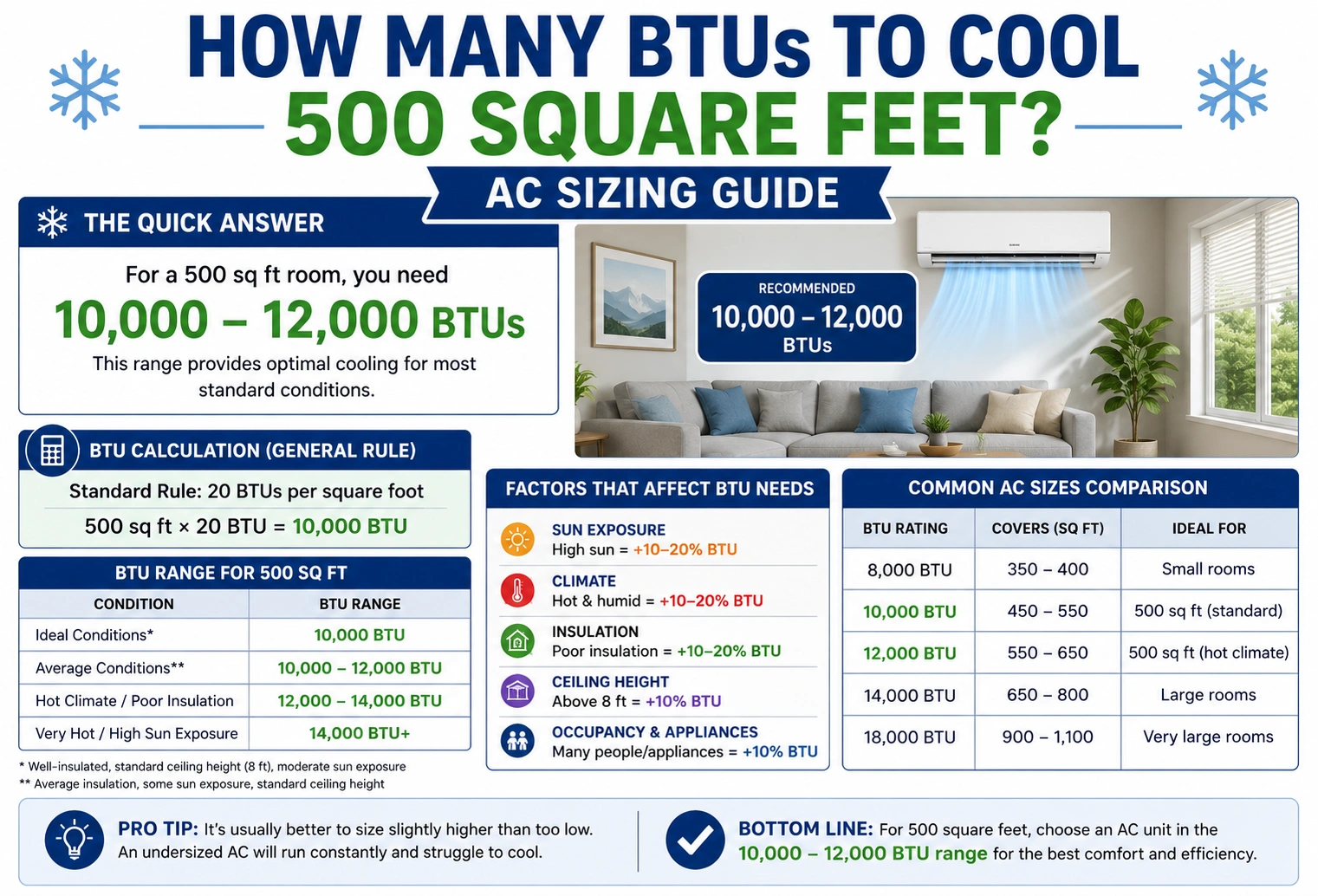
You need approximately 10,000 to 12,000 BTUs to cool 500 square feet.
However, several factors can increase or decrease your cooling requirements, including ceiling height, sunlight exposure, climate, and room occupancy.
This guide explains everything you need to know about sizing an air conditioner for a 500-square-foot space.
Quick Answer
How Many BTUs to Cool 500 Square Feet?
For a standard room:
- 500 square feet = 10,000–12,000 BTUs
Most HVAC sizing charts recommend:
| Room Size | Recommended BTUs |
|---|---|
| 450 sq ft | 10,000 BTUs |
| 500 sq ft | 10,000–12,000 BTUs |
| 550 sq ft | 12,000 BTUs |
A 12,000 BTU air conditioner is often considered the safest choice for a typical 500-square-foot room.
What Does BTU Mean?
Before choosing an AC unit, it’s helpful to understand what BTU actually measures.
Definition of BTU
BTU stands for:
British Thermal Unit
A BTU measures the amount of heat an air conditioner can remove from a room each hour.
Higher BTU ratings mean:
- More cooling power
- Faster cooling
- Larger coverage areas
Why BTU Matters for Cooling
Choosing the correct BTU size ensures:
- Comfortable temperatures
- Lower energy costs
- Better humidity control
- Longer equipment life
Proper sizing is one of the most important factors when purchasing an AC unit.
How Many BTUs to Cool 500 Square Feet?
Most air conditioner sizing charts recommend:
20–25 BTUs per square foot
For a 500-square-foot room:
20 × 500 = 10,000 BTUs
25 × 500 = 12,500 BTUs
Therefore:
500 square feet generally requires between 10,000 and 12,500 BTUs.
Most homeowners choose:
- 10,000 BTUs for moderate conditions
- 12,000 BTUs for warmer climates or sunny rooms
BTU Chart by Room Size
Use the following chart as a general guide.
| Room Size | Recommended BTUs |
|---|---|
| 150 sq ft | 5,000 BTUs |
| 250 sq ft | 6,000 BTUs |
| 350 sq ft | 8,000 BTUs |
| 450 sq ft | 10,000 BTUs |
| 500 sq ft | 10,000–12,000 BTUs |
| 550 sq ft | 12,000 BTUs |
| 700 sq ft | 14,000 BTUs |
| 1,000 sq ft | 18,000–24,000 BTUs |
These recommendations assume average ceiling heights and insulation.
Factors That Affect BTU Requirements
Not every 500-square-foot space has the same cooling needs.
Ceiling Height
Most sizing charts assume:
- 8-foot ceilings
If ceilings are:
- 10 feet
- 12 feet
- Vaulted
You’ll likely need additional BTUs.
Sun Exposure
South-facing rooms and large windows can significantly increase heat gain.
Sunny rooms often require:
- 10–20% more cooling capacity
Number of Occupants
Additional people generate heat.
A room with frequent occupancy may need extra cooling.
General rule:
- Add 600 BTUs per additional person beyond two occupants.
Appliances and Electronics
Heat-producing equipment increases cooling demand.
Examples include:
- Computers
- TVs
- Refrigerators
- Ovens
Climate Zone
Homes in hot climates require larger AC units than homes in cooler regions.
How to Calculate BTUs for 500 Square Feet
A simple rule is:
Square Feet × 20–25 BTUs
For 500 square feet:
10,000–12,500 BTUs
This provides a quick estimate for most residential spaces.
Example
A 500-square-foot living room with:
- Good insulation
- Average sunlight
- 8-foot ceilings
Would typically need:
10,000–12,000 BTUs
Window AC vs Portable AC vs Mini Split
Different AC types provide different performance levels.
Window Air Conditioner
Advantages:
- Affordable
- Efficient
- Easy installation
Recommended size:
- 10,000–12,000 BTUs
Portable Air Conditioner
Advantages:
- Movable
- Flexible placement
Disadvantages:
- Lower efficiency
For 500 square feet:
- 12,000–14,000 BTUs often perform best
Mini Split System
Advantages:
- Highly efficient
- Quiet operation
- Excellent cooling
Recommended size:
- 12,000 BTUs (1-ton system)
What Happens If Your AC Is Too Small?
Undersized units often experience:
- Constant operation
- Higher energy bills
- Uneven cooling
- Excessive wear
A small AC may never reach the desired temperature during hot weather.
What Happens If Your AC Is Too Large?
Many homeowners assume bigger is better.
Unfortunately, oversized units can cause problems.
Short Cycling
The system turns on and off frequently.
Poor Humidity Control
The room cools quickly before moisture is removed.
Increased Energy Waste
Frequent starts and stops reduce efficiency.
Higher Purchase Cost
Larger units typically cost more upfront.
Proper sizing is usually better than oversizing.
Energy Efficiency Tips for Cooling 500 Square Feet
Maximize cooling performance with these strategies.
Improve Insulation
Good insulation reduces heat gain.
Use Blackout Curtains
Curtains can significantly reduce solar heat.
Seal Air Leaks
Prevent cool air from escaping around:
- Doors
- Windows
- Vents
Use Ceiling Fans
Fans improve air circulation and reduce AC workload.
Maintain Your AC
Regular maintenance improves efficiency and extends equipment life.
Common AC Sizes for 500 Square Feet
The following sizes are commonly recommended.
| AC Size | Suitable For |
|---|---|
| 10,000 BTUs | Moderate conditions |
| 12,000 BTUs | Most homes |
| 14,000 BTUs | Very hot climates |
| 18,000 BTUs | Open floor plans |
For most homeowners:
12,000 BTUs provides the best balance of cooling and efficiency.
Common Mistakes When Choosing BTU Size
Choosing Based Only on Square Footage
Other factors like sunlight and insulation matter too.
Ignoring Ceiling Height
Higher ceilings increase room volume.
Oversizing the Unit
Larger isn’t always better.
Buying the Cheapest Option
Efficiency ratings often matter more than initial cost.
9. FAQs
1. How many BTUs do I need for 500 square feet?
Most rooms require 10,000 to 12,000 BTUs.
2. Is a 12,000 BTU air conditioner enough for 500 square feet?
Yes. A 12,000 BTU unit is generally ideal for cooling 500 square feet.
3. Can a 10,000 BTU AC cool 500 square feet?
Yes, under average conditions with good insulation and moderate heat exposure.
4. Is 14,000 BTUs too much for 500 square feet?
Not necessarily. It may be appropriate for very hot climates, sunny rooms, or open layouts.
5. What size mini split do I need for 500 square feet?
A 12,000 BTU mini split is typically recommended for a standard 500-square-foot area.
10. Conclusion
If you’re wondering how many BTUs to cool 500 square feet, the general recommendation is 10,000 to 12,000 BTUs, with 12,000 BTUs being the most common choice for residential spaces. This capacity provides efficient cooling for living rooms, apartments, offices, and similar areas under average conditions.
However, factors such as ceiling height, sunlight exposure, insulation quality, occupancy, and climate can affect your actual cooling needs. Choosing the correct BTU rating ensures better comfort, lower energy costs, improved humidity control, and longer-lasting equipment. For most homeowners, a properly sized 12,000 BTU air conditioner offers the best balance of performance and efficiency for a 500-square-foot space.
Discover More Articles
How Many Feet Is 7 Mi? Exact Miles to Feet Conversion