
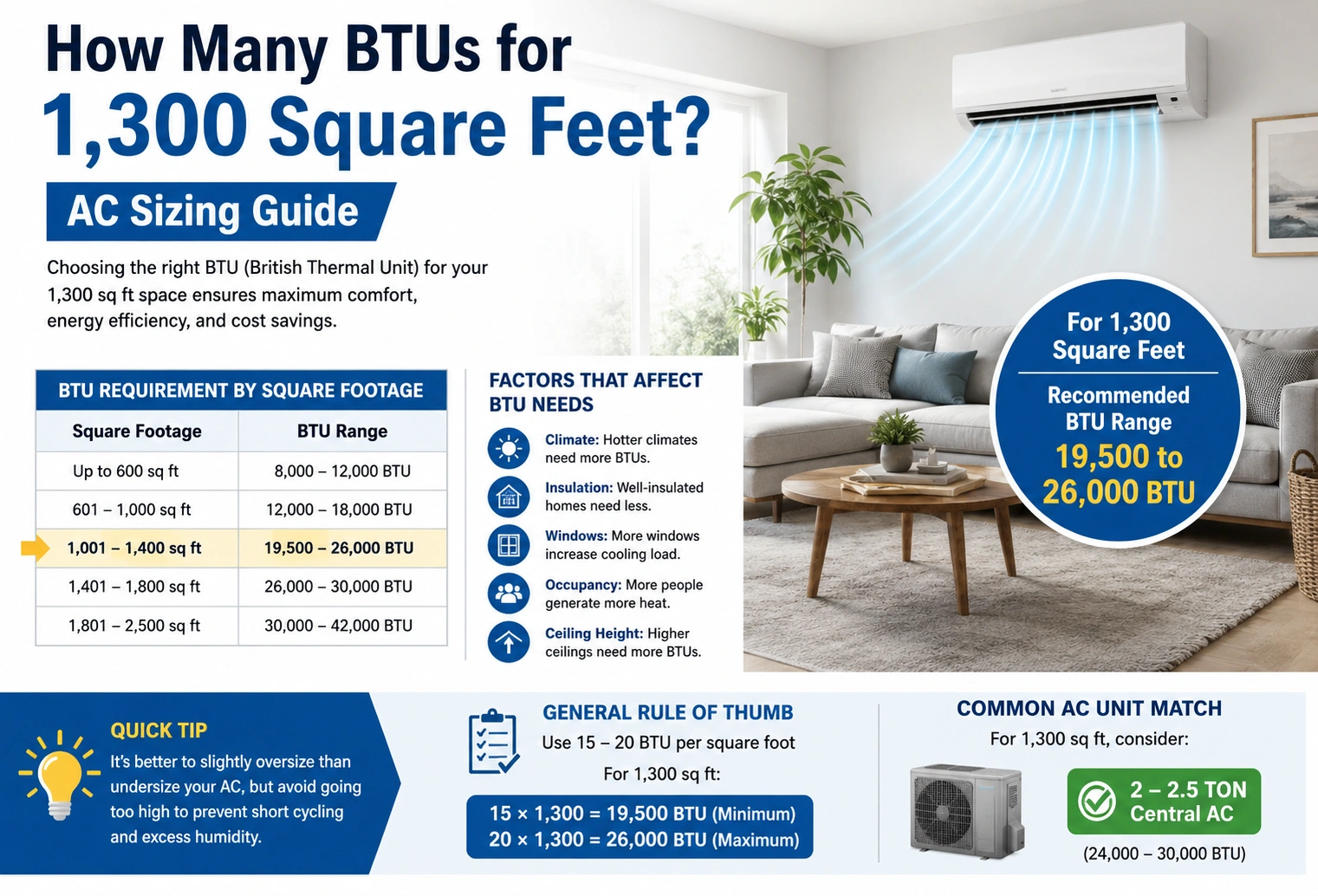
If you’re wondering how many BTUs for 1,300 square feet, a typical cooling estimate is around 24,000 to 30,000 BTUs, depending on the climate and characteristics of the home.
For many average 1,300-square-foot homes, approximately 25,000–30,000 BTUs can be a reasonable starting range. However, the correct air-conditioner size should not be determined by square footage alone.
Factors such as insulation, ceiling height, windows, sunlight, number of occupants, and local climate can significantly change the required cooling capacity.
Quick Answer
For a 1,300-square-foot home, a general starting estimate is:
24,000–30,000 BTUs
That corresponds roughly to:
- 2-ton AC: 24,000 BTUs
- 2.5-ton AC: 30,000 BTUs
A professional cooling-load calculation is the most reliable way to determine the correct system size.
What Does BTU Mean for an Air Conditioner?
BTU stands for British thermal unit.
For air conditioners, BTUs describe cooling capacity—the amount of heat the system can remove from a space under specified conditions.
A higher BTU rating generally means greater cooling capacity.
Common AC capacities include:
| AC Size | Approximate BTUs |
|---|---|
| 1.5 tons | 18,000 BTUs |
| 2 tons | 24,000 BTUs |
| 2.5 tons | 30,000 BTUs |
| 3 tons | 36,000 BTUs |
| 3.5 tons | 42,000 BTUs |
For a 1,300-square-foot home, a 2- to 2.5-ton system may be within the range worth considering, but the correct choice depends on the actual cooling load.
How Many BTUs Does 1,300 Square Feet Need?
A simple square-footage estimate can provide a starting point.
For 1,300 square feet, many general sizing guides place the cooling requirement somewhere around 24,000–30,000 BTUs.
However, the same-size house can require a different AC capacity depending on where it is located and how efficiently it is built.
For example, a well-insulated 1,300-square-foot home in a mild climate may require less cooling than a poorly insulated home of the same size in a very hot climate.
Is a 2-Ton AC Enough for 1,300 Square Feet?
A 2-ton air conditioner provides approximately:
2 × 12,000 = 24,000 BTUs
A 2-ton system may be appropriate for some 1,300-square-foot homes, particularly when the home has good insulation and moderate cooling requirements.
However, it could be undersized in a hot climate or a home with substantial heat gain.
The square footage alone doesn’t provide enough information to determine whether 24,000 BTUs will be sufficient.
Is a 2.5-Ton AC Enough for 1,300 Square Feet?
A 2.5-ton air conditioner provides approximately:
2.5 × 12,000 = 30,000 BTUs
A 30,000-BTU system may be suitable for some 1,300-square-foot homes with higher cooling loads.
However, choosing 2.5 tons simply because the home is 1,300 square feet can also result in an oversized system if the actual cooling load is lower.
Proper sizing is more important than simply selecting the larger unit.
Is a 3-Ton AC Too Big for 1,300 Square Feet?
Not necessarily, but 36,000 BTUs may be more cooling capacity than some 1,300-square-foot homes require.
An oversized AC can cool the air quickly but may not run long enough to remove humidity effectively.
Potential issues can include:
- Frequent cycling
- Uneven temperatures
- Poor humidity control
- Reduced comfort
- Inefficient operation
A 3-ton system can be appropriate in some situations, but it should be supported by an actual cooling-load calculation.
Factors That Affect AC Size
Square footage is only one part of HVAC sizing.
Climate
Homes in hotter climates generally experience greater cooling loads.
A 1,300-square-foot house in a very hot region may require more cooling capacity than an identical house in a mild climate.
Insulation
Good insulation reduces heat transfer between the outside and inside.
Poor insulation can increase the amount of work an air conditioner needs to do.
Windows
Large windows can allow significant solar heat into a home.
Window orientation, glazing, shading, and size can all affect cooling requirements.
Ceiling Height
A home with 10- or 12-foot ceilings contains more air volume than one with standard 8-foot ceilings.
Higher ceilings can therefore affect the cooling load.
Number of Occupants
People produce body heat.
A home regularly occupied by many people can require more cooling than a similarly sized home with fewer occupants.
Appliances
Ovens, refrigerators, computers, televisions, lighting, and other electrical equipment generate heat.
Does Climate Change the BTUs Needed for 1,300 Square Feet?
Yes.
Climate can have a substantial impact on AC sizing.
A home located in a hot, humid region may need significantly more cooling capacity than a similar home in a cooler climate.
The amount of sunlight, outdoor temperature, humidity, insulation, and construction quality all contribute to the cooling load.
This is why a single BTU-per-square-foot rule should only be treated as a rough estimate.
How Many Tons of AC for 1,300 Square Feet?
One ton of air-conditioning capacity equals approximately 12,000 BTUs.
Using common estimates:
- 24,000 BTUs = 2 tons
- 30,000 BTUs = 2.5 tons
- 36,000 BTUs = 3 tons
For a 1,300-square-foot home, a 2- to 2.5-ton system may be a reasonable general starting range, but the correct tonnage depends on the home’s actual cooling load.
What Happens If the AC Is Too Small?
An undersized AC may struggle to keep the home comfortable.
You may notice:
- The system runs for long periods
- Indoor temperatures remain high
- The AC struggles on very hot days
- Energy use can increase
- Some rooms remain warmer than others
An undersized system may not be able to remove enough heat during peak conditions.
What Happens If the AC Is Too Large?
An oversized system can create a different set of problems.
Because it may reach the thermostat setting quickly, it can cycle on and off frequently.
This may result in:
- Poor humidity removal
- Temperature fluctuations
- Increased wear
- Uneven cooling
- Less comfortable indoor conditions
Bigger is not automatically better when it comes to air-conditioning systems.
How to Determine the Right AC Size
The most accurate method is a professional Manual J load calculation.
A proper cooling-load calculation considers factors such as:
- Home size
- Location
- Outdoor design temperature
- Insulation
- Windows
- Doors
- Ceiling height
- Orientation
- Occupancy
- Internal heat sources
This provides a much better estimate than choosing an AC solely from the home’s square footage.
Central AC vs. Mini-Split for 1,300 Square Feet
The right system also depends on the type of property.
Central Air Conditioning
For a 1,300-square-foot house, central AC may be a practical choice when the entire home needs to be cooled.
The system should be sized for the whole house rather than simply selecting a unit based on square footage.
Mini-Split Systems
Mini-splits can be useful when cooling individual rooms or zones.
Instead of one system serving the entire house, several indoor units can be used to provide targeted cooling.
The capacity of each indoor unit should be matched to the room it serves.
Frequently Asked Questions
How many BTUs do I need for 1,300 square feet?
A general estimate for a 1,300-square-foot home is approximately 24,000–30,000 BTUs, but actual requirements depend on climate, insulation, windows, ceiling height, and other factors.
What size AC do I need for a 1,300-square-foot house?
A 2- to 2.5-ton AC may be a reasonable starting range for some 1,300-square-foot homes. A professional load calculation should determine the final size.
Is 24,000 BTUs enough for 1,300 square feet?
It can be enough for some homes, particularly in moderate conditions, but it may be insufficient for homes with high cooling loads.
How many tons is 30,000 BTUs?
30,000 BTUs equals 2.5 tons of cooling capacity.
Is a 3-ton AC too big for 1,300 square feet?
It may be oversized for some homes, but not necessarily all. The home’s actual cooling load determines whether 36,000 BTUs is appropriate.
Does insulation affect AC sizing?
Yes. Better insulation generally reduces heat gain and can lower the required cooling capacity.
Does ceiling height affect BTU requirements?
Yes. Higher ceilings increase the volume of the space and can affect the cooling load.
Can I size an AC using square footage alone?
Square footage can provide a rough starting estimate, but it isn’t sufficient for precise HVAC sizing. A professional load calculation is more accurate.
Conclusion
If you’re asking how many BTUs for 1,300 square feet, a reasonable general starting estimate is approximately 24,000–30,000 BTUs, equivalent to roughly 2–2.5 tons of cooling capacity.
However, the correct AC size depends on much more than floor area. Climate, insulation, windows, ceiling height, occupancy, sunlight, and internal heat sources can all change the cooling requirement.
For the best results, use square footage as a starting point and have the system properly sized using a professional cooling-load calculation before purchasing or installing an air conditioner.
Discover More Articles
8 Ft by 10 Ft Is How Many Square Feet? Easy Guide