
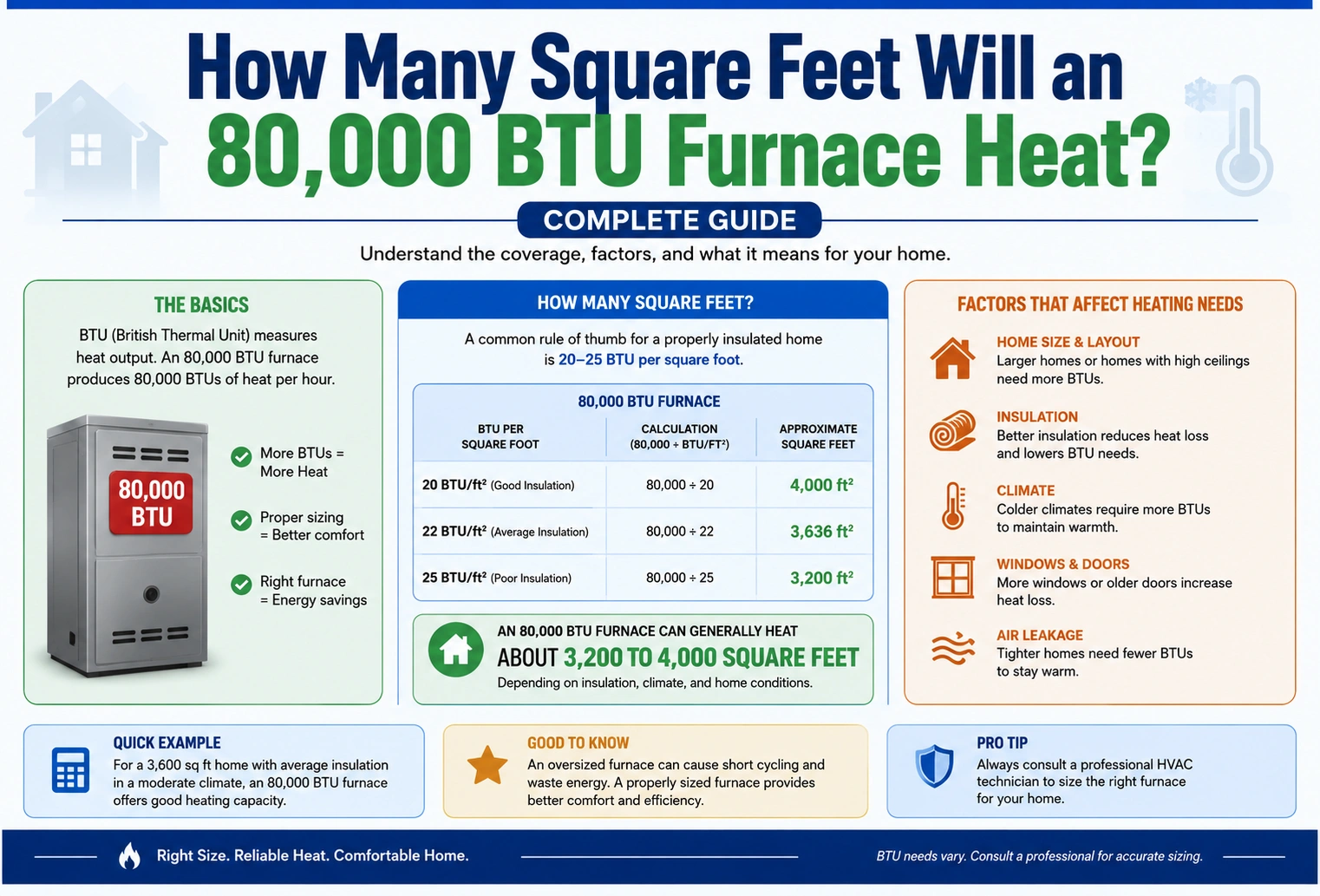
If you’re shopping for a new heating system, one of the most common questions is how many square feet will an 80,000 BTU furnace heat.
The answer depends on several factors, including your home’s insulation, climate, ceiling height, air leakage, and the furnace’s efficiency (AFUE). There is no single square-foot figure that applies to every home.
In general, an 80,000 BTU furnace can heat approximately 2,000 to 2,700 square feet in a well-insulated home under typical conditions.
Homes in colder climates may require more heating power, while well-insulated homes in milder climates may comfortably heat a larger area.
Quick Answer
An 80,000 BTU furnace typically heats:
- 2,000–2,700 square feet in many average homes.
- Smaller areas in very cold climates or older, poorly insulated homes.
- Larger areas in mild climates with excellent insulation.
Answer:
✅ An 80,000 BTU furnace is generally suitable for heating about 2,000 to 2,700 square feet, depending on home conditions and climate.
Average Coverage of an 80,000 BTU Furnace
Heating requirements vary because every home loses heat differently.
Some of the biggest factors include:
- Climate zone
- Insulation quality
- Number of windows
- Ceiling height
- Home layout
- Air leaks around doors and windows
- Furnace efficiency (AFUE)
For example:
- A newer, energy-efficient home may need fewer BTUs per square foot.
- An older home with poor insulation may require significantly more BTUs.
BTU Per Square Foot Guidelines
HVAC professionals often use rough estimates when discussing furnace sizing.
Typical guidelines include:
| Climate | Approximate BTUs per Square Foot |
|---|---|
| Warm | 20–30 BTUs |
| Moderate | 30–40 BTUs |
| Cold | 40–50 BTUs |
| Very Cold | 50–60+ BTUs |
These values are only starting points. A professional heat-loss calculation provides the most accurate furnace size.
How Furnace Efficiency Affects Heating
Not every furnace delivers all 80,000 BTUs as usable heat.
For example:
- An 80% AFUE furnace converts about 64,000 BTUs into usable heat.
- A 95% AFUE furnace delivers about 76,000 BTUs of usable heat.
Higher-efficiency furnaces waste less energy and can heat your home more effectively while reducing fuel costs.
Is an 80,000 BTU Furnace Right for Your Home?
An 80,000 BTU furnace may be a good choice if your home is:
- Around 2,000–2,700 square feet
- Properly insulated
- Equipped with energy-efficient windows
- Located in a moderate or cold climate
However, every home is different. HVAC professionals typically perform a Manual J load calculation to determine the correct furnace size based on your home’s unique characteristics.
Furnace Size Comparison Chart
| Furnace Size | Typical Coverage* |
| 40,000 BTU | 1,000–1,300 sq ft |
| 60,000 BTU | 1,500–2,000 sq ft |
| 80,000 BTU | 2,000–2,700 sq ft |
| 100,000 BTU | 2,500–3,300 sq ft |
| 120,000 BTU | 3,000–4,000 sq ft |
*Approximate ranges only. Actual heating capacity depends on climate, insulation, ceiling height, and furnace efficiency.
Why Proper Furnace Sizing Matters
Choosing the correct furnace size helps:
- Maintain consistent indoor temperatures.
- Reduce energy bills.
- Improve comfort.
- Extend furnace lifespan.
- Minimize unnecessary wear and tear.
- Prevent short cycling.
A furnace that’s too small may struggle to heat your home, while one that’s too large can cycle on and off too frequently.
Common Mistakes
Choosing a Furnace by Square Footage Alone
Square footage is only one factor. Insulation, windows, ceiling height, and climate are equally important.
Ignoring Furnace Efficiency
Two furnaces with the same BTU rating can produce different amounts of usable heat because of different AFUE ratings.
Oversizing the Furnace
A furnace that’s too large may heat the home quickly but operate inefficiently and reduce comfort.
Expert Tips
- Have an HVAC professional perform a Manual J load calculation before purchasing a furnace.
- Improve insulation before upgrading your heating system.
- Replace old windows if significant heat loss occurs.
- Schedule annual furnace maintenance for maximum efficiency.
- Consider high-efficiency (90–98% AFUE) models to reduce heating costs.
9. FAQs
1. How many square feet will an 80,000 BTU furnace heat?
An 80,000 BTU furnace typically heats about 2,000 to 2,700 square feet, depending on insulation, climate, and furnace efficiency.
2. Is an 80,000 BTU furnace enough for a 2,500-square-foot house?
In many cases, yes—especially if the home is well insulated and located in a moderate climate. However, a professional load calculation is recommended.
3. Does insulation affect furnace coverage?
Yes. Better insulation reduces heat loss, allowing the furnace to heat a larger area more efficiently.
4. What does AFUE mean?
AFUE (Annual Fuel Utilization Efficiency) measures how efficiently a furnace converts fuel into usable heat.
5. Can an oversized furnace cause problems?
Yes. Oversized furnaces can short cycle, reduce comfort, increase energy use, and shorten equipment life.
10. Conclusion
If you’re asking how many square feet will an 80,000 BTU furnace heat, a typical answer is approximately 2,000 to 2,700 square feet under average conditions. However, the actual coverage depends on your home’s insulation, local climate, ceiling height, air leakage, and the furnace’s efficiency rating.
For the best comfort and energy savings, don’t rely solely on square footage. A professional HVAC load calculation is the most reliable way to choose the right furnace size for your home.
Discover More Articles
How Many Feet Is a Yardstick? Exact Measurement Guide