
If you’re buying land, shopping for a home, or researching real estate, you may wonder how many square feet in a lot. The answer depends on the specific property because there is no universal lot size.
A lot is simply a defined piece of land. Some lots are small city parcels, while others span multiple acres in rural areas. Because of this, lot sizes can vary dramatically.
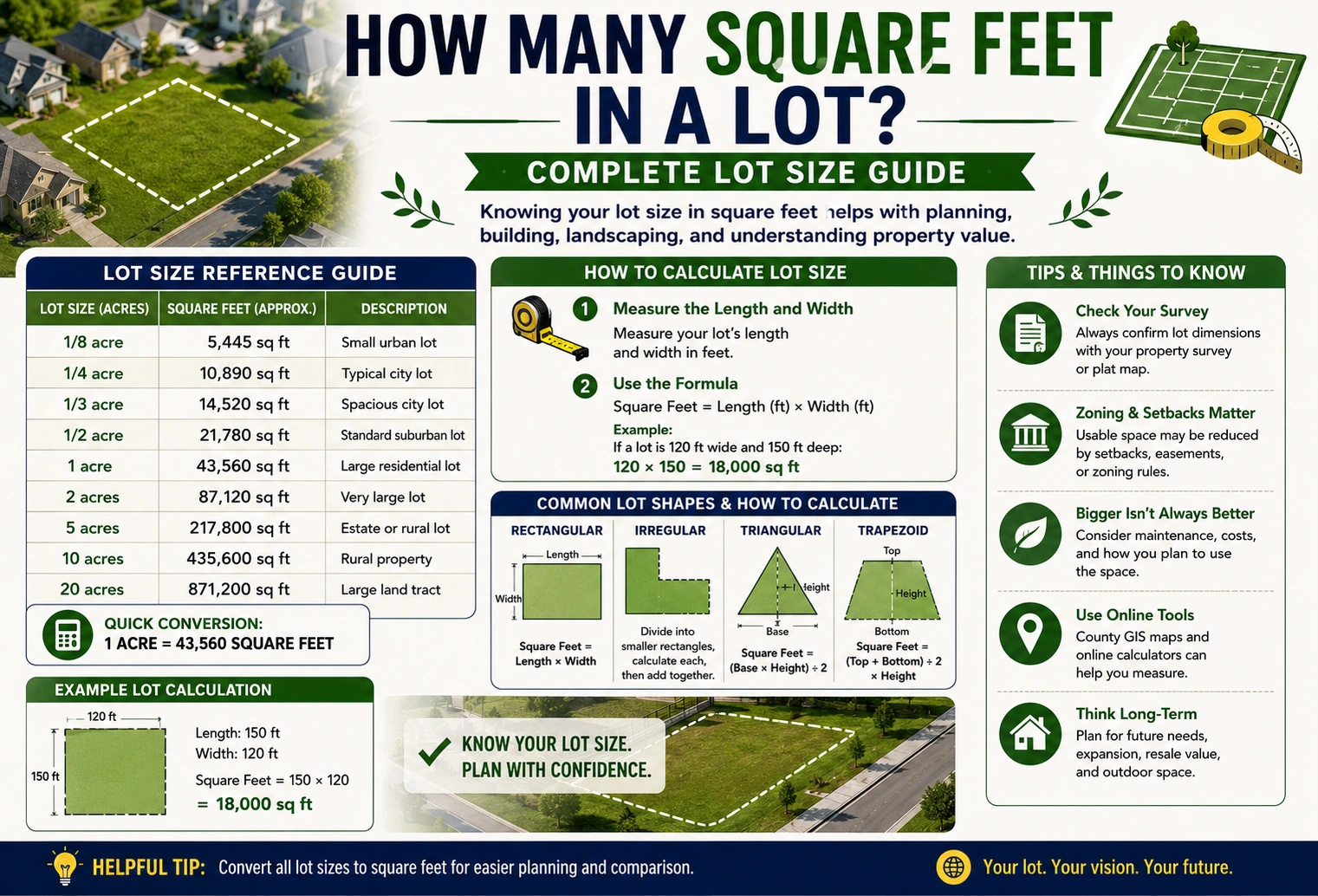
However, one of the most common lot sizes in residential real estate is approximately one-quarter acre, which equals 10,890 square feet.
Understanding lot measurements can help you compare properties, plan construction projects, and determine whether a piece of land meets your needs.
Quick Answer: Square Feet in a Lot
There is no fixed number of square feet in a lot.
Lot sizes vary based on:
- Location
- Zoning regulations
- Property type
- Neighborhood design
- Local real estate markets
Here are common examples:
| Lot Size | Square Feet |
|---|---|
| 1/8 Acre | 5,445 sq ft |
| 1/4 Acre | 10,890 sq ft |
| 1/3 Acre | 14,520 sq ft |
| 1/2 Acre | 21,780 sq ft |
| 1 Acre | 43,560 sq ft |
In many suburban neighborhoods, a lot ranges from 7,000 to 12,000 square feet.
What Is a Lot?
A lot is a legally defined parcel of land identified on a property map or survey.
Lots can be used for:
- Residential homes
- Commercial buildings
- Agricultural purposes
- Industrial development
- Recreational land
Every lot has specific dimensions and boundaries recorded through local land records.
Unlike standardized units such as acres, a lot does not have a fixed size.
How Many Square Feet in a Standard Lot?
Many people use the term “standard lot” when discussing residential properties.
However, lot sizes vary significantly across regions.
Typical Residential Lot Sizes
| Property Type | Average Lot Size |
|---|---|
| Urban Home | 2,500–5,000 sq ft |
| Suburban Home | 7,000–12,000 sq ft |
| Large Suburban Home | 12,000–20,000 sq ft |
| Rural Home | 1 acre or more |
A typical suburban lot often measures around:
10,000 square feet
This is close to one-quarter acre.
Common Residential Lot Sizes
Small Urban Lots
In dense cities, available land is limited.
Urban lots often range from:
- 2,000 square feet
- 3,000 square feet
- 5,000 square feet
These lots prioritize building space over large yards.
Suburban Lots
Suburban neighborhoods commonly feature:
- 7,000–12,000 square feet
These properties often include:
- Front yard
- Backyard
- Garage
- Driveway
Large Rural Lots
Rural properties may range from:
- 1 acre
- 5 acres
- 10 acres
- 50 acres or more
Even a single acre contains:
43,560 square feet
Understanding Lot Measurements
Lots are usually measured by:
Width
The distance across the front of the property.
Depth
The distance from the front boundary to the rear boundary.
Total Area
The overall square footage of the property.
For example:
A lot measuring:
- 100 feet wide
- 100 feet deep
Contains:
100 × 100 = 10,000 square feet
How to Calculate Square Feet in a Lot
Calculating lot size is straightforward for rectangular properties.
Formula
Area = Length × Width
For example:
A property measuring:
- 80 feet wide
- 125 feet deep
Produces:
80 × 125 = 10,000 square feet
For irregularly shaped lots, surveyors may divide the property into smaller geometric sections and calculate each area separately.
Square Feet to Acre Conversion
Acreage is one of the most common ways land is measured.
The standard conversion is:
1 Acre = 43,560 Square Feet
Here’s a helpful comparison chart:
| Acres | Square Feet |
|---|---|
| 0.10 | 4,356 |
| 0.25 | 10,890 |
| 0.50 | 21,780 |
| 0.75 | 32,670 |
| 1.00 | 43,560 |
| 2.00 | 87,120 |
| 5.00 | 217,800 |
Understanding this conversion helps when comparing property listings.
Lot Size Comparison Chart
Below are examples of common lot dimensions and their corresponding square footage.
| Dimensions | Square Feet |
|---|---|
| 50 × 100 ft | 5,000 |
| 60 × 120 ft | 7,200 |
| 80 × 125 ft | 10,000 |
| 90 × 120 ft | 10,800 |
| 100 × 100 ft | 10,000 |
| 100 × 150 ft | 15,000 |
| 150 × 200 ft | 30,000 |
These examples can help visualize different property sizes.
Why Lot Size Matters
Lot size affects much more than property value.
Building Potential
Larger lots allow:
- Bigger homes
- Additional structures
- Swimming pools
- Workshops
Property Value
In many markets, larger lots command higher prices.
Privacy
More land often means greater distance from neighbors.
Future Expansion
Extra land provides flexibility for future improvements.
Landscaping Opportunities
Large lots offer space for:
- Gardens
- Patios
- Outdoor entertainment areas
Common Mistakes When Measuring Lot Size
Confusing Lot Size With House Size
A home’s square footage and the lot’s square footage are different measurements.
Ignoring Easements
Utility easements may reduce usable land.
Estimating Without Survey Data
Property surveys provide the most accurate measurements.
Assuming All Lots Are Rectangles
Many lots are irregularly shaped and require more detailed calculations.
Forgetting Zoning Restrictions
Even if a lot is large, zoning laws may limit development options.
Real-World Examples of Lot Sizes
Starter Home Lot
A small suburban property:
- 60 × 100 feet
- 6,000 square feet
Typical Suburban Property
A medium-sized neighborhood lot:
- 80 × 125 feet
- 10,000 square feet
Quarter-Acre Lot
One of the most common residential lot sizes:
- 10,890 square feet
One-Acre Property
A spacious residential or rural parcel:
- 43,560 square feet
Five-Acre Homestead
Ideal for farming or livestock:
- 217,800 square feet
Expert Tips for Understanding Lot Size
Read Property Surveys
Survey documents provide exact dimensions.
Use Online Mapping Tools
Many property websites show lot boundaries.
Compare Lots Using Acres
Large parcels are easier to compare when measured in acres.
Verify Local Records
County assessor records often list official lot sizes.
Consider Usable Space
Not all square footage is buildable due to slopes, easements, or environmental restrictions.
9. FAQs
How many square feet are in a standard lot?
There is no standard lot size, but many residential lots range from 7,000 to 12,000 square feet.
How many square feet are in a quarter-acre lot?
A quarter-acre lot contains 10,890 square feet.
How do I calculate the square footage of my lot?
Multiply the lot’s length by its width if it is rectangular.
Is 10,000 square feet a large lot?
For many suburban neighborhoods, 10,000 square feet is considered an above-average residential lot.
How many square feet are in one acre?
One acre equals 43,560 square feet.
10. Conclusion
When asking how many square feet in a lot, it’s important to remember that lot sizes vary widely depending on location and property type. While many residential lots fall between 7,000 and 12,000 square feet, some urban parcels are much smaller and rural properties can span several acres.
To determine the square footage of a lot, multiply its length by its width or consult a property survey. Understanding lot measurements helps buyers, homeowners, and investors evaluate properties more effectively and make informed real estate decisions.
Discover More Articles
How Many Square Feet Is a Bedroom Usually?
How Many Square Feet Is a Slab of Granite? Countertop Size Guide