
If you’re planning a landscaping project, one of the first questions you’ll likely ask is: how many cubic feet in one yard of mulch?
Whether you’re refreshing flower beds, covering tree rings, or improving curb appeal, understanding mulch measurements helps you buy the right amount and avoid overspending.
The simple answer is:
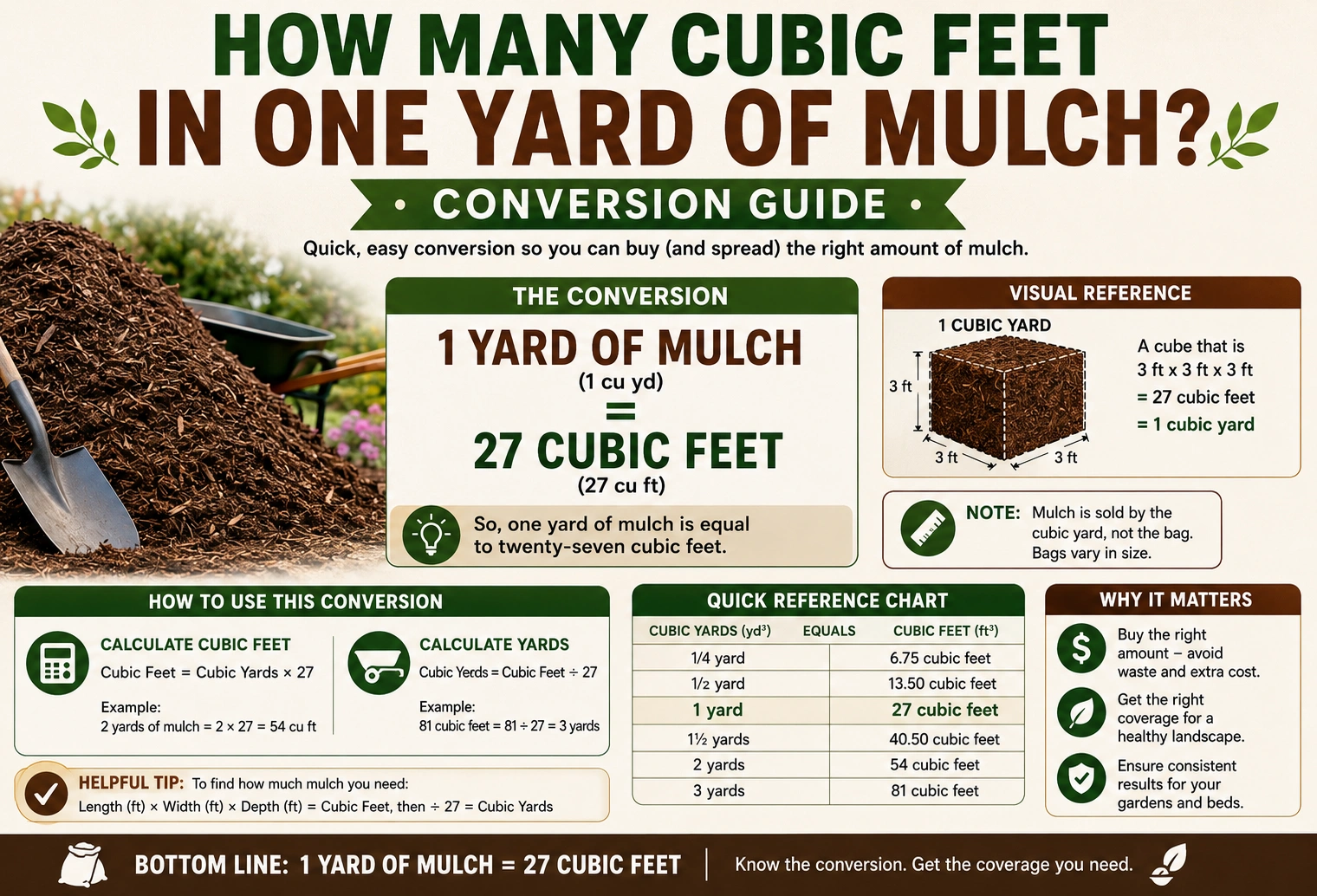
One cubic yard of mulch equals 27 cubic feet.
While that conversion is straightforward, knowing how it applies to mulch coverage, bag quantities, and landscaping projects can save both time and money.
This guide explains everything you need to know about mulch volume calculations, coverage charts, and practical examples.
Quick Answer
One Cubic Yard of Mulch = 27 Cubic Feet
This conversion applies to all mulch types, including:
- Hardwood mulch
- Pine bark mulch
- Cedar mulch
- Dyed mulch
- Wood chips
- Compost mulch
The formula never changes:
1 cubic yard = 27 cubic feet
This is because a yard measures 3 feet on each side:
- Length = 3 feet
- Width = 3 feet
- Height = 3 feet
Multiply them together:
3 × 3 × 3 = 27 cubic feet
Understanding Cubic Yards and Cubic Feet
Before ordering mulch, it helps to understand these common volume measurements.
What Is a Cubic Foot?
A cubic foot is the volume of a cube measuring:
- 1 foot long
- 1 foot wide
- 1 foot high
It equals:
- 12 inches × 12 inches × 12 inches
Bagged mulch is typically sold in cubic feet.
Common bag sizes include:
- 1 cubic foot
- 1.5 cubic feet
- 2 cubic feet
- 3 cubic feet
What Is a Cubic Yard?
A cubic yard is much larger.
It represents a cube measuring:
- 3 feet long
- 3 feet wide
- 3 feet high
Since each side is three times larger than a foot:
3 × 3 × 3 = 27 cubic feet
Landscaping suppliers typically sell bulk mulch by the cubic yard.
How Many Cubic Feet in One Yard of Mulch?
The conversion is simple:
Cubic Feet = Cubic Yards × 27
For one yard:
1 × 27 = 27 cubic feet
Therefore:
One yard of mulch contains 27 cubic feet.
This conversion works regardless of mulch type.
Simple Example
Suppose a supplier offers:
- 3 cubic yards of mulch
Convert to cubic feet:
3 × 27 = 81 cubic feet
You would receive:
81 cubic feet of mulch
Mulch Conversion Chart
| Cubic Yards | Cubic Feet |
|---|---|
| 1 | 27 |
| 2 | 54 |
| 3 | 81 |
| 4 | 108 |
| 5 | 135 |
| 6 | 162 |
| 7 | 189 |
| 8 | 216 |
| 9 | 243 |
| 10 | 270 |
This chart helps when comparing bulk mulch deliveries with bagged mulch purchases.
How Much Area Does One Yard of Mulch Cover?
Coverage depends on mulch depth.
The deeper the mulch layer, the less area one yard will cover.
Coverage at 1 Inch
One cubic yard covers approximately:
324 square feet
Suitable for:
- Light top dressing
- Seasonal refreshes
Coverage at 2 Inches
One cubic yard covers approximately:
162 square feet
Suitable for:
- Decorative landscaping
Coverage at 3 Inches
One cubic yard covers approximately:
108 square feet
This is the recommended depth for most garden beds.
Coverage at 4 Inches
One cubic yard covers approximately:
81 square feet
Ideal for:
- Weed suppression
- Moisture retention
Mulch Coverage Chart
| Depth | Coverage Per Cubic Yard |
|---|---|
| 1 inch | 324 sq ft |
| 2 inches | 162 sq ft |
| 3 inches | 108 sq ft |
| 4 inches | 81 sq ft |
How Many Bags of Mulch Equal One Cubic Yard?
Many homeowners buy mulch in bags.
Since one cubic yard equals 27 cubic feet, you can estimate the number of bags needed.
| Bag Size | Bags Per Cubic Yard |
|---|---|
| 1 cu ft | 27 bags |
| 1.5 cu ft | 18 bags |
| 2 cu ft | 13.5 bags |
| 3 cu ft | 9 bags |
For example:
If bags contain 2 cubic feet each:
27 ÷ 2 = 13.5 bags
You would need approximately 14 bags.
How to Calculate Mulch Needed for Your Project
Follow these simple steps.
Step 1: Measure Length
Measure the landscape bed length.
Example:
20 feet
Step 2: Measure Width
Measure the bed width.
Example:
10 feet
Step 3: Calculate Square Footage
20 × 10 = 200 square feet
Step 4: Determine Desired Depth
Recommended depth:
- 2–3 inches for flower beds
- 3–4 inches for weed control
Let’s use 3 inches.
Step 5: Convert to Cubic Yards
Formula:
Square Feet × Depth (inches) ÷ 324
Example:
200 × 3 ÷ 324
= 1.85 cubic yards
Round up to:
2 cubic yards
Bulk Mulch vs Bagged Mulch
Both options have advantages.
Bulk Mulch
Pros:
- Lower cost per cubic foot
- Better for large projects
- Less packaging waste
Cons:
- Delivery fees
- Requires storage space
Bagged Mulch
Pros:
- Easy transport
- Convenient handling
- Cleaner storage
Cons:
- Higher cost
- More plastic waste
For projects larger than two cubic yards, bulk mulch is often the better value.
Common Mulch Types and Density Differences
While volume remains the same, weight can vary.
Common mulch types include:
Hardwood Mulch
- Durable
- Popular landscaping choice
Pine Bark Mulch
- Lightweight
- Attractive appearance
Cedar Mulch
- Natural insect resistance
- Long-lasting
Dyed Mulch
- Consistent color
- Decorative appeal
Regardless of type:
One cubic yard still equals 27 cubic feet.
Common Mistakes When Ordering Mulch
Not Measuring Accurately
Guessing often leads to overbuying or underbuying.
Forgetting Depth Requirements
Coverage changes dramatically between 2-inch and 4-inch applications.
Ignoring Settling
Fresh mulch may settle over time.
Consider ordering slightly extra.
Mixing Units
Many homeowners confuse cubic feet with square feet.
Remember:
- Square feet measure area.
- Cubic feet measure volume.
Expert Tips for Buying the Right Amount of Mulch
- Measure every bed separately.
- Use a 3-inch depth for most landscaping projects.
- Round calculations upward.
- Buy bulk mulch for large jobs.
- Refresh mulch annually rather than replacing it completely.
- Keep mulch away from tree trunks to prevent rot.
These simple practices help maintain healthy and attractive landscapes.
9. FAQs
1. How many cubic feet are in one yard of mulch?
One cubic yard of mulch equals 27 cubic feet.
2. How much area does one yard of mulch cover?
At a depth of 3 inches, one cubic yard covers approximately 108 square feet.
3. How many 2-cubic-foot bags equal one yard of mulch?
You need approximately 14 bags of 2-cubic-foot mulch.
4. Is bulk mulch cheaper than bagged mulch?
Yes. Bulk mulch generally costs less per cubic foot and is more economical for larger projects.
5. What is the ideal mulch depth?
Most experts recommend 2–4 inches, with 3 inches being ideal for many landscape beds.
10. Conclusion
Understanding how many cubic feet in one yard of mulch is essential for accurate landscaping calculations. Since one cubic yard equals 27 cubic feet, converting between bulk and bagged mulch becomes simple and straightforward.
Whether you’re covering flower beds, trees, or garden borders, knowing this conversion helps you estimate coverage, compare prices, and avoid purchasing too much or too little mulch. By measuring carefully and using the coverage charts provided, you can confidently plan your next landscaping project and achieve professional-looking results while staying within budget.
Discover More Articles
How Many Square Feet Is a Bedroom Usually?
How Many Square Feet Is a Slab of Granite? Countertop Size Guide