

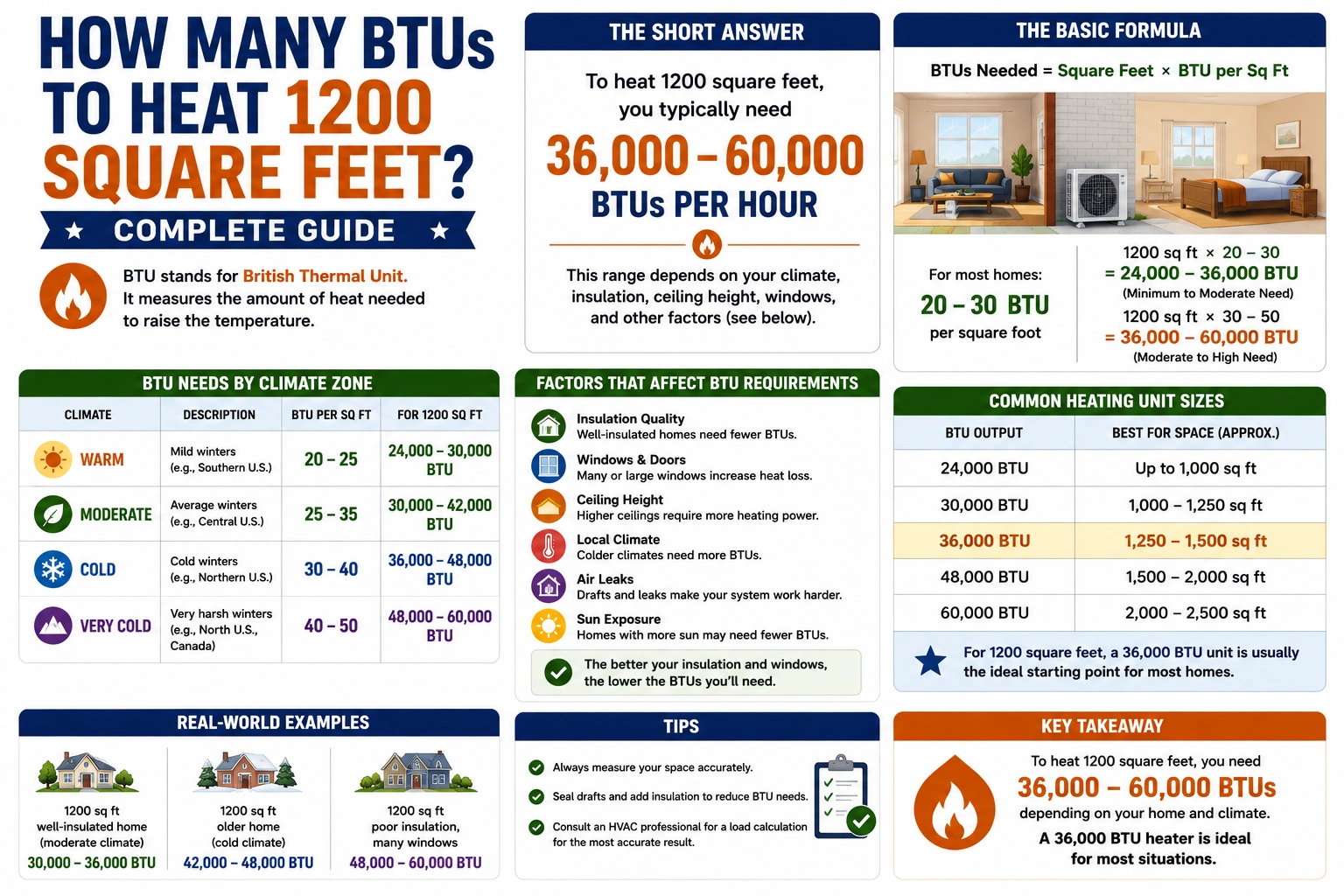
If you are wondering “how many BTUs to heat 1200 square feet,” the typical recommendation is:
30–40 BTUs per square foot
For a 1,200-square-foot home or room, that usually means:
1,200×30=36,000
to
1,200×40=48,000
So, most spaces around 1,200 square feet need approximately:
- 36,000 to 48,000 BTUs
However, the exact number depends on:
- Climate
- Insulation
- Ceiling height
- Windows
- Home efficiency
Choosing the right BTU level is important because an oversized or undersized system can waste energy and reduce comfort.
In this complete guide, you will learn:
- What BTUs mean
- How to calculate heating needs
- Climate-based BTU recommendations
- HVAC sizing tips
- Common heating mistakes
- Expert energy-saving advice
Let’s get started.
Quick Answer for Heating 1200 Square Feet
The average heating recommendation is:
| Climate | Recommended BTUs |
|---|---|
| Warm climate | 30,000–36,000 BTUs |
| Moderate climate | 36,000–42,000 BTUs |
| Cold climate | 42,000–48,000 BTUs |
Most homes around 1,200 square feet need:
- Approximately 36,000–48,000 BTUs
What Is a BTU?
Before calculating heating needs, it helps to understand what BTUs actually measure.
BTU Definition
BTU stands for:
- British Thermal Unit
It measures the amount of heat needed to raise the temperature of one pound of water by one degree Fahrenheit.
Why BTUs Matter in Heating
Heating systems are rated by BTU output.
Higher BTUs mean:
- More heating power
Lower BTUs mean:
- Less heating capacity
Heating vs Cooling BTUs
Both heaters and air conditioners use BTU ratings, but:
- Heating BTUs measure heat production
- Cooling BTUs measure heat removal
How to Calculate BTUs for 1200 Square Feet
A simple formula helps estimate heating needs.
Basic BTU Formula
Most HVAC professionals use:
Square Feet×BTUs per Square Foot
The common estimate is:
- 30–40 BTUs per square foot
Step-by-Step Example
Lower Estimate
1,200×30=36,000 BTUs
Higher Estimate
1,200×40=48,000 BTUs
So:
- 36,000–48,000 BTUs is the common range
Climate Adjustments
Colder climates require:
- More BTUs
Warmer climates require:
- Fewer BTUs
Recommended BTU Range for Different Climates
Climate plays a major role in heating needs.
Warm Climates
Homes in warmer regions may need:
- 30–35 BTUs per square foot
Example:
1,200×30=36,000
Moderate Climates
Average climates often need:
- 35–40 BTUs per square foot
Cold Climates
Cold northern regions may require:
- 40–45 BTUs per square foot
Example:
1,200×45=54,000
Factors That Affect Heating Requirements
Square footage alone is not enough for perfect sizing.
Insulation Quality
Well-insulated homes lose less heat.
Poor insulation increases heating demand.
Ceiling Height
Higher ceilings create more air volume to heat.
Windows and Doors
Drafty windows can significantly increase BTU requirements.
Sun Exposure
Homes receiving direct sunlight may need less heating during daytime hours.
Choosing the Right Heater Size
Different systems use BTU ratings differently.
Furnaces
Furnaces are commonly rated between:
- 40,000–100,000 BTUs
A 1,200-square-foot home often fits within the lower range.
Space Heaters
Portable heaters typically heat:
- Single rooms
- Small apartments
- Offices
Heat Pumps
Heat pumps use efficient heating technology and may require different sizing calculations.
Common Mistakes When Sizing Heating Systems
Incorrect sizing can cause major issues.
Oversized Systems
Oversized heaters:
- Waste energy
- Cycle too frequently
- Reduce efficiency
Undersized Systems
Undersized systems struggle to maintain comfortable temperatures.
Ignoring Insulation
Two homes with the same square footage may require different BTU outputs.
Forgetting Climate Conditions
Cold climates dramatically increase heating demand.
Expert Tips for Efficient Heating
These tips improve comfort and reduce energy costs.
Improve Insulation
Better insulation reduces heat loss.
Seal Air Leaks
Drafts around:
- Doors
- Windows
- Attics
Can waste energy.
Use Programmable Thermostats
Smart thermostats improve efficiency and comfort.
Maintain HVAC Systems
Clean filters and regular servicing improve heater performance.
BTU Heating Chart by Square Footage
Here is a quick reference chart.
| Square Feet | Recommended BTUs |
|---|---|
| 500 sq ft | 15,000–20,000 BTUs |
| 800 sq ft | 24,000–32,000 BTUs |
| 1,000 sq ft | 30,000–40,000 BTUs |
| 1,200 sq ft | 36,000–48,000 BTUs |
| 1,500 sq ft | 45,000–60,000 BTUs |
This chart provides general estimates only.
Practical Situations Where BTU Calculations Matter
Heating calculations are important in many situations.
Buying a Furnace
Correct sizing improves:
- Efficiency
- Comfort
- Equipment lifespan
Renovating a Home
Room additions may require HVAC upgrades.
Energy Savings
Efficient systems reduce monthly utility costs.
Winter Comfort
Proper BTU sizing helps maintain consistent indoor temperatures.
FAQs
How many BTUs do I need for 1200 square feet?
Most 1,200-square-foot spaces require approximately 36,000–48,000 BTUs.
What is the average BTU per square foot?
Most homes use:
- 30–40 BTUs per square foot
Can a heater be too powerful?
Yes. Oversized heaters waste energy and cycle inefficiently.
Does insulation affect BTU requirements?
Yes. Better insulation reduces heating needs.
Is climate important when calculating BTUs?
Absolutely. Colder climates require significantly more heating power.
Conclusion
So, how many BTUs to heat 1200 square feet?
The general recommendation is:
- 36,000 to 48,000 BTUs
1,200 sq ft≈36,000–48,000 BTUs
However, the exact heating requirement depends on:
- Climate
- Insulation
- Ceiling height
- Window efficiency
- Home design
Understanding BTU sizing helps homeowners choose the right heating system for:
- Better comfort
- Improved energy efficiency
- Lower utility bills
- Longer HVAC lifespan
Once you know the basics of BTU calculations, selecting the right heater becomes much easier and more accurate.
Discover More Articles
How Many Feet Is a Tractor Trailer? Full Size Guide