
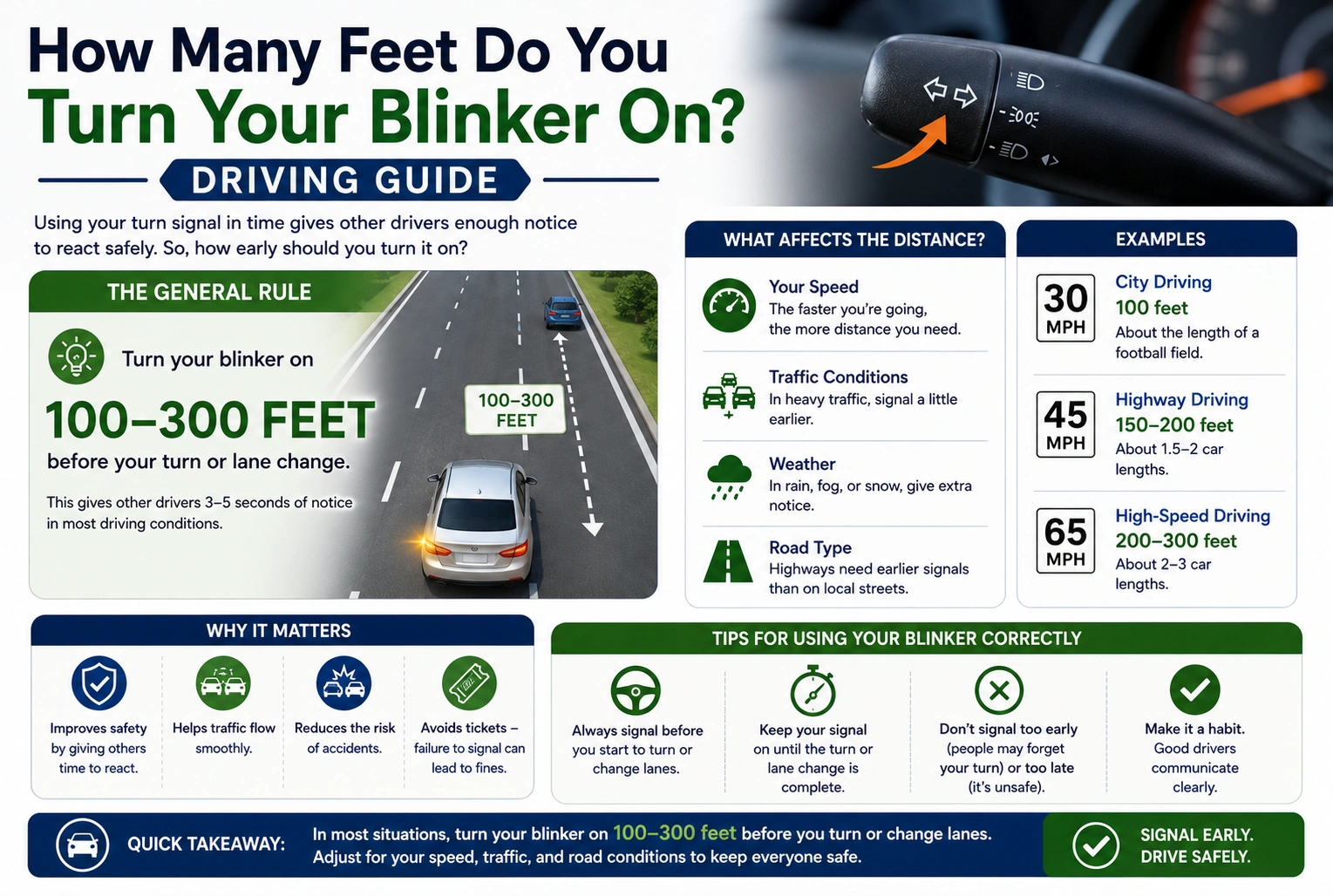
If you’re wondering how many feet do you turn your blinker on, the commonly taught guideline in many U.S. states is to signal continuously for at least 100 feet before making a turn.
This gives other drivers, cyclists, and pedestrians enough time to recognize your intentions and react safely.
However, traffic laws vary by state and country, so you should always follow the rules in your local jurisdiction.
Quick Answer
| Situation | Common Recommendation* |
|---|---|
| Before a Turn | At least 100 feet |
| Before Entering a Driveway | At least 100 feet |
| Before an Intersection | At least 100 feet |
*Always follow your local traffic laws, as legal requirements may differ.
Standard Signaling Distance
Many driver’s education programs teach motorists to activate their turn signal at least 100 feet before turning.
This distance allows surrounding traffic to prepare for your movement and reduces the risk of sudden braking or unexpected lane changes.
Whether you’re turning:
- Right
- Left
- Into a driveway
- Into a parking lot
signaling early is an important part of safe driving.
Why Is 100 Feet Recommended?
Using your turn signal well before your turn helps improve road safety.
Early signaling gives:
- Drivers behind you time to slow down.
- Oncoming traffic time to anticipate your movement.
- Cyclists additional awareness.
- Pedestrians more time to react.
- Other road users clearer communication.
Failing to signal—or signaling too late—can increase the likelihood of confusion and collisions.
How Far Is 100 Feet?
Many new drivers have difficulty estimating 100 feet.
To help visualize it:
- It’s roughly the length of 6 to 7 average passenger cars parked end to end.
- It’s about one-third of the length of a standard American football field.
- It’s approximately 30 meters.
These comparisons can help you judge when to activate your signal while driving.
Turn Signals and Driving Tests
During most driving exams, examiners pay close attention to proper signaling.
Common expectations include:
- Signal before every turn.
- Signal before changing lanes.
- Keep the signal on long enough for other road users to notice it.
- Turn the signal off after completing the maneuver if it does not cancel automatically.
Forgetting to signal or activating it too late may result in point deductions or, depending on the situation, an unsuccessful driving test.
Situations That Require a Turn Signal
Besides turning at intersections, you should generally use your turn signal whenever your vehicle changes direction in a way that could affect other road users.
Examples include:
- Turning into driveways
- Leaving parking spaces
- Changing lanes
- Merging into traffic
- Entering or exiting roundabouts (where required by local rules)
- Pulling over to the curb
Using your signal consistently helps communicate your intentions and contributes to safer driving for everyone.
Using Your Blinker When Changing Lanes
Turn signals are just as important for lane changes as they are for turns.
Before moving into another lane, drivers should generally:
- Check mirrors.
- Check blind spots.
- Activate the turn signal.
- Move only when it is safe to do so.
- Cancel the signal after completing the lane change.
While many jurisdictions require signaling before a lane change, the exact timing can vary. Signaling early gives nearby drivers more time to react and helps reduce the risk of collisions.
Common Turn Signal Mistakes
Many driving errors involve improper use of turn signals.
Signaling Too Late
Activating the blinker only moments before turning gives other drivers very little time to respond.
Forgetting to Signal
Failing to use your turn signal can confuse other road users and may violate traffic laws.
Leaving the Signal On
Sometimes the turn signal does not cancel automatically.
Always check your dashboard after completing a turn or lane change to avoid misleading other drivers.
Signaling Without Turning
Turning on the blinker accidentally can cause confusion, especially in heavy traffic.
Defensive Driving Tips
Using your turn signal is only one part of safe driving.
To improve safety:
- Signal early whenever possible.
- Check mirrors before slowing down.
- Look over your shoulder to check blind spots.
- Avoid sudden braking before a turn.
- Stay aware of cyclists and pedestrians.
- Maintain a safe following distance.
- Follow all local traffic laws.
Clear communication with other road users helps prevent misunderstandings and accidents.
Do Signal Distance Requirements Vary?
Yes. While 100 feet before a turn is a commonly taught guideline and legal requirement in many U.S. jurisdictions, signaling rules are set by individual states, provinces, or countries.
Some locations may have different requirements depending on:
- Speed limits
- Road type
- Lane changes
- Roundabouts
- Highway exits
Always consult your local driver’s handbook or traffic laws for the rules where you drive.
Why Turn Signals Matter
Turn signals help everyone on the road understand what you plan to do next.
Proper signaling improves:
- Traffic flow
- Driver communication
- Pedestrian awareness
- Cyclist safety
- Overall road safety
Even when traffic appears light, using your blinker is a good driving habit.
Frequently Asked Questions
How many feet before a turn should you turn your blinker on?
In many U.S. states, drivers are expected to signal at least 100 feet before turning. However, requirements can vary, so always follow your local traffic laws.
Do I need to use my blinker when changing lanes?
Yes. In most jurisdictions, drivers are required to signal before changing lanes so other road users know their intentions.
Can I fail a driving test for not using my turn signal?
Possibly. Failing to signal, signaling too late, or using the signal incorrectly may result in point deductions or, in some situations, an unsuccessful driving test, depending on local testing standards.
Why is the 100-foot rule important?
Signaling well in advance gives other drivers, cyclists, and pedestrians enough time to recognize your intended movement and adjust safely.
Should I signal if no other vehicles are around?
Yes. Developing the habit of signaling every time you turn or change lanes promotes consistent, safe driving and ensures you’re following the rules if another road user is nearby but not immediately visible.
Conclusion
If you’re asking how many feet do you turn your blinker on, the commonly taught answer is at least 100 feet before making a turn. This guideline is widely used in driver education and is a legal requirement in many U.S. jurisdictions, although traffic laws can differ depending on where you drive.
Using your turn signal early, checking mirrors and blind spots, and following local driving regulations all contribute to safer roads. Whether you’re preparing for a driving test or simply improving your driving habits, signaling consistently is one of the easiest and most effective ways to communicate with other road users.
Discover More Articles
How Many Roofing Squares in 2,000 Square Feet?