
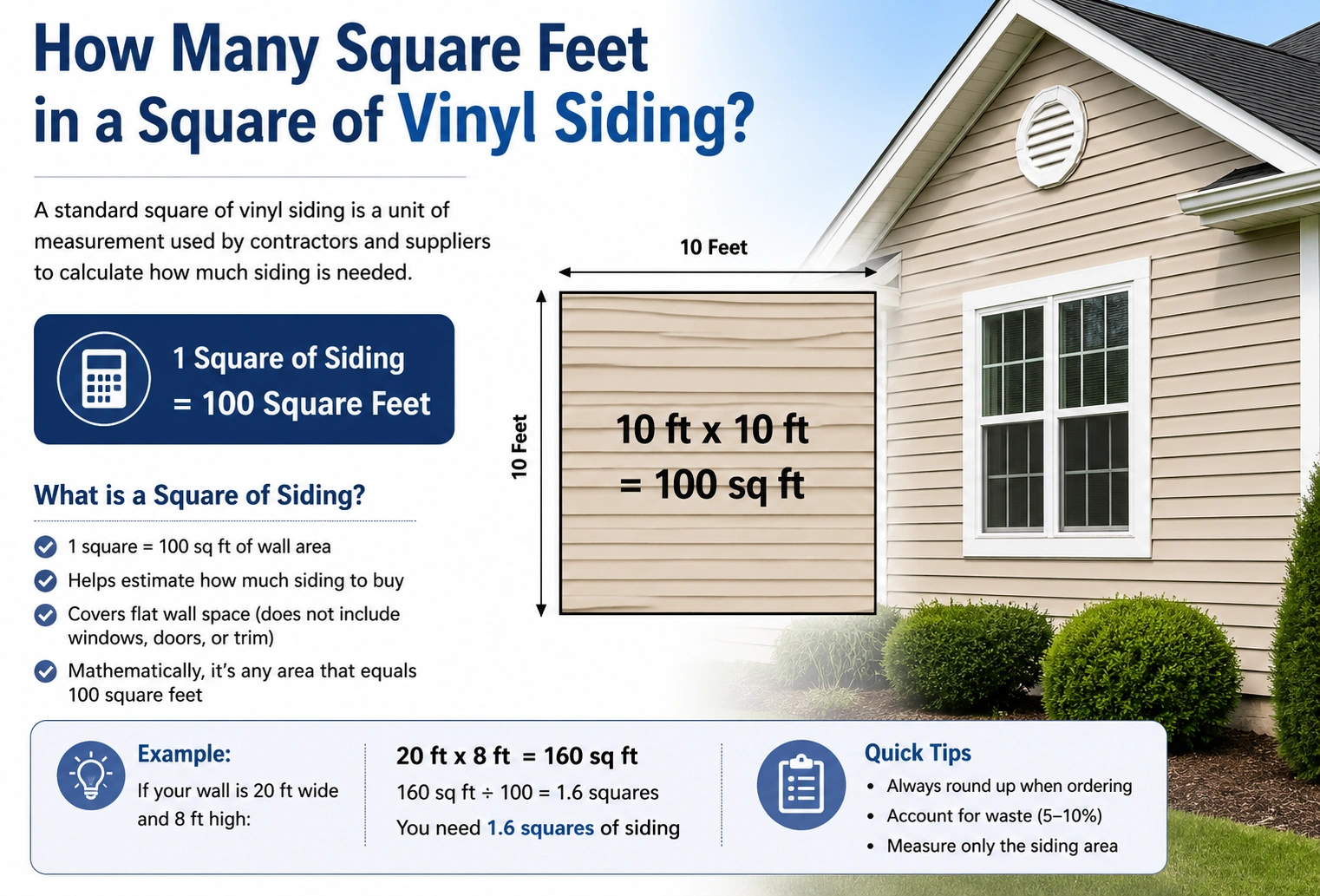
If you’re wondering how many square feet are in a square of vinyl siding, one siding square generally covers 100 square feet of wall area.
The word square is a standard construction measurement used for many exterior building materials, including siding.
The basic conversion is:
1 square of vinyl siding = 100 square feet
So, if the exterior walls of a house require 1,500 square feet of siding coverage, you would need approximately:
1,500 ÷ 100 = 15 squares
This is before adding extra material for cutting, fitting, installation waste, and future repairs.
Quick Answer
1 square of vinyl siding = 100 square feet of coverage.
This does not mean that every package of vinyl siding physically contains exactly 100 square feet of material. Package coverage depends on the specific siding product, panel dimensions, exposure, and manufacturer.
For estimating purposes, however, siding is commonly measured in squares, with each square representing 100 square feet of wall coverage.
What Does a Square of Vinyl Siding Mean?
In siding terminology, a square is a unit of area rather than the shape of an individual siding panel.
One square represents:
100 square feet
For example:
| Siding Squares | Square Feet of Coverage |
|---|---|
| 1 square | 100 sq ft |
| 2 squares | 200 sq ft |
| 3 squares | 300 sq ft |
| 5 squares | 500 sq ft |
| 10 squares | 1,000 sq ft |
| 15 squares | 1,500 sq ft |
| 20 squares | 2,000 sq ft |
| 25 squares | 2,500 sq ft |
| 30 squares | 3,000 sq ft |
To convert square feet to siding squares, divide the wall area by 100.
Siding Squares = Wall Area ÷ 100
For example, a wall area of 2,400 square feet would require:
2,400 ÷ 100 = 24 squares
How Do You Calculate How Many Squares of Vinyl Siding You Need?
First, calculate the total exterior wall area that will receive siding.
For a simple rectangular wall, use:
Wall Area = Length × Height
For example, suppose one wall is 40 feet long and 10 feet high:
40 × 10 = 400 square feet
If another wall is also 40 × 10 feet:
40 × 10 = 400 square feet
Two walls would therefore have:
400 + 400 = 800 square feet
Continue calculating each exterior wall and add the areas together.
Then divide the total by 100:
Total Siding Squares = Total Wall Area ÷ 100
If the total wall area is 1,800 square feet:
1,800 ÷ 100 = 18 squares
You would then account for windows, doors, gables, waste, and other factors before placing the final order.
Should You Subtract Windows and Doors?
Yes, when making a detailed material estimate, large windows and doors can be subtracted from the total wall area because those areas generally do not require siding.
For example, suppose a home’s exterior walls total 2,000 square feet.
If windows and doors account for 200 square feet:
2,000 − 200 = 1,800 square feet
The adjusted siding area is 1,800 square feet.
Then:
1,800 ÷ 100 = 18 squares
This provides a more precise estimate than simply dividing the entire wall area by 100.
However, small openings may not always be worth subtracting because the resulting pieces can be used around other areas during installation.
How Much Extra Vinyl Siding Should You Buy?
You generally should not order exactly the calculated number of squares because siding installation creates waste.
Extra material may be needed because of:
- Cutting
- Angled walls
- Gables
- Corners
- Windows
- Doors
- Damaged panels
- Incorrect cuts
- Future repairs
A common estimating approach is to add approximately 10% extra material, although the appropriate amount depends on the complexity of the building and installation.
For example, if your calculated siding requirement is 20 squares:
20 × 10% = 2 squares
Adding that allowance gives:
20 + 2 = 22 squares
So you might plan for approximately 22 squares.
For a simple rectangular building with very little cutting, the waste percentage may be lower. Complex homes with multiple rooflines, gables, corners, and architectural features may require more.
Vinyl Siding Squares With 10% Waste
| Required Coverage | Base Squares | Approx. Squares With 10% Extra |
| 500 sq ft | 5 | 5.5 |
| 1,000 sq ft | 10 | 11 |
| 1,500 sq ft | 15 | 16.5 |
| 2,000 sq ft | 20 | 22 |
| 2,500 sq ft | 25 | 27.5 |
| 3,000 sq ft | 30 | 33 |
| 3,500 sq ft | 35 | 38.5 |
| 4,000 sq ft | 40 | 44 |
Because siding is normally purchased in whole packages or squares, the final quantity should be rounded according to the manufacturer’s packaging and your project’s requirements.
How Many Square Feet Does One Box of Vinyl Siding Cover?
This depends on the specific product.
A siding square always represents 100 square feet of coverage, but manufacturers package vinyl siding in different quantities.
One box or carton may contain enough siding for a fraction of a square, approximately one square, or more than one square depending on the panel dimensions and product.
Always check the manufacturer’s stated coverage per carton rather than assuming that one box equals one siding square.
This distinction is important when converting a project estimate into the number of boxes to purchase.
How Many Vinyl Siding Panels Are in a Square?
There is no universal number of panels in one square.
The number depends on:
- Panel length
- Panel height
- Exposure
- Product design
- Manufacturer
- Installation method
For example, a longer panel covers more wall area than a shorter panel, so fewer panels may be needed to cover the same 100 square feet.
Because of these differences, it is better to calculate the project in square feet or siding squares first, then use the manufacturer’s coverage information to determine the number of cartons or panels.
How Many Squares of Vinyl Siding Does a House Need?
The answer depends on the home’s exterior wall area, not simply its interior living area.
For example, a 2,000-square-foot house does not necessarily require 20 squares of siding.
The home’s 2,000 square feet of living space is different from the total square footage of its exterior walls.
A two-story house, ranch-style house, house with multiple gables, and house with a complex floor plan can all have different exterior wall areas despite having the same interior floor area.
Therefore, calculate the actual siding surface rather than using the home’s interior square footage.
Example: Calculating Siding for a 1,500-Square-Foot Wall Area
Suppose the total exterior wall area requiring siding is 1,500 square feet.
Convert it to squares:
1,500 ÷ 100 = 15 squares
If you add 10% for waste:
15 × 1.10 = 16.5 squares
Depending on the product packaging, you would generally need to purchase enough material to cover at least 16.5 squares, which may mean rounding up to the next practical quantity.
Example: Calculating Siding for a 2,400-Square-Foot Wall Area
Suppose your measured siding area is 2,400 square feet.
First convert to squares:
2,400 ÷ 100 = 24 squares
With a 10% allowance:
24 × 1.10 = 26.4 squares
You would need enough material to cover approximately 26.4 squares, so the actual purchase quantity would normally be rounded up based on how the siding is packaged.
Common Siding Coverage Examples
| Exterior Wall Area | Siding Squares Needed | With 10% Allowance |
| 800 sq ft | 8 | 8.8 |
| 1,000 sq ft | 10 | 11 |
| 1,200 sq ft | 12 | 13.2 |
| 1,500 sq ft | 15 | 16.5 |
| 1,800 sq ft | 18 | 19.8 |
| 2,000 sq ft | 20 | 22 |
| 2,400 sq ft | 24 | 26.4 |
| 3,000 sq ft | 30 | 33 |
These are estimating examples. The actual requirement should be based on the measured siding surface and the manufacturer’s installation specifications.
Does Siding Square Footage Include Trim?
The 100-square-foot siding-square measurement refers to the siding coverage area. Trim and accessories are generally estimated separately.
A siding project may also require:
- Starter strips
- Corner posts
- J-channels
- Window and door trim
- Utility trim
- Soffit
- Fascia
- Underlayment or house wrap
- Fasteners
These materials are not necessarily included in the number of siding squares.
For an accurate material list, estimate the siding panels separately from trim and accessories.
Why Is Vinyl Siding Sold by the Square?
Using squares makes it easier for contractors and suppliers to estimate large exterior surfaces.
Instead of saying a project requires 2,350 square feet of siding, a contractor can describe the requirement as approximately 23.5 squares before waste.
The same terminology is widely used for other building materials, including roofing.
Because one square represents 100 square feet, the calculation is simple:
Square Feet ÷ 100 = Squares
This allows contractors to compare material quantities quickly.
Frequently Asked Questions
How many square feet are in one square of vinyl siding?
One square of vinyl siding represents 100 square feet of coverage.
Is one square of siding always 100 square feet?
Yes, a siding square is defined as 100 square feet of coverage. However, the number of panels or cartons required to make one square varies by product.
How many squares of siding do I need for 1,000 square feet?
You need 10 squares to cover 1,000 square feet before accounting for waste.
How many squares of siding do I need for 2,000 square feet?
You need 20 squares for 2,000 square feet of coverage before adding an allowance for waste.
How much extra siding should I buy?
A common planning allowance is around 10% extra, but the appropriate amount depends on the building’s shape, number of corners, gables, windows, doors, and installation complexity.
Does a 2,000-square-foot house need 20 squares of siding?
Not necessarily. A home’s interior square footage is different from its exterior wall area. You should calculate the actual wall surface that will receive siding.
How do I calculate siding squares?
Measure the exterior wall areas, add them together, subtract appropriate openings such as large windows and doors, and divide the resulting square footage by 100.
Does one box of vinyl siding equal one square?
Not necessarily. Carton coverage varies by manufacturer and product. Check the product’s stated coverage per carton.
Are siding trim pieces included in the siding square?
Generally, no. Trim and accessories such as corner posts, J-channel, and starter strips are normally estimated separately.
Conclusion
If you’re asking how many square feet are in a square of vinyl siding, the answer is 100 square feet.
The basic conversion is:
1 siding square = 100 square feet
To estimate how many squares you need, calculate the total exterior wall area, account for large openings such as windows and doors, and divide the result by 100. It is also wise to include an appropriate waste allowance, especially for homes with multiple corners, gables, and architectural details.
Remember that a siding square is a unit of coverage, while the number of panels or boxes required to provide that coverage depends on the specific vinyl siding product.
Discover More Articles
One Gajam Equal to How Many Square Feet? Exact Guide