
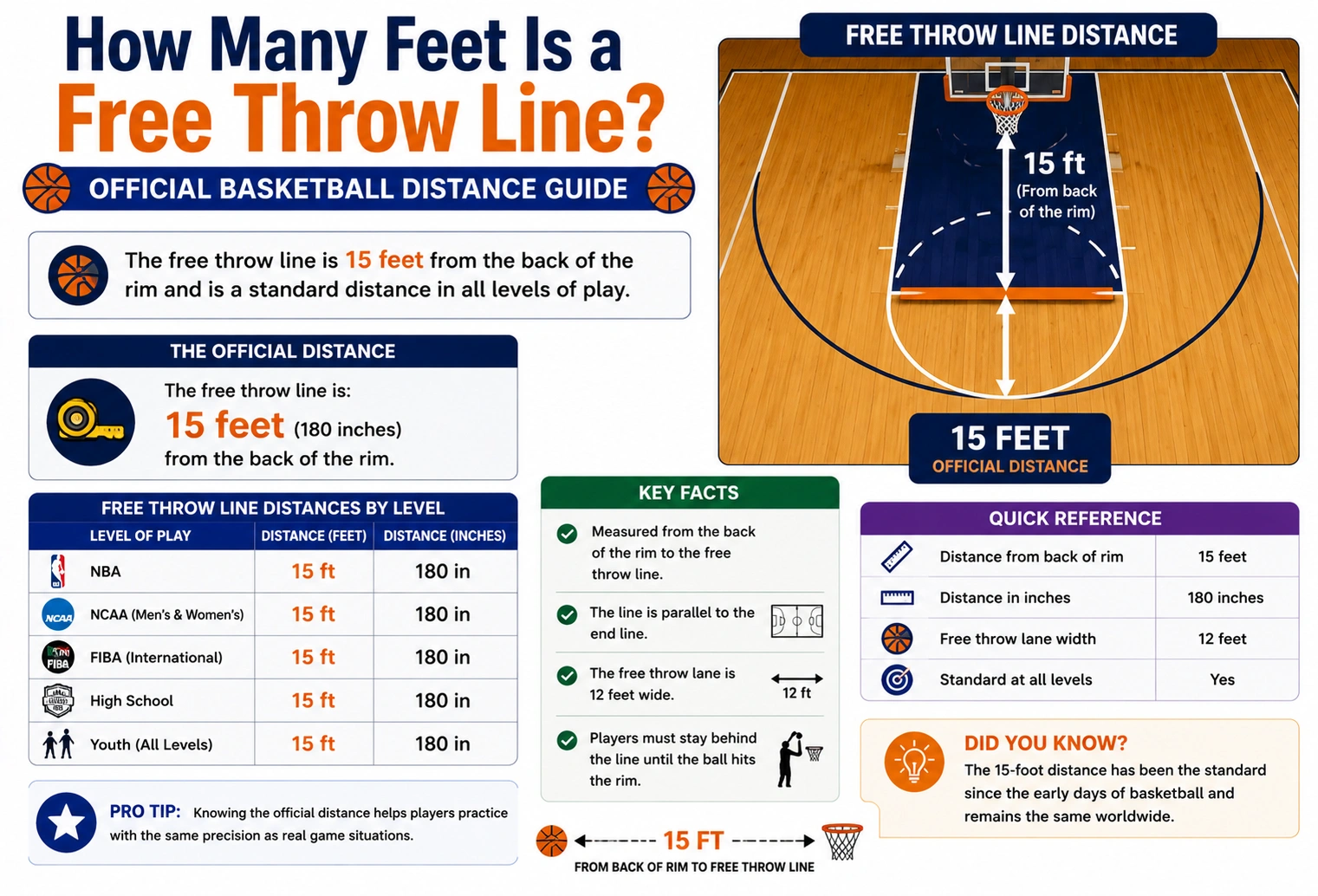
If you’re wondering how many feet is a free throw line, the official answer is:
The free throw line is 15 feet from the front of the backboard.
This distance is used in the NBA, WNBA, NCAA, and most high school basketball leagues. It has remained one of the most consistent measurements in basketball and is essential for maintaining fairness and uniformity in the game.
Players take free throws from behind this line after certain fouls, making it one of the most recognizable markings on a basketball court.
Quick Answer
| Measurement | Distance |
|---|---|
| Free Throw Line to Backboard | 15 feet |
| Free Throw Line to Basket (Hoop Center)* | Approximately 13 feet 9 inches |
| Basket Height | 10 feet |
*The basket projects 15 inches from the backboard, so the distance from the free throw line to the center of the rim is approximately 13 feet 9 inches.
Official Free Throw Line Distance
According to official basketball rules, the free throw line is located:
15 feet from the front of the backboard
This measurement applies across nearly all major levels of competitive basketball.
The free throw line is centered within the free throw lane, also known as the key or the paint.
Free Throw Line in Different Basketball Leagues
One reason basketball courts feel familiar across different levels of play is that the free throw line distance remains consistent.
| League | Free Throw Line Distance |
| NBA | 15 feet |
| WNBA | 15 feet |
| NCAA | 15 feet |
| High School | 15 feet |
| FIBA | 15 feet |
Although other court dimensions may vary slightly between organizations, the free throw line remains 15 feet from the backboard.
Why Is the Free Throw Line 15 Feet Away?
The 15-foot distance provides a balanced challenge.
It requires players to demonstrate:
- Shooting accuracy
- Proper shooting mechanics
- Consistency
- Focus under pressure
A shorter distance would make free throws too easy, while a longer distance would significantly reduce shooting percentages.
The current measurement has been used successfully for decades and is recognized worldwide.
Other Important Court Measurements
The free throw line is only one part of a basketball court.
Some other official measurements include:
| Court Feature | Measurement |
| Hoop Height | 10 feet |
| Rim Diameter | 18 inches |
| Backboard Width | 6 feet |
| Free Throw Lane Width (NBA) | 16 feet |
| Free Throw Lane Width (FIBA) | 16 feet |
Together, these measurements create a standardized playing environment for athletes at every level.
How Players Practice Free Throws
Because every free throw is taken from the same distance, players spend significant time practicing from the line.
A typical practice routine includes:
- Repeating the same shooting motion
- Maintaining consistent foot placement
- Following through after each shot
- Developing mental focus
- Building muscle memory
Professional players often practice hundreds of free throws during training sessions to improve accuracy under game conditions.
History of the Free Throw Line
The free throw has been part of basketball since the early years of the sport. While many court dimensions have changed over time, the 15-foot free throw line has remained a standard measurement in major basketball organizations.
Keeping this distance consistent allows players at different levels—from youth leagues to professional basketball—to develop the same shooting fundamentals and compete under similar conditions.
Why the Free Throw Line Matters
Free throws can have a major impact on the outcome of a game.
They reward players after certain fouls and test their ability to score without defensive pressure.
Strong free-throw shooters often help their teams by:
- Scoring easy points
- Maintaining momentum
- Finishing close games
- Punishing opponents for fouling
- Improving overall offensive efficiency
Because every shot is taken from the same distance, consistency becomes one of the most valuable skills in basketball.
Real-World Examples
NBA Games
Every free throw in the NBA is taken from 15 feet from the front of the backboard, regardless of the arena.
College Basketball
NCAA men’s and women’s basketball also use the same 15-foot free throw line, helping players transition smoothly between different levels of competition.
High School Basketball
Most high school courts follow the same standard, allowing young athletes to practice using official measurements before advancing to college or professional play.
Recreational Courts
Many community gyms and public basketball courts are built using official court dimensions, including the 15-foot free throw line, so recreational players can enjoy the same experience as competitive athletes.
Common Misconceptions
The Free Throw Line Is 15 Feet from the Rim
This is not entirely correct.
The official measurement is 15 feet from the front of the backboard. Since the rim extends 15 inches from the backboard, the distance from the free throw line to the center of the hoop is approximately 13 feet 9 inches.
Different Leagues Use Different Free Throw Distances
Although some court dimensions vary between leagues, the free throw line distance remains 15 feet in the NBA, WNBA, NCAA, FIBA, and most high school competitions.
Taller Players Shoot from Farther Away
Every player shoots from the same free throw line regardless of height, position, or skill level.
Tips for Improving Free Throw Shooting
Successful free throw shooting relies on consistency and proper technique.
Some helpful practice tips include:
- Develop a consistent pre-shot routine.
- Keep your eyes focused on the rim.
- Bend your knees and use your legs for power.
- Maintain balanced foot placement behind the line.
- Follow through with your shooting hand after releasing the ball.
- Practice regularly to build confidence and muscle memory.
Even experienced players continue practicing free throws throughout their careers.
Frequently Asked Questions
How many feet is a free throw line?
The free throw line is 15 feet from the front of the backboard in official basketball.
How far is the free throw line from the basket?
The distance from the free throw line to the center of the rim is approximately 13 feet 9 inches, because the rim projects 15 inches from the backboard.
Is the free throw distance the same in the NBA and NCAA?
Yes. The NBA, NCAA, WNBA, FIBA, and most high school leagues all use a 15-foot free throw line.
Why is the free throw line 15 feet away?
The 15-foot distance provides a balanced level of difficulty, testing shooting accuracy and consistency while keeping the game fair across all levels of competition.
Can players step on the free throw line?
No. A shooter must remain behind the free throw line until the ball contacts the rim. Stepping on or over the line too early is a violation under basketball rules.
Conclusion
If you’re asking how many feet is a free throw line, the official answer is 15 feet from the front of the backboard. This standard measurement is used across the NBA, WNBA, NCAA, FIBA, and most high school basketball leagues, making it one of the most consistent dimensions in the sport.
Whether you’re practicing your shooting, coaching a team, building a basketball court, or simply learning the rules of the game, understanding the official free throw distance provides a better appreciation of basketball fundamentals. Consistent practice from the 15-foot line helps players improve accuracy, confidence, and overall performance on the court.
Discover More Articles
How Many Feet Is 1.2m? Exact Conversion Guide