

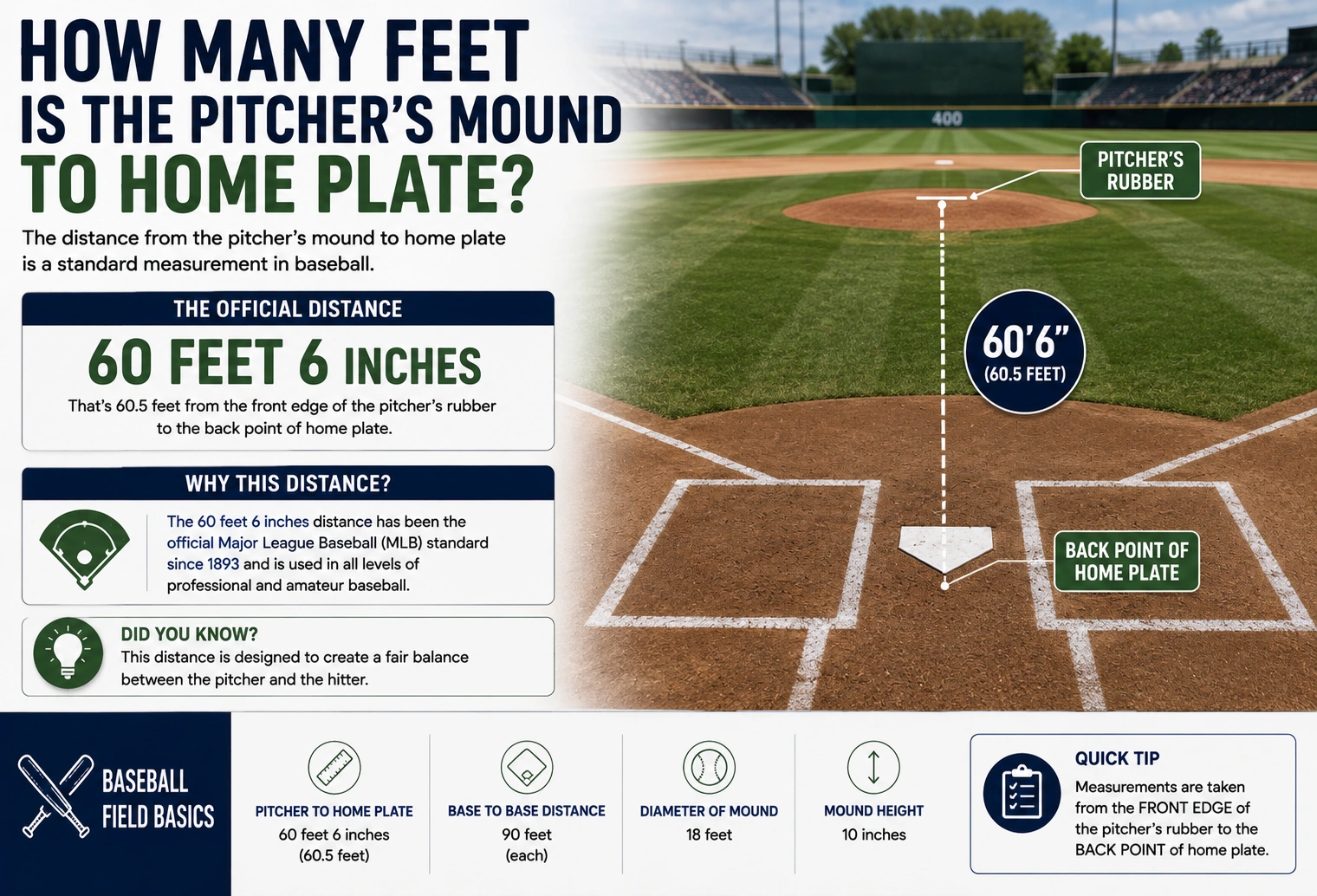
If you’re wondering how many feet the pitcher’s mound is from home plate, the standard distance for professional baseball is 60 feet 6 inches from the pitching rubber to the rear point of home plate.
Because 6 inches equals 0.5 feet, the distance can also be expressed as:
60 feet 6 inches = 60.5 feet
This is the standard pitching distance used in Major League Baseball (MLB) and is also commonly used in adult baseball.
An important detail is that the official distance is not measured from the center of the pitcher’s mound. It is measured from the front edge of the pitching rubber to the rear point of home plate.
Quick Answer
The pitcher’s mound is 60 feet 6 inches from home plate in professional baseball.
That equals:
60.5 feet
| Measurement | Distance |
|---|---|
| Feet and inches | 60 ft 6 in |
| Decimal feet | 60.5 ft |
| Inches | 726 in |
| Yards | 20.17 yd |
| Meters | 18.44 m |
So, if you’re measuring an MLB-style baseball field, the official pitching distance from the pitching rubber to home plate is 60 feet 6 inches.
However, youth baseball fields often use shorter pitching distances to match the age and ability of the players.
Official Distance From the Pitcher’s Mound to Home Plate
The official professional baseball pitching distance is 60 feet 6 inches.
This measurement is taken from the front edge of the pitcher’s rubber to the back point of home plate.
The distinction is important because people often assume the measurement begins at the center of the mound. The mound itself is larger than the actual pitching point, so measuring from its center can produce an inaccurate result.
For an MLB-style field:
Pitching rubber → 60 feet 6 inches → rear point of home plate
The pitching rubber provides the specific reference point used to establish the official pitching distance.
Why the Distance Is Measured From the Pitching Rubber
The pitcher’s mound is a raised area, but the pitcher does not use the entire mound as the starting point for every pitch.
Instead, the pitcher works from a rectangular pitching rubber, sometimes called the pitching plate.
The official distance is measured from the appropriate edge of this rubber to the designated point on home plate.
This creates a consistent pitching distance across properly constructed baseball fields.
For example, two fields might have mounds that appear slightly different in size or shape, but if the pitching rubber is positioned correctly, the pitching distance can still meet the required specification.
This is why measuring from the center of the mound is not the correct way to determine the official pitching distance.
Pitching Distance by Baseball Level
The distance between the pitching area and home plate is not the same for every type of baseball.
Youth leagues often use shorter distances because younger players have less throwing strength and need a field designed for their age group.
| Baseball Level | Approximate Pitching Distance |
|---|---|
| MLB / Professional | 60 ft 6 in |
| College baseball | 60 ft 6 in |
| High school baseball | 60 ft 6 in |
| Little League Majors | 46 ft |
| Some younger youth divisions | Shorter distances may apply |
The exact youth distance can vary depending on the league, age division, and field regulations.
Therefore, if you’re building or measuring a youth baseball field, don’t automatically use the professional 60-foot-6-inch distance.
Always check the specific league’s field specifications.
How Far Is 60 Feet 6 Inches in Other Units?
Converting the standard pitching distance into other units can make the measurement easier to understand.
The professional distance is 60.5 feet.
| Unit | Equivalent |
|---|---|
| Feet | 60.5 ft |
| Feet & inches | 60 ft 6 in |
| Inches | 726 in |
| Yards | 20.17 yd |
| Meters | 18.44 m |
| Centimeters | 1,844 cm |
To convert the distance into inches:
60 × 12 + 6 = 726 inches
To convert it into yards:
60.5 ÷ 3 ≈ 20.17 yards
To convert it into meters:
60.5 × 0.3048 = 18.44 meters
How to Measure From Home Plate to the Pitcher’s Mound
If you need to measure an existing baseball field, use a measuring tape, measuring wheel, or other accurate distance-measuring equipment.
The important part is measuring between the correct reference points.
Step 1: Locate Home Plate
Identify the rear point of home plate, which is the point farthest from the pitcher.
Step 2: Locate the Pitching Rubber
Find the rectangular pitching rubber on the mound.
Step 3: Measure the Distance
Measure along the intended centerline from the rear point of home plate to the appropriate edge of the pitching rubber.
For an MLB-style field, the result should be:
60 feet 6 inches
Step 4: Check the Alignment
The pitching rubber and home plate should be aligned along the centerline of the baseball diamond.
A measurement that is the correct length but not properly aligned can still create a field that does not meet the intended specifications.
Pitcher’s Mound and Pitching Rubber Dimensions
The pitching distance is only one measurement associated with the mound.
The mound itself is a raised area around the pitching rubber. The rubber provides the specific reference point for the pitching distance.
For a professional-style field, the pitching mound is approximately 18 feet in diameter.
The pitching rubber is positioned within the mound, and the mound’s height and slope are also regulated.
| Feature | Professional Baseball |
|---|---|
| Pitching distance | 60 ft 6 in |
| Mound diameter | 18 ft |
| Pitching rubber length | 24 in |
| Pitching rubber width | 6 in |
| Mound height | 10 in |
These specifications help create consistency between properly constructed professional baseball fields.
Why Pitching Distance Matters
The distance from the pitching rubber to home plate has a major effect on the game.
A pitcher throwing from 60 feet 6 inches has a specific amount of space in which the baseball travels toward the batter.
Changing the distance can affect:
- Pitch reaction time
- Pitch velocity perception
- Breaking-ball movement
- Batter timing
- Pitcher mechanics
- Field design
- Player development
A shorter pitching distance generally gives the batter less physical distance to cover before the ball reaches home plate, while a longer distance gives the ball more room to travel.
This is one reason youth baseball uses different field dimensions.
Pitching Distance vs. Distance to the Center of the Mound
One of the most common measurement mistakes is assuming the official distance is from home plate to the center of the pitcher’s mound.
That’s not how the official pitching distance is defined.
The relevant measurement uses the pitching rubber and the designated point of home plate.
This matters because the mound itself has a diameter and covers a much larger area than the pitching rubber.
For field construction, always use the official reference points rather than estimating from the visible center of the mound.
Is the Pitcher’s Mound 60 Feet From Home Plate?
The short answer is not exactly.
The standard distance is:
60 feet 6 inches
That’s half a foot longer than exactly 60 feet.
In decimal form:
60.5 feet
This extra 6 inches is important when constructing or measuring a regulation baseball field.
| Description | Distance |
|---|---|
| Exactly 60 feet | 60 ft |
| Standard pitching distance | 60 ft 6 in |
| Difference | 6 in |
| Standard distance in decimal feet | 60.5 ft |
How Pitching Distance Compares With a Baseball Base Path
The distance between bases in a standard professional baseball diamond is 90 feet.
The pitching distance of 60 feet 6 inches is therefore considerably shorter than the distance between bases.
| Baseball Measurement | Distance |
|---|---|
| Pitching rubber to home plate | 60 ft 6 in |
| Base to base | 90 ft |
| First base to third base | 127 ft 3⅜ in |
| Home plate to second base | About 127 ft 3⅜ in |
This comparison helps show where the pitching distance fits into the overall baseball diamond.
Common Mistakes When Measuring Pitching Distance
Measuring From the Center of the Mound
The official distance isn’t measured from the center of the mound.
Use the pitching rubber and the correct reference point on home plate.
Rounding 60 Feet 6 Inches Down to 60 Feet
Although 60 feet is close, the official professional distance is 60 feet 6 inches.
Assuming Every Baseball Field Uses 60 Feet 6 Inches
Youth baseball fields frequently use different pitching distances.
Always check the rules for the specific league.
Measuring in the Wrong Direction
The distance should follow the centerline between the pitching area and home plate.
Confusing Pitching Distance With Base Distance
The pitching distance and distance between bases are completely different measurements.
A regulation professional baseball field uses 60 feet 6 inches for pitching distance and 90 feet between bases.
FAQs
How many feet is the pitcher’s mound from home plate?
In professional baseball, the pitching distance is 60 feet 6 inches, or 60.5 feet, from the pitching rubber to the rear point of home plate.
Is the pitching mound 60 feet 6 inches from home plate?
Yes. The standard professional pitching distance is 60 feet 6 inches.
How far is the Little League pitching mound from home plate?
Little League’s standard pitching distance for its Majors division is 46 feet. Other youth divisions may use different field dimensions.
How many meters is 60 feet 6 inches?
The professional pitching distance is approximately 18.44 meters.
Is pitching distance measured from the center of the mound?
No. The official measurement uses the pitching rubber as the pitching reference point, rather than the center of the mound.
How far is the pitcher’s mound from home plate in high school baseball?
High school baseball generally uses the same 60 feet 6 inches pitching distance as professional baseball.
How far is the pitcher’s mound from home plate in college baseball?
College baseball uses a 60 feet 6 inches pitching distance.
How many yards is the pitching distance?
60 feet 6 inches equals approximately 20.17 yards.
Conclusion
So, how many feet is the pitcher’s mound to home plate? In professional, college, and high school baseball, the standard pitching distance is 60 feet 6 inches, which equals 60.5 feet or approximately 18.44 meters.
The measurement is taken from the pitching rubber to the rear point of home plate, not from the center of the mound.
Youth baseball uses different pitching distances depending on the league and age division. For example, Little League Majors uses a 46-foot pitching distance.
If you’re measuring or constructing a baseball field, use the appropriate league’s official specifications and measure from the correct reference points. This ensures the pitching distance is accurate and the field is properly laid out.
Discover More Articles
How Many Feet Are in 6.096 mm? Exact Conversion Guide