
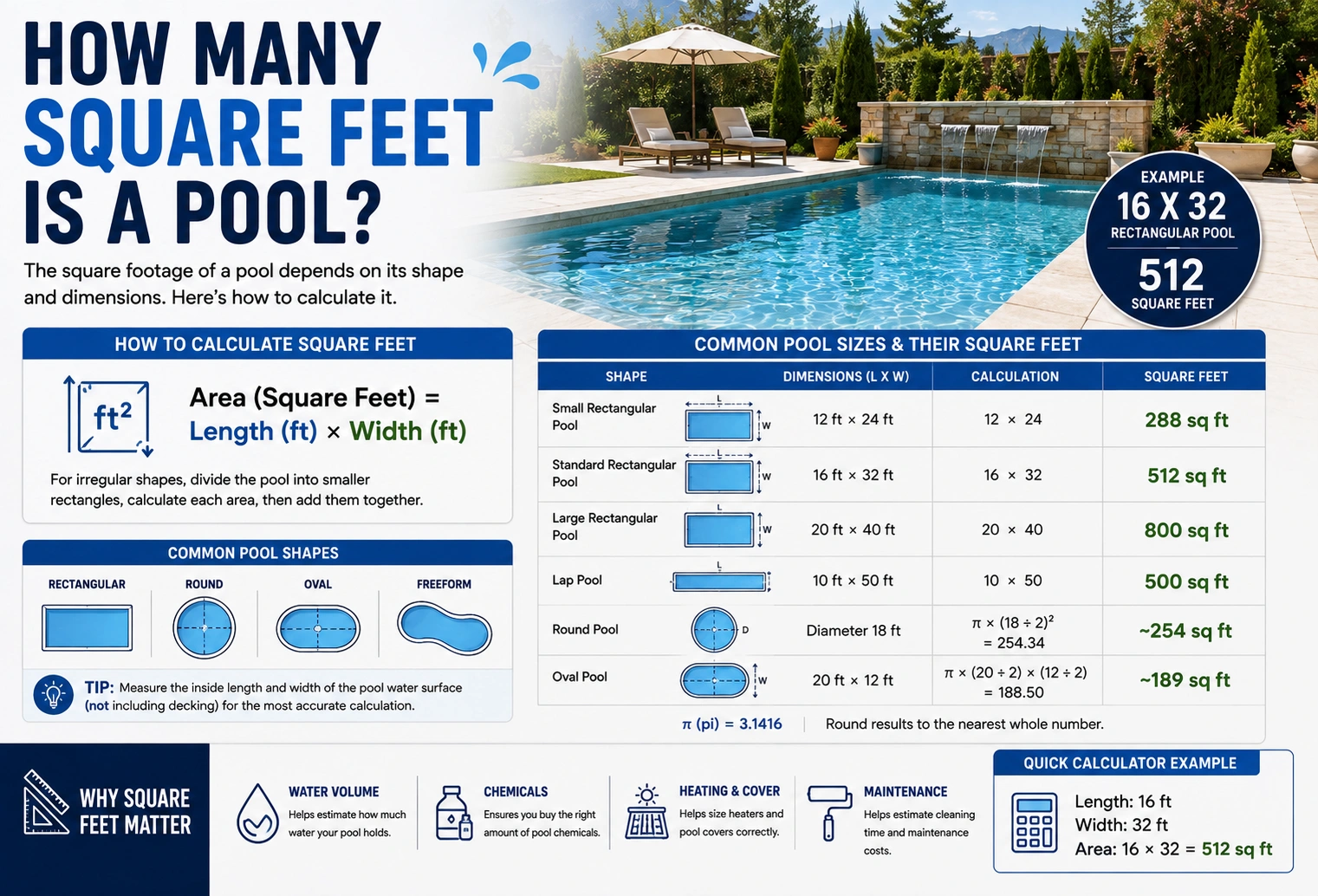
There is no single square-foot size for a pool because pools come in many shapes and dimensions. A small residential pool may be around 200–400 square feet, while a larger backyard pool can exceed 600 square feet.
For a rectangular pool, calculate the surface area with:
Length × Width = Square Feet
For example, a 20 × 10-foot pool is:
20 × 10 = 200 square feet
| Pool Size | Surface Area |
|---|---|
| 10 × 20 ft | 200 sq ft |
| 12 × 24 ft | 288 sq ft |
| 14 × 28 ft | 392 sq ft |
| 15 × 30 ft | 450 sq ft |
| 16 × 32 ft | 512 sq ft |
| 20 × 40 ft | 800 sq ft |
How Many Square Feet Is a Pool?
The square footage of a pool refers to its surface area, or the amount of horizontal space covered by the water.
Unlike a room, there is no standard pool size. Pool dimensions depend on the available yard, intended use, budget, shape, and property layout.
A typical residential swimming pool may range from a compact plunge pool to a large family pool.
| Pool Type | Approximate Surface Area |
|---|---|
| Small plunge pool | 100–250 sq ft |
| Small backyard pool | 200–350 sq ft |
| Medium residential pool | 300–500 sq ft |
| Large residential pool | 500–800+ sq ft |
| Lap pool | 300–800+ sq ft |
| Commercial pool | 1,000+ sq ft |
These are general size ranges rather than fixed standards.
How Do You Calculate Pool Square Feet?
For a rectangular or square pool, calculating square footage is simple.
Square Pool
Use:
Area = Length × Width
If a square pool is 15 feet long and 15 feet wide:
15 × 15 = 225 square feet
The pool has 225 square feet of surface area.
Rectangular Pool
Suppose a pool measures 30 feet long and 15 feet wide:
30 × 15 = 450 square feet
Therefore, the pool’s surface area is 450 square feet.
| Length | Width | Pool Area |
|---|---|---|
| 10 ft | 20 ft | 200 sq ft |
| 12 ft | 24 ft | 288 sq ft |
| 14 ft | 28 ft | 392 sq ft |
| 15 ft | 30 ft | 450 sq ft |
| 16 ft | 32 ft | 512 sq ft |
| 18 ft | 36 ft | 648 sq ft |
| 20 ft | 40 ft | 800 sq ft |
Common Swimming Pool Sizes in Square Feet
Pool sizes vary widely, but certain dimensions are commonly considered for residential installations.
| Pool Dimensions | Square Feet | General Use |
|---|---|---|
| 10 × 20 ft | 200 sq ft | Small backyard pool |
| 12 × 20 ft | 240 sq ft | Compact family pool |
| 12 × 24 ft | 288 sq ft | Medium-small pool |
| 14 × 28 ft | 392 sq ft | Family swimming |
| 15 × 30 ft | 450 sq ft | Larger family pool |
| 16 × 32 ft | 512 sq ft | Large backyard pool |
| 18 × 36 ft | 648 sq ft | Large pool |
| 20 × 40 ft | 800 sq ft | Very large residential pool |
The best size depends on how much yard space you have and how you plan to use the pool.
How Many Square Feet Is a 10 x 20 Pool?
A 10 × 20-foot pool has:
10 × 20 = 200 square feet
So, the pool’s surface area is 200 square feet.
This is a relatively compact rectangular pool and can work well where backyard space is limited.
How Many Square Feet Is a 12 x 24 Pool?
A 12 × 24-foot pool has:
12 × 24 = 288 square feet
Therefore, a 12 × 24 pool contains 288 square feet of surface area.
| Pool Size | Calculation | Area |
|---|---|---|
| 10 × 20 | 10 × 20 | 200 sq ft |
| 12 × 24 | 12 × 24 | 288 sq ft |
| 14 × 28 | 14 × 28 | 392 sq ft |
| 15 × 30 | 15 × 30 | 450 sq ft |
| 16 × 32 | 16 × 32 | 512 sq ft |
How Many Square Feet Is a 14 x 28 Pool?
A 14 × 28-foot pool has:
14 × 28 = 392 square feet
So, the pool covers 392 square feet of surface area.
This size provides considerably more swimming space than a 10 × 20 pool.
How Many Square Feet Is a 15 x 30 Pool?
A 15 × 30-foot pool has:
15 × 30 = 450 square feet
This means the pool’s water surface covers 450 square feet.
A 15 × 30 pool is a substantial residential pool and offers enough length and width for swimming, recreation, and family use.
How Many Square Feet Is a 16 x 32 Pool?
A 16 × 32-foot pool has:
16 × 32 = 512 square feet
Therefore, a 16 × 32 pool contains 512 square feet of surface area.
| Pool Dimensions | Area |
|---|---|
| 12 × 24 ft | 288 sq ft |
| 14 × 28 ft | 392 sq ft |
| 15 × 30 ft | 450 sq ft |
| 16 × 32 ft | 512 sq ft |
| 18 × 36 ft | 648 sq ft |
| 20 × 40 ft | 800 sq ft |
How Many Square Feet Is a Round Pool?
Round pools require a different formula.
Use:
Area = π × radius²
The radius is half of the pool’s diameter.
For example, if a circular pool has a 20-foot diameter:
Radius = 20 ÷ 2 = 10 feet
Then:
Area = 3.14 × 10 × 10
Area ≈ 314 square feet
So, a 20-foot-diameter circular pool has approximately 314 square feet of surface area.
| Pool Diameter | Approximate Surface Area |
|---|---|
| 12 ft | 113 sq ft |
| 15 ft | 177 sq ft |
| 18 ft | 254 sq ft |
| 20 ft | 314 sq ft |
| 24 ft | 452 sq ft |
| 30 ft | 707 sq ft |
How Many Square Feet Is an Oval Pool?
Oval pools require a slightly different calculation.
The approximate formula is:
Area = π × half-length × half-width
For example, an oval pool measuring 30 feet long and 15 feet wide has:
- Half-length = 15 feet
- Half-width = 7.5 feet
Therefore:
3.14 × 15 × 7.5 ≈ 353 square feet
So, a 30 × 15-foot oval pool has approximately 353 square feet of surface area.
The exact calculation can vary depending on the pool’s actual geometry.
How Many Square Feet Is an L-Shaped Pool?
An L-shaped pool cannot normally be calculated by simply multiplying the longest length by the widest width.
Instead, divide the pool into two or more rectangles.
For example:
| Section | Dimensions | Area |
|---|---|---|
| Section A | 20 × 10 ft | 200 sq ft |
| Section B | 10 × 10 ft | 100 sq ft |
| Total | — | 300 sq ft |
So, this example L-shaped pool would have 300 square feet of surface area.
This method works for many irregular pool designs: divide the shape into simple sections, calculate each section, and then add the results.
Does Pool Depth Affect Square Footage?
No. Pool depth does not change the surface square footage.
Square footage measures the pool’s horizontal surface area. Depth is important when calculating the amount of water the pool holds.
For example, two pools can have exactly the same surface area but different depths.
| Pool | Surface Area | Depth | Surface Area Changed? |
|---|---|---|---|
| Pool A | 400 sq ft | 4 ft | No |
| Pool B | 400 sq ft | 6 ft | No |
| Pool C | 400 sq ft | 8 ft | No |
Their water volume would be different, but their surface areas would all remain 400 square feet.
Pool Square Feet vs. Pool Water Volume
It is important to distinguish between surface area and water volume.
Square footage tells you how much horizontal space the pool occupies. Cubic feet or gallons tell you how much water the pool contains.
For a simple rectangular pool:
Volume = Length × Width × Average Depth
For example, a 20 × 10-foot pool with an average depth of 5 feet would have:
20 × 10 × 5 = 1,000 cubic feet
The surface area is still:
20 × 10 = 200 square feet
| Measurement | Example |
|---|---|
| Length | 20 ft |
| Width | 10 ft |
| Average depth | 5 ft |
| Surface area | 200 sq ft |
| Approximate volume | 1,000 cu ft |
Actual pool water volume can be different because pools often have sloped bottoms, steps, benches, and varying depths.
How Much Yard Space Does a Pool Need?
A pool’s square footage is not the same as the total space needed for installation.
You also need to consider:
- Pool deck
- Walkways
- Equipment
- Fencing
- Landscaping
- Property setbacks
- Drainage
- Access for construction
For example, a 400-square-foot pool does not mean you only need 400 square feet of backyard.
| Component | Space Needed |
|---|---|
| Pool | Depends on pool dimensions |
| Deck | Additional space |
| Walkways | Additional space |
| Pool equipment | Additional space |
| Fence | Surrounding area |
| Landscaping | Optional additional area |
Local building regulations may also require specific setbacks and safety barriers.
How Much Decking Is Needed Around a Pool?
Pool decking is calculated separately from pool surface area.
Suppose you have a 20 × 10-foot rectangular pool and want a 5-foot-wide deck around it.
The pool itself is:
20 × 10 = 200 square feet
The outside dimensions including the deck would be:
30 × 20 feet
The total area inside that larger rectangle is:
30 × 20 = 600 square feet
Subtract the pool area:
600 − 200 = 400 square feet
So, in this simplified example, the deck area would be 400 square feet.
| Area | Square Feet |
|---|---|
| Pool | 200 sq ft |
| Pool + deck | 600 sq ft |
| Deck only | 400 sq ft |
Actual deck layouts may differ because of stairs, curves, equipment, and other features.
What Is a Good Pool Size for a Backyard?
There is no universal best pool size. The right size depends on the available yard and intended use.
| Pool Size | Approx. Area | Best For |
|---|---|---|
| 10 × 20 ft | 200 sq ft | Compact yards |
| 12 × 24 ft | 288 sq ft | Small families |
| 14 × 28 ft | 392 sq ft | General family use |
| 15 × 30 ft | 450 sq ft | Recreation and swimming |
| 16 × 32 ft | 512 sq ft | Larger families |
| 18 × 36 ft | 648 sq ft | Large backyards |
A smaller pool may be better if you want more room for a patio, garden, outdoor kitchen, or lawn.
Pool Size for Swimming Laps
If your primary goal is swimming laps, length is often more important than total square footage.
A narrow, long pool can provide more useful swimming distance than a short, wide pool with similar square footage.
| Pool Dimensions | Area | General Lap-Swimming Suitability |
|---|---|---|
| 10 × 20 ft | 200 sq ft | Limited |
| 10 × 30 ft | 300 sq ft | Better |
| 10 × 40 ft | 400 sq ft | Good |
| 12 × 40 ft | 480 sq ft | Better for longer laps |
| 10 × 50 ft | 500 sq ft | Long swimming area |
The ideal dimensions depend on your goals, available space, and design.
Common Mistakes When Calculating Pool Square Feet
Using Depth in the Square-Foot Calculation
Depth is not part of a basic surface-area calculation.
For a rectangular pool:
Length × Width = Surface Area
Forgetting the Pool Shape
A circular, oval, freeform, and L-shaped pool may require different calculations.
Measuring the Wrong Dimensions
Measure the actual pool dimensions rather than estimating from the surrounding deck.
Confusing Pool Area With Yard Area
A 400-square-foot pool does not mean your entire pool installation occupies only 400 square feet.
Confusing Square Feet With Gallons
Square feet measure area. Gallons measure water volume.
These measurements answer different questions.
Expert Tips for Measuring Pool Square Footage
For the most accurate estimate:
- Measure the pool’s longest usable dimensions.
- Measure width at the appropriate points.
- Identify whether the pool is rectangular, circular, oval, or irregular.
- Divide irregular shapes into smaller sections.
- Calculate each section separately.
- Add the sections together.
- Keep pool surface area separate from deck and surrounding yard space.
For a complex freeform pool, a professional measurement can provide a more accurate result.
Frequently Asked Questions
How many square feet is a normal pool?
There is no single normal size, but many residential pools fall somewhere around 200–600 square feet of surface area. Larger pools can exceed 800 square feet.
How many square feet is a 20 x 10 pool?
A 20 × 10-foot pool is 200 square feet.
20 × 10 = 200 sq ft
How many square feet is a 20 x 40 pool?
A 20 × 40-foot pool is 800 square feet.
20 × 40 = 800 sq ft
Does pool depth count toward square footage?
No. Pool square footage normally refers to surface area, so depth does not affect the square-foot calculation.
How do I calculate square feet for a round pool?
Use the circle-area formula:
Area = π × radius²
The radius is half the pool’s diameter.
Conclusion
So, how many square feet is a pool? It depends on the pool’s dimensions and shape. A rectangular pool is calculated by multiplying its length by its width.
For example, a 20 × 10-foot pool has 200 square feet, while a 16 × 32-foot pool has 512 square feet.
Remember that pool surface area is different from water volume and the total yard space required for the pool, deck, fencing, and equipment. Measure each part separately for accurate planning.
Discover More Articles
How Many Feet Are in 6.096 mm? Exact Conversion Guide