
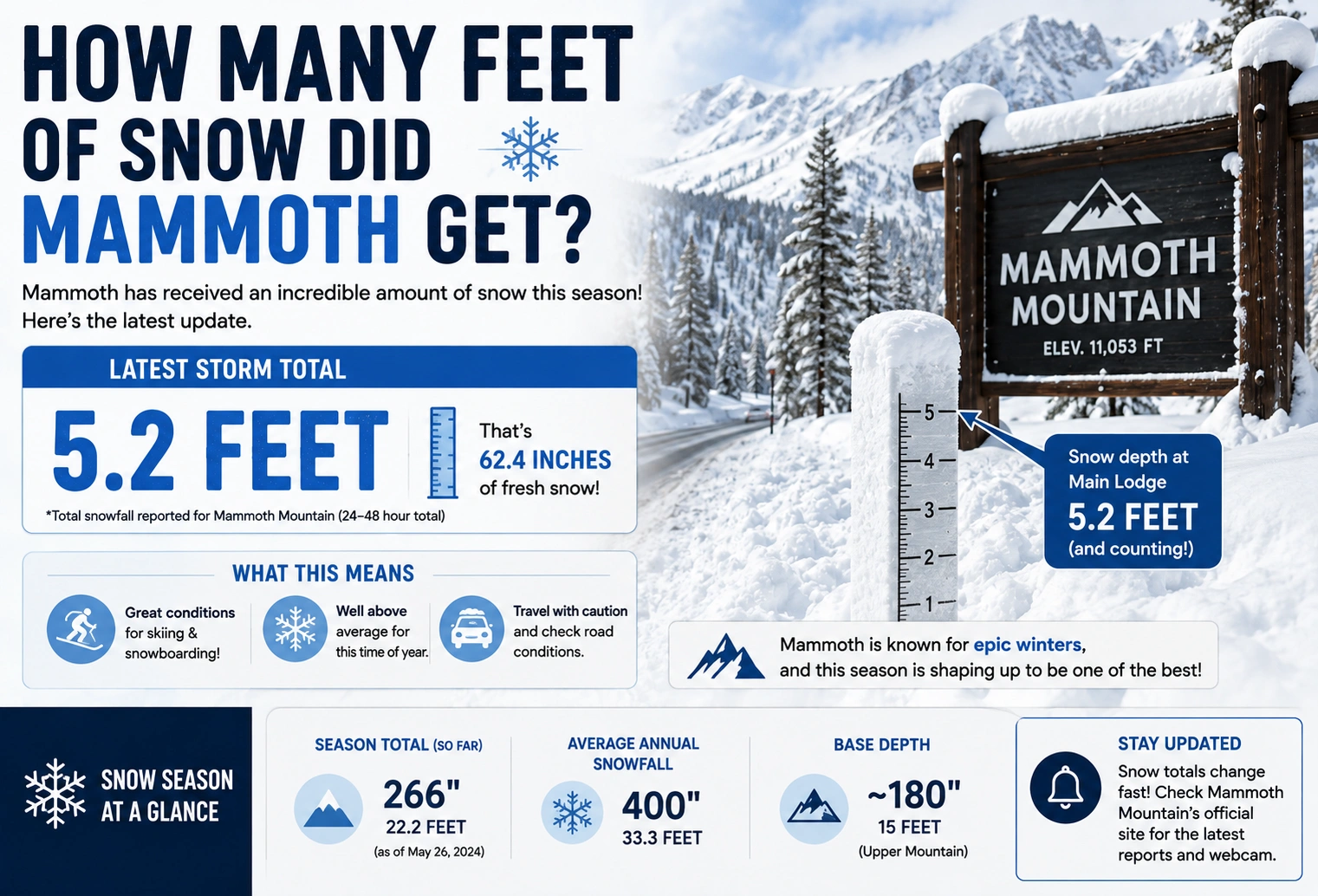
If you’re wondering how many feet of snow Mammoth got, the answer depends on the season and the location being measured. For the most recently completed 2025–26 winter season, Mammoth Mountain recorded 297 inches of snowfall at Main Lodge.
Since 12 inches equals 1 foot, 297 inches converts to:
297 ÷ 12 = 24.75 feet
So, Mammoth received approximately 24.75 feet of snow, or nearly 25 feet, at Main Lodge during the 2025–26 season. Mammoth Mountain’s official snowfall history lists the season total as 297 inches.
That figure represents cumulative snowfall, not the amount of snow sitting on the ground at one time. Snow can melt, settle, compact, or be blown by wind throughout the season.
Quick Answer
Mammoth Mountain received 297 inches of snow at Main Lodge during the 2025–26 season.
Converting inches to feet:
297 ÷ 12 = 24.75 feet
Therefore:
Mammoth got approximately 24.75 feet of snow during the 2025–26 season.
| Measurement | 2025–26 Total |
|---|---|
| Snowfall | 297 inches |
| Snowfall in feet | 24.75 feet |
| Snowfall in yards | 8.25 yards |
| Snowfall in meters | About 7.54 m |
The season ended on June 7, 2026, after 199 days of operation. Reports at the end of the season also confirmed the 297-inch Main Lodge total.
Mammoth’s 2025–26 Snowfall Total
Mammoth Mountain’s official snowfall history reports snowfall measured at Main Lodge. For the 2025–26 season, the resort recorded a total of 297 inches.
That total was built throughout the winter rather than arriving in one massive storm.
The monthly totals were:
| Month | Snowfall |
|---|---|
| October | 16 in |
| November | 24 in |
| December | 73 in |
| January | 43 in |
| February | 87 in |
| March | 1 in |
| April | 48 in |
| May | 5 in |
| Season Total | 297 in |
February was the snowiest month, with 87 inches, or 7.25 feet, of snowfall at Main Lodge.
December was also significant, producing 73 inches, or just over 6 feet, of snow.
How Many Feet Is 297 Inches of Snow?
To convert the Mammoth snowfall total from inches to feet, divide by 12.
297 inches ÷ 12 = 24.75 feet
This means the reported seasonal snowfall adds up to nearly 25 feet of snow if every snowfall event were stacked without melting, settling, or compaction.
| Snowfall | Equivalent in Feet |
|---|---|
| 12 inches | 1 foot |
| 24 inches | 2 feet |
| 60 inches | 5 feet |
| 120 inches | 10 feet |
| 180 inches | 15 feet |
| 240 inches | 20 feet |
| 297 inches | 24.75 feet |
| 300 inches | 25 feet |
It’s important to understand that this does not mean there was a 24.75-foot-deep layer of snow covering Main Lodge at the end of the season.
Seasonal snowfall is a cumulative measurement.
Mammoth Snowfall by Month
The 2025–26 season had a relatively uneven distribution of snowfall.
December and February were particularly strong months, while March was unusually light.
| Month | Inches | Feet |
|---|---|---|
| October | 16 | 1.33 ft |
| November | 24 | 2.00 ft |
| December | 73 | 6.08 ft |
| January | 43 | 3.58 ft |
| February | 87 | 7.25 ft |
| March | 1 | 0.08 ft |
| April | 48 | 4.00 ft |
| May | 5 | 0.42 ft |
| Total | 297 | 24.75 ft |
February alone contributed more than 7 feet of snowfall.
The resort’s official data also shows that April added another 48 inches, or exactly 4 feet, helping extend the season into June.
How Mammoth’s Snowfall Compared With Previous Seasons
Mammoth’s snowfall can vary dramatically from one winter to another.
The recent history illustrates just how different individual seasons can be.
| Season | Snowfall at Main Lodge |
|---|---|
| 2025–26 | 297 in (24.75 ft) |
| 2024–25 | 286 in (23.83 ft) |
| 2023–24 | 367 in (30.58 ft) |
| 2022–23 | 715 in (59.58 ft) |
| 2021–22 | 260 in (21.67 ft) |
| 2020–21 | 244.5 in (20.38 ft) |
| 2019–20 | 281 in (23.42 ft) |
| 2018–19 | 492 in (41 ft) |
Mammoth’s 2022–23 season was exceptional, with 715 inches at Main Lodge—almost 60 feet of cumulative snowfall. The resort describes 2022–23 as its snowiest season on record, with more than 700 inches at Main Lodge and close to 900 inches at the summit.
By comparison, the 2025–26 total of 297 inches was considerably lower than that extraordinary season.
How Much Snow Does Mammoth Usually Get?
Mammoth is known for heavy snowfall compared with many other California ski destinations.
Mammoth Mountain states that it receives an average of around 400 inches of snowfall, although the exact average can vary depending on the measurement location and period used.
Its 2025–26 fact sheet also describes average snowfall at the base as more than 350 inches.
That means Mammoth can experience substantial differences between an individual season and its long-term average.
For perspective:
| Snowfall | Feet |
|---|---|
| 200 in | 16.67 ft |
| 250 in | 20.83 ft |
| 300 in | 25 ft |
| 350 in | 29.17 ft |
| 400 in | 33.33 ft |
| 500 in | 41.67 ft |
| 700 in | 58.33 ft |
A season approaching 400 inches would represent more than 33 feet of cumulative snowfall.
Why Mammoth Can Receive So Much Snow
Mammoth Mountain is located in California’s Eastern Sierra Nevada, where elevation and storm patterns contribute to substantial winter snowfall.
The mountain reaches a summit elevation of 11,053 feet. Its high elevation helps it retain cold conditions suitable for snow during many winter storms.
Mammoth also has a large vertical range. The base is around 7,953 feet, while the summit reaches 11,053 feet.
These elevation differences mean that snowfall amounts and snow conditions can vary across the mountain.
This is also why a snowfall number reported at Main Lodge should not automatically be treated as the exact snowfall amount at every location on Mammoth Mountain.
Snowfall at Mammoth Mountain vs. Snow Depth
One of the most important distinctions when reading a Mammoth snow report is the difference between snowfall and snow depth.
Snowfall
Snowfall measures how much new snow accumulated during individual storms or over a period.
For example, Mammoth’s 297-inch 2025–26 figure is a seasonal cumulative snowfall total.
Snow Depth
Snow depth measures how much snow is currently present on the ground at a particular location.
These numbers can be very different.
For example, if a mountain receives 24 inches of snow and then experiences warm temperatures, wind, melting, and compaction, the actual snow depth afterward may be much less than 24 inches.
The same principle applies over an entire season.
Cumulative snowfall is not the same as final snowpack depth.
What Mammoth’s Snow Total Means for Skiers
A seasonal total of 297 inches is still a substantial amount of snowfall.
The number can be useful when comparing different seasons, but it does not tell the entire story about ski conditions.
Skiers should also consider:
- Current base depth
- Recent snowfall
- Snow quality
- Temperature
- Wind
- Open terrain
- Grooming
- Weather forecasts
- Operating lifts
- Avalanche conditions
A season with less total snowfall can still provide good skiing if the snow arrives at favorable times and temperatures remain cold enough to preserve it.
Conversely, a large seasonal snowfall total does not guarantee excellent conditions on every day.
How Much Snow Did Mammoth Get in February 2026?
Mammoth received 87 inches of snow in February 2026, according to the resort’s official snowfall history.
Converting that amount to feet:
87 ÷ 12 = 7.25 feet
So Mammoth received 7.25 feet of snow during February 2026 at Main Lodge.
That month accounted for nearly 30% of the season’s final 297-inch total.
How Much Snow Did Mammoth Get in December 2025?
Mammoth received 73 inches in December 2025.
In feet:
73 ÷ 12 = 6.08 feet
Therefore, Mammoth received approximately 6.08 feet of snow in December 2025 at Main Lodge.
December was the second-snowiest month of the 2025–26 season, behind February.
Mammoth’s Snowiest Recent Season
The 2022–23 winter season stands out as an extraordinary snowfall year at Mammoth.
The official resort history lists 715 inches at Main Lodge, equivalent to:
715 ÷ 12 = 59.58 feet
That is nearly 60 feet of cumulative snowfall at Main Lodge during the season. The resort also reports close to 900 inches at the summit during that record-setting winter.
For comparison, 715 inches is more than twice the 297 inches recorded during the 2025–26 season.
FAQs
How many feet of snow did Mammoth get in 2026?
During the completed 2025–26 winter season, Mammoth Mountain recorded 297 inches, equivalent to 24.75 feet, at Main Lodge.
How many inches of snow did Mammoth get in 2025–26?
Mammoth recorded 297 inches of seasonal snowfall at Main Lodge during the 2025–26 season.
How much snow did Mammoth get in February 2026?
Mammoth received 87 inches, or 7.25 feet, at Main Lodge in February 2026.
How much snow does Mammoth get in an average year?
Mammoth Mountain states that it averages around 400 inches of snowfall, while its 2025–26 fact sheet lists more than 350 inches of average snowfall at the base.
What was Mammoth’s snowiest season?
Mammoth’s 2022–23 season was its snowiest on record, with 715 inches at Main Lodge and close to 900 inches at the summit, according to the resort.
Is 25 feet of snow the same as 25 feet of snow depth?
No. A seasonal snowfall total is the cumulative amount of new snow recorded throughout the season. Snow depth measures how much snow is actually present on the ground at a particular time.
Where is Mammoth Mountain?
Mammoth Mountain is located near Mammoth Lakes, California, in the Eastern Sierra Nevada. The resort’s summit reaches 11,053 feet.
Conclusion
So, how many feet of snow did Mammoth get? During the completed 2025–26 winter season, Mammoth Mountain received 297 inches of snow at Main Lodge, which converts to 24.75 feet, or nearly 25 feet of cumulative snowfall.
The snowfall was spread across the season, with February producing the most at 87 inches, or 7.25 feet. December contributed another 73 inches, while April added 48 inches.
Mammoth’s snowfall can vary considerably from year to year. The 2025–26 total was much lower than the extraordinary 715-inch total recorded during the 2022–23 season, which remains Mammoth’s snowiest season on record.
When comparing Mammoth snow totals, remember that cumulative snowfall is different from snow depth. The snowfall total tells you how much new snow was recorded over the season, while snow depth tells you how much snow is actually on the ground at a given time.
Discover More Articles
How Many Feet Are in 6.096 mm? Exact Conversion Guide