

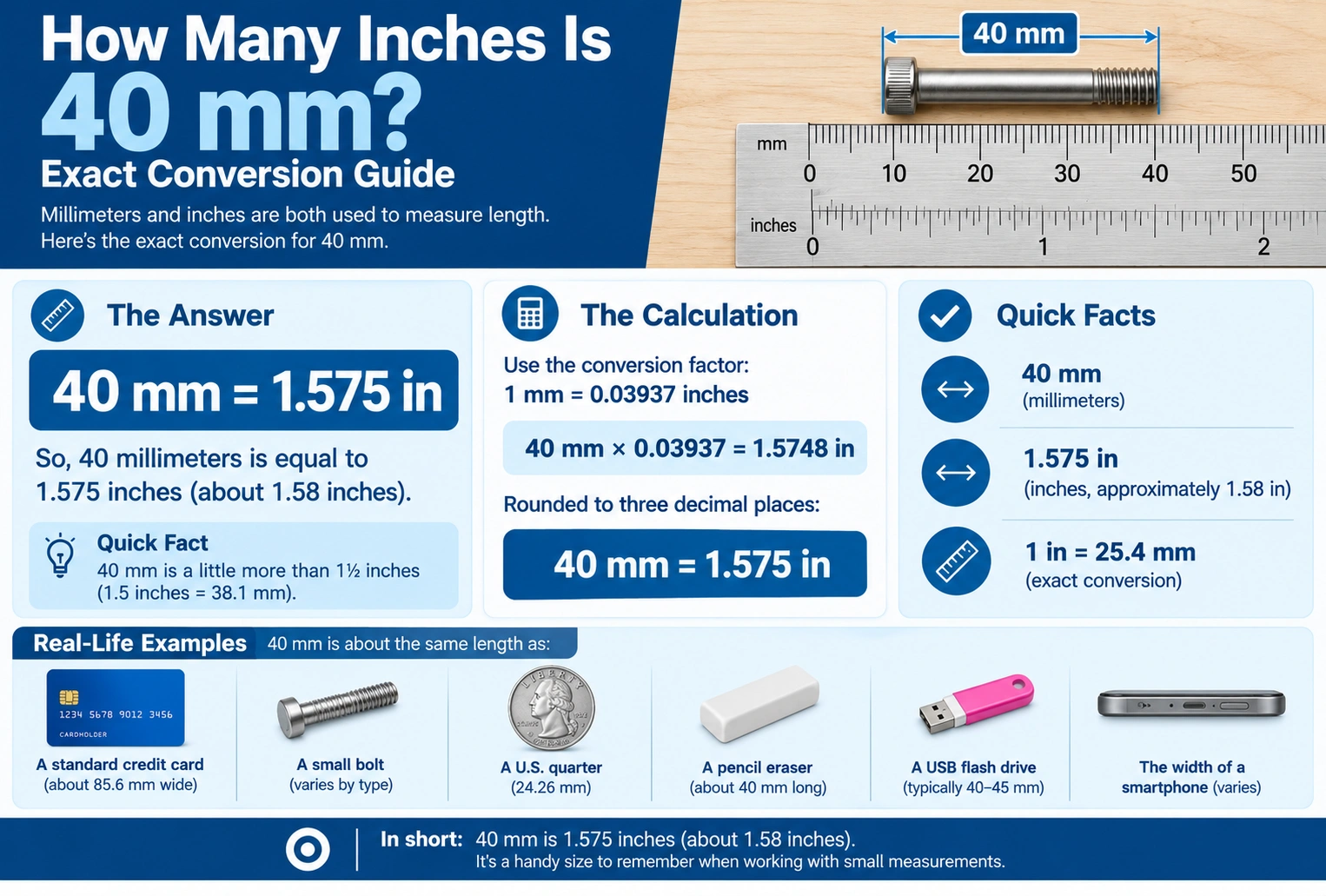
40 millimeters (mm) equals 1.5748 inches. For everyday measurements, you can round this to 1.57 inches.
The conversion uses the standard relationship:
1 inch = 25.4 millimeters
So:
40 ÷ 25.4 = 1.5748 inches
| Millimeters | Inches |
|---|---|
| 10 mm | 0.3937 in |
| 20 mm | 0.7874 in |
| 30 mm | 1.1811 in |
| 40 mm | 1.5748 in |
| 50 mm | 1.9685 in |
| 60 mm | 2.3622 in |
| 100 mm | 3.9370 in |
Introduction
If you are asking how many inches is 40 mm, the exact answer is 1.5748 inches. Rounded to two decimal places, 40 mm is approximately 1.57 inches.
This conversion is useful when working with metric measurements and need to understand their equivalent in inches. It can be helpful for tools, hardware, product dimensions, construction materials, mechanical parts, crafts, and everyday objects.
How Many Inches Is 40 mm?
To convert millimeters to inches, divide the millimeter measurement by 25.4 because one inch is exactly 25.4 millimeters.
Formula:
Inches = Millimeters ÷ 25.4
For 40 mm:
40 ÷ 25.4 = 1.574803…
Therefore:
40 mm = 1.5748 inches
For most practical purposes, you can write this as:
40 mm ≈ 1.57 inches
If you need a more precise measurement, use 1.5748 inches.
How to Convert 40 mm to Inches
The calculation is straightforward.
Step 1: Start With the Millimeter Measurement
The measurement is:
40 mm
Step 2: Use the Conversion Factor
One inch equals:
25.4 mm
Step 3: Divide
40 ÷ 25.4 = 1.574803…
Final Answer
40 mm = 1.5748 inches
Rounded versions include:
| Precision | 40 mm in Inches |
|---|---|
| Exact decimal | 1.574803… in |
| 4 decimal places | 1.5748 in |
| 3 decimal places | 1.575 in |
| 2 decimal places | 1.57 in |
| 1 decimal place | 1.6 in |
For most everyday uses, 1.57 inches is the easiest rounded answer.
Why Is 1 Inch Equal to 25.4 mm?
The inch has been internationally standardized at exactly 25.4 millimeters.
This fixed conversion factor makes it possible to move between the metric and U.S. customary measurement systems without estimating.
The relationship works in both directions:
1 inch = 25.4 mm
and:
1 mm = 0.0393701 inches
Therefore, you can either divide millimeters by 25.4 or multiply them by approximately 0.03937.
40 mm to Inches Conversion Formula
There are two useful formulas for converting millimeters to inches.
Method 1: Divide by 25.4
Inches = mm ÷ 25.4
For 40 mm:
40 ÷ 25.4 = 1.5748 inches
Method 2: Multiply by 0.03937
Since one millimeter is approximately 0.03937 inches:
40 × 0.03937 ≈ 1.5748 inches
The first method is preferable when you want the most direct calculation.
40 mm Compared With Common Millimeter Measurements
A comparison table can help you see where 40 mm falls among other common metric sizes.
| Millimeters | Inches | Approximate Inches |
|---|---|---|
| 5 mm | 0.1969 in | 0.20 in |
| 10 mm | 0.3937 in | 0.39 in |
| 15 mm | 0.5906 in | 0.59 in |
| 20 mm | 0.7874 in | 0.79 in |
| 25 mm | 0.9843 in | 0.98 in |
| 30 mm | 1.1811 in | 1.18 in |
| 40 mm | 1.5748 in | 1.57 in |
| 50 mm | 1.9685 in | 1.97 in |
| 60 mm | 2.3622 in | 2.36 in |
| 75 mm | 2.9528 in | 2.95 in |
| 100 mm | 3.9370 in | 3.94 in |
This shows that 40 mm is noticeably larger than 1 inch but smaller than 2 inches.
Is 40 mm More Than 1 Inch?
Yes. 40 mm is more than 1 inch.
Since:
1 inch = 25.4 mm
and:
40 mm > 25.4 mm
40 mm must be greater than one inch.
The difference is:
40 − 25.4 = 14.6 mm
So 40 mm is 14.6 mm longer than 1 inch.
In inches, the difference is approximately:
1.5748 − 1 = 0.5748 inches
Therefore, 40 mm is about 0.575 inches longer than one inch.
Is 40 mm Close to 1.5 Inches?
Yes. It is fairly close.
1.5 inches × 25.4 = 38.1 mm
So 1.5 inches equals 38.1 mm, while 40 mm equals 1.5748 inches.
| Measurement | Millimeters | Inches |
|---|---|---|
| 1 inch | 25.4 mm | 1.0000 in |
| 1.25 inches | 31.75 mm | 1.2500 in |
| 1.5 inches | 38.1 mm | 1.5000 in |
| 40 mm | 40 mm | 1.5748 in |
| 1.75 inches | 44.45 mm | 1.7500 in |
| 2 inches | 50.8 mm | 2.0000 in |
40 mm is therefore only 1.9 mm longer than 1.5 inches.
Is 40 mm Close to 2 Inches?
40 mm is less than 2 inches.
Two inches equals:
2 × 25.4 = 50.8 mm
The difference between 50.8 mm and 40 mm is:
50.8 − 40 = 10.8 mm
So 40 mm is 10.8 mm shorter than 2 inches.
In decimal form, 40 mm is approximately 1.57 inches, compared with exactly 2 inches.
40 mm in Inches and Fractions
Sometimes measurements are expressed as fractions rather than decimals.
40 mm is exactly:
1.5748 inches
A convenient fractional approximation is around 1 9/16 inches.
That fraction equals:
1 9/16 = 1.5625 inches
The difference from 40 mm is small:
1.5748 − 1.5625 ≈ 0.0123 inches
So, for rough visual comparison, 40 mm is close to 1 9/16 inches, but 1.5748 inches is the more accurate conversion.
| Measurement | Decimal Inches |
|---|---|
| 1 1/2 in | 1.5000 |
| 1 9/16 in | 1.5625 |
| 40 mm | 1.5748 |
| 1 5/8 in | 1.6250 |
| 1 3/4 in | 1.7500 |
For precision work, do not substitute the fraction for the exact metric conversion unless the tolerance allows it.
What Does 40 mm Look Like?
A measurement of 40 mm is approximately 4 centimeters because:
10 mm = 1 cm
Therefore:
40 mm = 4 cm
In inches, 4 centimeters is approximately 1.57 inches.
| Unit | Equivalent of 40 mm |
|---|---|
| Millimeters | 40 mm |
| Centimeters | 4 cm |
| Inches | 1.5748 in |
| Meters | 0.04 m |
| Feet | 0.1312 ft |
This gives several ways to visualize the same measurement.
40 mm to Centimeters
Converting 40 mm to centimeters is even simpler.
Since:
10 mm = 1 cm
divide 40 by 10:
40 ÷ 10 = 4 cm
Therefore:
40 mm = 4 cm
You can then convert centimeters to inches if needed:
4 ÷ 2.54 = 1.5748 inches
So both conversion paths produce the same result.
40 mm to Feet
Although inches are the primary focus, you may also need the equivalent in feet.
Since:
1 foot = 12 inches
and 40 mm equals 1.5748 inches:
1.5748 ÷ 12 ≈ 0.1312 feet
Therefore:
40 mm ≈ 0.1312 feet
This is a very small portion of a foot.
40 mm to Other Common Units
Here is a broader conversion reference.
| Unit | 40 mm Equivalent |
|---|---|
| Inches | 1.5748 in |
| Centimeters | 4 cm |
| Meters | 0.04 m |
| Feet | 0.1312 ft |
| Yards | 0.0437 yd |
The exact value you need depends on the measurement system used for your project.
Common Uses for a 40 mm Measurement
A 40 mm measurement can appear in many situations.
Tools and Hardware
Metric sockets, nuts, bolts, washers, and other hardware can be specified in millimeters. A 40 mm size may refer to a particular width, diameter, or other dimension.
Construction
Building materials and components may use metric measurements, especially in countries that primarily use the metric system.
Manufacturing
Mechanical parts often require precise metric dimensions. In these cases, converting 40 mm to 1.5748 inches can help when working with inch-based specifications.
Crafts and DIY Projects
People may encounter metric dimensions on imported products or instructions and need to convert them into inches.
Product Dimensions
International products can list dimensions in millimeters, while customers may be more familiar with inches.
The meaning of “40 mm” depends on what is being measured. It could represent length, width, thickness, diameter, or another dimension.
40 mm vs. 1.5 Inches
Because 40 mm is close to 1.5 inches, it is useful to compare the two directly.
| Measurement | Inches | Millimeters |
|---|---|---|
| 40 mm | 1.5748 in | 40 mm |
| 1.5 inches | 1.5000 in | 38.1 mm |
| Difference | 0.0748 in | 1.9 mm |
So 40 mm is slightly larger than 1.5 inches.
This difference may not matter for casual measurement, but it can be important in engineering, machining, manufacturing, or other precision applications.
How to Measure 40 mm With a Ruler
If you have a metric ruler, finding 40 mm is simple.
Because there are 10 millimeters in each centimeter, 40 mm is the same as 4 centimeters.
On a ruler:
- Find the zero mark.
- Count to the 4-centimeter mark.
- The 4-centimeter mark represents 40 mm.
- On the inch scale, this is approximately 1.57 inches.
If your ruler only has inches, use the approximate value of 1.57 inches.
For accurate work, use a ruler or caliper with the appropriate scale rather than relying on visual estimation.
Common Mistakes When Converting 40 mm to Inches
Using 10 mm = 1 Inch
This is incorrect. 10 mm equals 1 centimeter, not 1 inch.
The correct relationship is:
25.4 mm = 1 inch
Multiplying Instead of Dividing
When converting millimeters to inches, divide by 25.4.
40 ÷ 25.4 = 1.5748
Do not multiply 40 by 25.4.
Rounding Too Early
If precision matters, avoid immediately rounding 40 mm to 1.6 inches. Keep the full value until the final step.
Confusing Diameter With Length
If a product says it is 40 mm, determine what dimension the 40 mm refers to. It could be diameter, width, thickness, or length.
Assuming 40 mm Equals 1.5 Inches Exactly
40 mm is close to 1.5 inches, but it is not exactly 1.5 inches.
40 mm = 1.5748 inches
while:
1.5 inches = 38.1 mm
Frequently Asked Questions
How many inches is 40 mm?
40 mm equals 1.5748 inches, or approximately 1.57 inches when rounded to two decimal places.
Is 40 mm the same as 1.5 inches?
No. 40 mm is 1.5748 inches, while 1.5 inches equals 38.1 mm. Therefore, 40 mm is 1.9 mm larger than 1.5 inches.
Is 40 mm close to 2 inches?
Yes, but it is smaller than 2 inches. 40 mm is approximately 1.57 inches, while 2 inches equals 50.8 mm.
How many centimeters is 40 mm?
40 mm equals 4 centimeters. Divide the millimeter measurement by 10 to convert it to centimeters.
What is 40 mm as a fraction of an inch?
40 mm is approximately 1 9/16 inches as a convenient fractional approximation. The exact decimal conversion is 1.5748 inches.
Conclusion
So, how many inches is 40 mm? The exact conversion is:
40 mm = 1.5748 inches
For everyday measurements, you can round this to 1.57 inches.
The conversion is based on the exact relationship of 25.4 millimeters per inch:
40 ÷ 25.4 = 1.5748 inches
You can also remember that 40 mm equals 4 centimeters, making it easy to visualize. Although 40 mm is close to 1.5 inches, it is slightly larger; 1.5 inches equals 38.1 mm.
For accurate work, especially with hardware, manufacturing, construction, or mechanical components, use the full 1.5748-inch conversion rather than a rough rounded value.
Discover More Articles
One Cent How Many Square Feet? Exact Land Conversion