

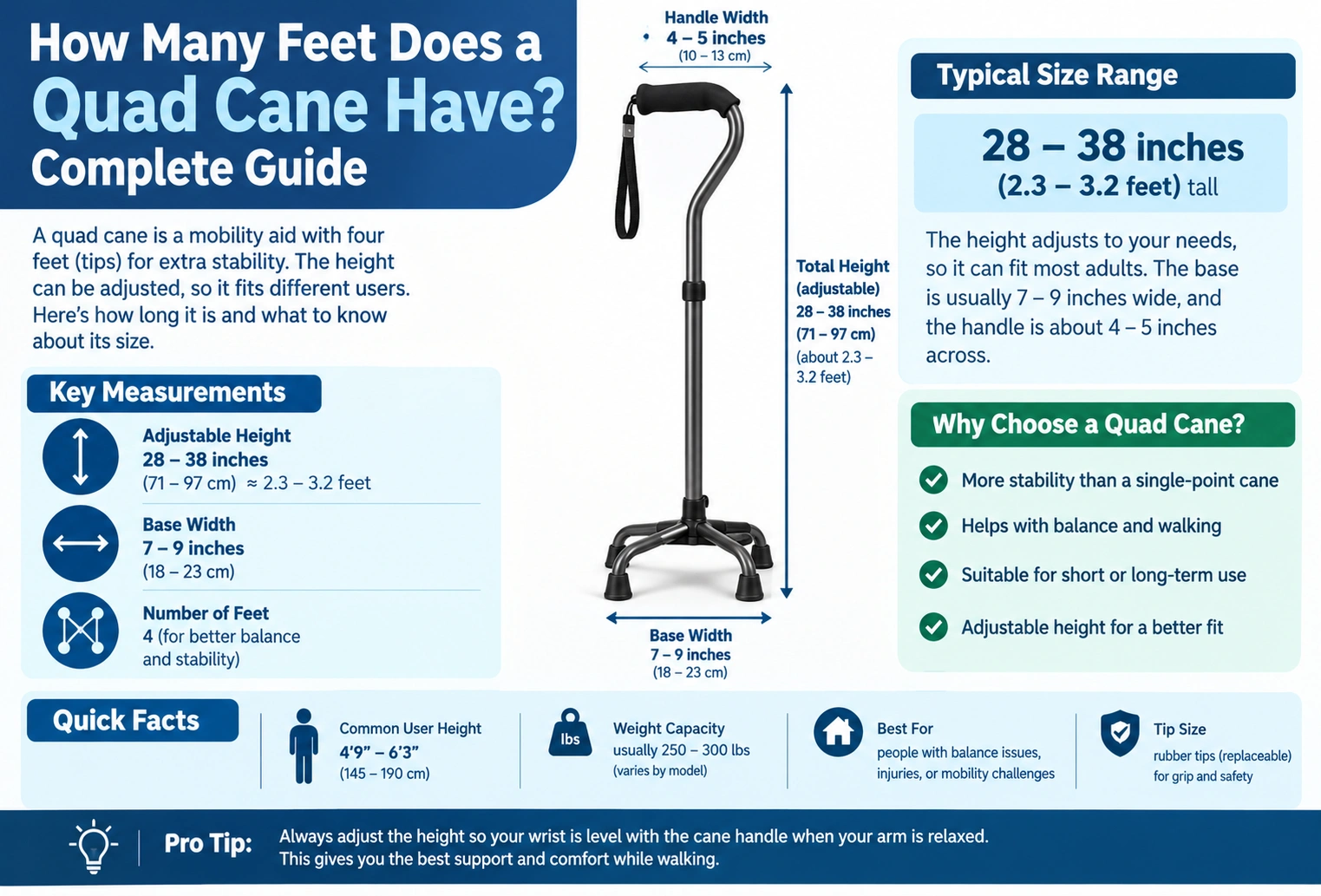
A quad cane has four feet, or four small contact points at the bottom of its base. These four feet give the cane a wider and more stable support area than a standard single-point cane.
| Cane Type | Number of Feet/Contact Points |
|---|---|
| Standard cane | 1 |
| Tripod cane | 3 |
| Quad cane | 4 |
| Walker | 4 |
The four feet of a quad cane are arranged in a rectangular or square-shaped base. This design helps provide additional stability for people who need more support while walking.
What Is a Quad Cane?
A quad cane is a mobility aid designed to provide support and balance while walking. Unlike a traditional cane, which has one rubber tip touching the ground, a quad cane has a four-point base.
The word “quad” means four, which explains why a quad cane has four feet.
Each foot contacts the floor through a rubber or non-slip tip. Together, these four contact points create a broader support base.
Quad canes are commonly used by people who need more stability than a standard cane can provide.
How Many Feet Does a Quad Cane Have?
A quad cane has four feet.
The four feet are located at the bottom of the cane’s base. They typically form a rectangular arrangement that keeps the cane supported when it is placed on the ground.
The basic structure looks like this:
| Feature | Quad Cane |
|---|---|
| Number of feet | 4 |
| Base design | Four-point |
| Main purpose | Stability and balance |
| Typical handle | Single hand grip |
| Ground contact | Four rubber tips |
The four feet allow the cane to remain more stable than a single-point cane when it is placed on a flat surface.
Why Does a Quad Cane Have Four Feet?
The main reason for having four feet is increased stability.
A single-point cane provides support through one contact point. A quad cane spreads that support across four points.
This wider base can make the cane less likely to tip when properly positioned on a suitable surface.
| Cane Base | Contact Points | General Stability |
|---|---|---|
| Single-point cane | 1 | Basic |
| Tripod cane | 3 | More stable |
| Quad cane | 4 | Highly stable |
However, more contact points can also make a quad cane slightly more difficult to move smoothly compared with a standard cane.
How Are the Four Feet Arranged?
The four feet of a quad cane are normally positioned at the corners of its base.
This creates a broad support area beneath the user’s hand and arm.
A simplified arrangement looks like:
| Front | |
|---|---|
| Foot 1 | Foot 2 |
| Foot 3 | Foot 4 |
The exact spacing depends on the cane’s design and manufacturer.
Some quad canes have a relatively large base, while others use a smaller base for easier movement.
How Big Is the Base of a Quad Cane?
Quad cane bases vary in size. There is no single universal base dimension that applies to every quad cane.
Common designs are often described as small-base or large-base quad canes.
| Quad Cane Type | Base Characteristics | Typical Use |
|---|---|---|
| Small-base quad cane | Narrower and easier to maneuver | Indoor use and tighter spaces |
| Large-base quad cane | Wider support area | Users needing additional stability |
| Adjustable quad cane | Size varies by model | Flexible everyday use |
The important point is that four feet do not necessarily mean every quad cane has the same base dimensions.
Quad Cane vs. Regular Cane
The biggest difference between a quad cane and a regular cane is the number of ground contact points.
A traditional cane has one tip, while a quad cane has four.
| Feature | Regular Cane | Quad Cane |
|---|---|---|
| Feet/contact points | 1 | 4 |
| Base width | Narrow | Wider |
| Stability | Moderate | Greater |
| Maneuverability | Easier | Can require more effort |
| Support area | Small | Larger |
A regular cane is often easier to swing and reposition, while a quad cane provides a broader base of support.
Quad Cane vs. Tripod Cane
A tripod cane has three feet, while a quad cane has four.
Both are designed to offer more stability than a traditional single-point cane.
| Feature | Tripod Cane | Quad Cane |
|---|---|---|
| Number of feet | 3 | 4 |
| Support points | 3 | 4 |
| Base | Three-point | Four-point |
| Stability | High | Generally higher |
| Maneuverability | Often easier than quad | Can be slightly harder |
The difference may seem small, but the arrangement of the feet affects how the mobility aid sits on the ground.
Do All Four Feet Touch the Ground?
Ideally, all four feet of a quad cane should make appropriate contact with a flat, stable surface when the cane is positioned correctly.
However, uneven ground can prevent all four tips from sitting evenly.
This is one reason quad canes are generally easier to use on smooth, firm surfaces.
| Surface | Quad Cane Contact |
|---|---|
| Smooth indoor floor | Usually excellent |
| Sidewalk | Generally good |
| Grass | Can be uneven |
| Gravel | Less predictable |
| Stairs | Requires special care |
| Wet/slippery surface | Reduced traction may occur |
The condition of the rubber tips is also important. Worn or damaged tips can reduce traction.
How Many Rubber Tips Does a Quad Cane Have?
A typical quad cane has four rubber tips, one on each foot.
These tips are important because they create traction between the cane and the ground.
| Component | Typical Number |
|---|---|
| Cane shaft | 1 |
| Handle | 1 |
| Feet | 4 |
| Rubber tips | 4 |
The tips can wear down over time and may need replacement.
Users should regularly inspect the tips for cracks, excessive wear, or missing pieces.
Why Are Quad Cane Feet Important?
The feet are one of the most important parts of a quad cane because they directly interact with the walking surface.
They help:
- Provide traction
- Create a stable base
- Distribute support across four points
- Reduce movement of the cane on suitable surfaces
- Support balance during walking
A damaged foot can affect the way the cane sits on the ground.
For this reason, all four feet should be checked regularly.
How Much Weight Can a Quad Cane Support?
Weight capacity varies by model and manufacturer. There is no single weight limit for every quad cane.
Always check the manufacturer’s specifications for the exact model.
| Factor | Why It Matters |
|---|---|
| Cane construction | Determines strength |
| Aluminum or steel frame | Affects durability |
| Base design | Affects stability |
| User weight | Must remain within rated capacity |
| Condition of feet | Affects safe ground contact |
| Proper adjustment | Helps maintain correct positioning |
Never assume that all quad canes have the same weight capacity.
Can a Quad Cane Stand by Itself?
Many quad canes can remain standing when placed correctly because their four-foot base provides more stability than a single-point cane.
However, whether a specific cane stands independently depends on:
- Base design
- Cane angle
- Surface
- Weight distribution
- Manufacturer design
A quad cane should not be treated as completely tip-proof.
The user still needs to position the cane correctly and use it according to professional or manufacturer guidance.
How to Use the Four Feet Correctly
For a quad cane to provide its intended support, the entire base should be positioned appropriately on the floor.
A general approach is:
- Place the quad cane firmly on the ground.
- Make sure the four feet are positioned on a stable surface.
- Keep the cane close enough to provide useful support.
- Avoid placing it too far away from your body.
- Check that the rubber tips are in good condition.
- Follow instructions from a qualified healthcare professional if the cane is being used for mobility assistance.
Correct positioning is more important than simply knowing that the cane has four feet.
Small-Base vs. Large-Base Quad Cane
Quad canes are often available with different base sizes.
A small-base quad cane is generally easier to maneuver in narrow areas, while a large-base quad cane offers a broader footprint.
| Characteristic | Small Base | Large Base |
|---|---|---|
| Base size | Smaller | Larger |
| Maneuverability | Easier | Can require more space |
| Support footprint | Smaller | Larger |
| Tight spaces | Better suited | Less convenient |
| Stability | Good | Generally greater |
The best choice depends on the user’s mobility needs, environment, and professional recommendations.
Can You Replace the Feet on a Quad Cane?
In many quad cane designs, the rubber tips can be replaced when they become worn.
Replacement parts must match the cane’s specifications.
Before replacing a tip, check:
- Tip diameter
- Stem size
- Cane model
- Manufacturer specifications
- Compatibility with the existing base
Do not continue using a cane if one of its feet is missing or seriously damaged.
How Often Should Quad Cane Feet Be Checked?
There is no universal replacement schedule because wear depends on how frequently the cane is used and the surfaces it encounters.
A quick inspection should be performed regularly.
Look for:
| Problem | What to Check |
|---|---|
| Cracks | Rubber tip damage |
| Flattening | Excessive wear |
| Missing material | Reduced contact area |
| Loose tip | Poor attachment |
| Uneven wear | Incorrect or uneven contact |
If the tips look worn or damaged, replacement may be necessary.
Are Four Feet Better Than One?
Four feet can provide a broader support base, but that does not automatically mean a quad cane is better for every person.
The right mobility aid depends on the user’s balance, strength, coordination, environment, and ability to maneuver the device.
| Cane Type | Main Advantage | Potential Limitation |
|---|---|---|
| Single-point cane | Easy to maneuver | Less stable |
| Tripod cane | More support | Larger base |
| Quad cane | Broad support base | Can be harder to maneuver |
| Walker | Very broad support | Larger and less portable |
A healthcare professional can help determine which mobility aid is appropriate.
Common Mistakes About Quad Cane Feet
Mistake 1: Thinking a Quad Cane Has Three Feet
A quad cane has four feet. The word “quad” refers to four.
Mistake 2: Counting the Cane Shaft as a Foot
The shaft is the main vertical portion of the cane. It is not an additional ground-contact foot.
Mistake 3: Assuming Every Quad Cane Has the Same Base
Quad cane bases can vary in size and design.
Mistake 4: Ignoring Worn Rubber Tips
The feet are directly responsible for contacting the walking surface. Worn tips should not be ignored.
Mistake 5: Assuming Four Feet Make the Cane Tip-Proof
A four-point base improves stability, but a quad cane can still move or tip if used incorrectly or on an unsuitable surface.
Frequently Asked Questions
1. How many feet does a quad cane have?
A quad cane has four feet. Each foot normally has a rubber or non-slip tip that contacts the ground.
2. Why does a quad cane have four feet?
Four feet create a wider support base than a standard one-point cane, which can provide greater stability.
3. How many rubber tips does a quad cane need?
A typical quad cane uses four rubber tips, one for each foot.
4. Is a quad cane more stable than a regular cane?
Generally, yes. A quad cane has four ground contact points and a wider base, which can provide more stability than a single-point cane.
5. Do quad cane feet need to be replaced?
They may need replacement when they become worn, cracked, loose, or damaged. The replacement tips should be compatible with the specific cane.
Conclusion
So, how many feet does a quad cane have? A quad cane has four feet. These four ground-contact points form a wider base that can provide greater stability than a traditional single-point cane.
The key facts are simple:
| Quad Cane Feature | Answer |
|---|---|
| Number of feet | 4 |
| Typical rubber tips | 4 |
| Main purpose | Stability |
| Base design | Four-point |
| Compared with regular cane | Wider support base |
Although four feet can improve stability, the correct cane size, base design, rubber-tip condition, and proper use are all important for safe mobility.
Discover More Articles
How Many Chicken Feet for Dogs? Safe Feeding Guide