

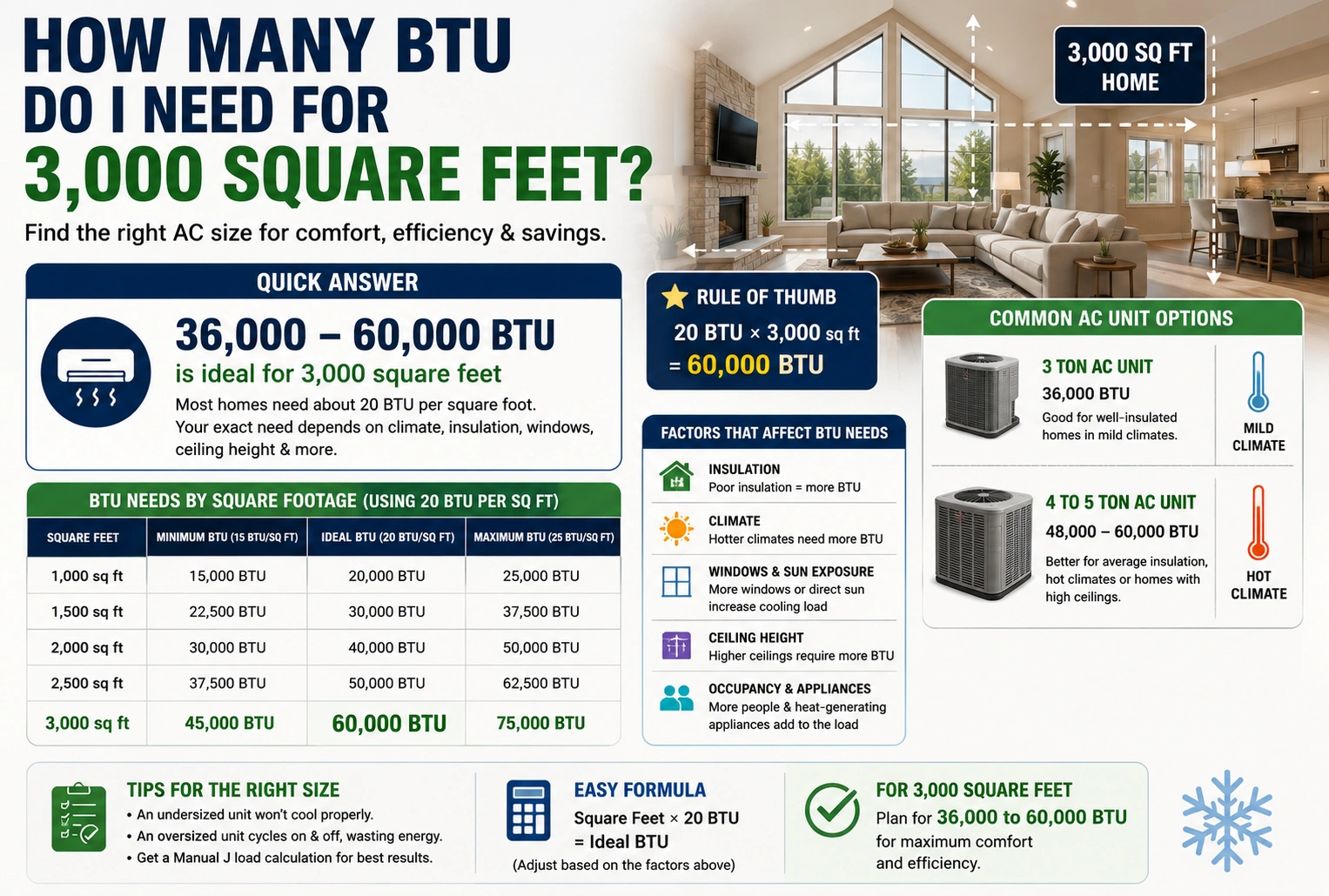
For a 3,000-square-foot home, the BTU requirement depends on whether you are heating or cooling the property, as well as your climate, insulation, windows, ceiling height, and home construction.
For heating, a rough preliminary estimate can range from about 60,000 to 180,000 BTUs per hour, depending heavily on climate and the home’s efficiency.
For cooling, a rough estimate is often around 60,000 to 90,000 BTUs per hour, equivalent to approximately 5 to 7.5 tons of air-conditioning capacity. Actual AC sizing should be based on a proper cooling-load calculation rather than square footage alone.
Quick Answer
| Application | Approximate BTU Range for 3,000 Sq Ft |
|---|---|
| Heating, mild conditions | 60,000–90,000 BTU/hr |
| Heating, moderate conditions | 90,000–120,000 BTU/hr |
| Heating, cold conditions | 120,000–180,000 BTU/hr |
| Cooling | 60,000–90,000 BTU/hr |
| Cooling capacity | About 5–7.5 tons |
These figures are rough planning estimates, not a substitute for professional HVAC sizing.
How Many BTUs Do I Need to Heat 3,000 Square Feet?
A simple heating estimate uses:
BTUs Needed = Square Feet × BTUs per Square Foot
For 3,000 square feet, the result changes depending on the assumed heating requirement.
| Heating Requirement | BTUs for 3,000 Sq Ft |
| 20 BTU/sq ft | 60,000 BTU |
| 25 BTU/sq ft | 75,000 BTU |
| 30 BTU/sq ft | 90,000 BTU |
| 35 BTU/sq ft | 105,000 BTU |
| 40 BTU/sq ft | 120,000 BTU |
| 50 BTU/sq ft | 150,000 BTU |
| 60 BTU/sq ft | 180,000 BTU |
For example, using 40 BTUs per square foot:
3,000 × 40 = 120,000 BTU
That gives a preliminary estimate of 120,000 BTU per hour.
However, the actual heating load could be substantially lower or higher.
What Size Furnace Do I Need for 3,000 Square Feet?
There is no single furnace size that is correct for every 3,000-square-foot house.
A rough estimate might place the required furnace capacity somewhere around 90,000–150,000 BTU, depending on climate and building efficiency.
For example, a well-insulated home in a relatively mild climate may require significantly less heating capacity than an older, poorly insulated home in a very cold climate.
The furnace should be sized according to the home’s calculated heat loss rather than simply choosing a furnace based on square footage.
Is a 100,000 BTU Furnace Enough for 3,000 Square Feet?
It can be, depending on the home’s heating requirement.
A 100,000 BTU furnace provides:
100,000 ÷ 3,000 = 33.3 BTU per square foot
If the home’s calculated heating load is around 33 BTUs per square foot, a 100,000 BTU system could potentially be appropriate.
But if the house has significant heat loss, 100,000 BTUs may not be enough.
Conversely, if the house is highly efficient, a 100,000 BTU furnace could be larger than necessary.
Is a 120,000 BTU Furnace Enough for 3,000 Square Feet?
A 120,000 BTU furnace provides:
120,000 ÷ 3,000 = 40 BTUs per square foot
Using a simple 40-BTU-per-square-foot estimate, that would correspond to 3,000 square feet.
Whether it is actually the correct furnace depends on the home’s heat-loss calculation, climate, insulation, windows, air leakage, and other factors.
Is a 150,000 BTU Furnace Too Much for 3,000 Square Feet?
It could be.
A 150,000 BTU furnace provides:
150,000 ÷ 3,000 = 50 BTUs per square foot
For an efficient home in a moderate climate, that may be more capacity than necessary.
An oversized furnace can cycle on and off more frequently and may not provide the most efficient or comfortable operation.
In colder climates or homes with substantial heat loss, however, a higher capacity may be justified.
How Many BTUs Do I Need to Cool 3,000 Square Feet?
Cooling requirements are different from heating requirements.
A very rough rule sometimes used for preliminary estimates is around 20–30 BTUs per square foot for cooling, although actual requirements vary significantly.
Using that range:
| Cooling Requirement | BTUs for 3,000 Sq Ft |
| 20 BTU/sq ft | 60,000 BTU |
| 25 BTU/sq ft | 75,000 BTU |
| 30 BTU/sq ft | 90,000 BTU |
This corresponds to approximately 5–7.5 tons of cooling capacity because:
1 ton = 12,000 BTU/hr
For example:
60,000 ÷ 12,000 = 5 tons
and:
90,000 ÷ 12,000 = 7.5 tons
These figures are only starting estimates. Oversizing an air conditioner can reduce its ability to remove humidity and may lead to short cycling.
What Size AC Do I Need for 3,000 Square Feet?
A 3,000-square-foot home might require approximately 5 to 7.5 tons of cooling capacity under a simple BTU-per-square-foot estimate.
However, many homes will fall outside that range because cooling load depends on factors such as:
- Climate
- Insulation
- Window area
- Window orientation
- Ceiling height
- Air leakage
- Number of occupants
- Appliances
- Sun exposure
- Home construction
A professional Manual J load calculation is a better method for determining the correct AC size.
AC Size Comparison for 3,000 Square Feet
| AC Capacity | BTU/hr | Approx. BTU per Sq Ft |
| 4 tons | 48,000 BTU | 16 BTU/sq ft |
| 5 tons | 60,000 BTU | 20 BTU/sq ft |
| 6 tons | 72,000 BTU | 24 BTU/sq ft |
| 7 tons | 84,000 BTU | 28 BTU/sq ft |
| 7.5 tons | 90,000 BTU | 30 BTU/sq ft |
The largest commonly available residential AC systems may have limitations depending on equipment type and local installation practices, so a 3,000-square-foot home may sometimes need multiple systems or a carefully designed HVAC setup.
What Factors Affect How Many BTUs You Need?
Square footage alone cannot accurately determine HVAC size.
Climate
Climate is one of the biggest factors.
A 3,000-square-foot house in a mild climate may need considerably less heating than the same-size house in a region with severe winter temperatures.
Cooling requirements also vary with summer temperatures and humidity.
Insulation
A well-insulated home loses and gains heat more slowly.
Poor insulation can substantially increase heating and cooling loads.
Windows
Large windows can increase solar heat gain during summer and heat loss during winter.
Modern energy-efficient windows can reduce these effects.
Ceiling Height
A 3,000-square-foot home with 8-foot ceilings has less conditioned volume than a home with the same floor area and 10- or 12-foot ceilings.
Higher ceilings can therefore affect HVAC requirements.
Air Leakage
Drafty doors, windows, ductwork, and other openings can increase the amount of heating or cooling needed.
A tightly sealed building generally requires less energy to maintain indoor temperatures.
Sun Exposure
A home with large south- or west-facing windows may receive substantial solar heat during warmer months.
This can increase cooling requirements.
Number of Occupants
People generate heat indoors.
A home with many occupants can therefore have a higher cooling load than an otherwise identical home with fewer occupants.
Why You Should Not Size HVAC Equipment by Square Footage Alone
A square-footage rule is useful for a quick estimate, but it cannot account for the actual heat gain or heat loss of a building.
Two 3,000-square-foot homes can have very different HVAC requirements.
For example:
| Home | Likely HVAC Requirement |
| New, well-insulated home | Lower |
| Older, poorly insulated home | Higher |
| Mild-climate home | Lower |
| Extreme cold-climate home | Higher heating requirement |
| Shaded home with efficient windows | Lower cooling requirement |
| Home with large sun-exposed windows | Higher cooling requirement |
This is why professional HVAC sizing uses more detailed information than floor area alone.
What Is a BTU?
BTU stands for British thermal unit.
In HVAC applications, BTUs are commonly used to describe the amount of heating or cooling capacity a system can provide over time.
When you see a furnace labeled 100,000 BTU, the number generally refers to its rated input capacity unless the specification specifically identifies output capacity.
For air conditioners, BTU ratings generally describe cooling capacity per hour.
BTU Input vs. BTU Output for Furnaces
Furnace ratings can be confusing because input BTU and output BTU are not necessarily the same.
For example, an 80,000-BTU furnace with 80% efficiency would have a nominal output around:
80,000 × 0.80 = 64,000 BTU
A 100,000-BTU furnace operating at 95% efficiency would have a nominal output around:
100,000 × 0.95 = 95,000 BTU
| Furnace Input | Efficiency | Approx. Output |
| 80,000 BTU | 80% | 64,000 BTU |
| 100,000 BTU | 80% | 80,000 BTU |
| 100,000 BTU | 90% | 90,000 BTU |
| 100,000 BTU | 95% | 95,000 BTU |
| 120,000 BTU | 95% | 114,000 BTU |
Actual equipment performance can vary, so check the manufacturer’s specifications.
How Many BTUs for a 3,000 Square Foot House in a Cold Climate?
A cold-climate home may require substantially more heating capacity than a similar home in a mild climate.
Using a rough 50–60 BTU-per-square-foot estimate:
3,000 × 50 = 150,000 BTU
3,000 × 60 = 180,000 BTU
That gives a preliminary range of 150,000–180,000 BTU.
However, these numbers should not be used as a final furnace-selection method. Modern well-insulated homes can require much less capacity even in colder regions.
How Many BTUs for a 3,000 Square Foot House in a Mild Climate?
A well-insulated home in a mild climate may have a substantially lower heating requirement.
Using a rough 20–30 BTU-per-square-foot estimate:
3,000 × 20 = 60,000 BTU
3,000 × 30 = 90,000 BTU
That produces an estimated range of 60,000–90,000 BTU.
Again, the actual heating load should be calculated from the building’s characteristics.
Frequently Asked Questions
How many BTUs do I need for 3,000 square feet?
A rough heating estimate can range from 60,000 to 180,000 BTUs, depending on climate and building efficiency. For cooling, a preliminary estimate may be around 60,000–90,000 BTU/hr.
What size furnace do I need for a 3,000-square-foot house?
A 3,000-square-foot home might require roughly 90,000–150,000 BTUs, but the correct furnace size depends on the home’s calculated heat loss.
Is 100,000 BTU enough for 3,000 square feet?
It can be. A 100,000 BTU furnace provides approximately 33.3 BTUs per square foot for a 3,000-square-foot home.
Is 120,000 BTU enough for 3,000 square feet?
It can be under a 40-BTU-per-square-foot assumption. However, actual requirements depend on climate, insulation, windows, and other building characteristics.
How many BTUs do I need to cool 3,000 square feet?
A rough estimate is approximately 60,000–90,000 BTU/hr, equivalent to about 5–7.5 tons of cooling. A professional cooling-load calculation should determine the final size.
Can an HVAC system be too large for 3,000 square feet?
Yes. Oversized heating and cooling equipment can cycle too frequently and may reduce comfort and efficiency.
Does insulation reduce the BTUs needed for 3,000 square feet?
Yes. Better insulation generally reduces heat loss in winter and heat gain in summer, lowering the required HVAC capacity.
Does climate affect BTU requirements?
Yes. Climate has a major effect on heating and cooling loads. Colder regions generally require more heating capacity, while hotter climates can require more cooling capacity.
Conclusion
So, how many BTUs do you need for 3,000 square feet?
For heating, a rough preliminary range is approximately 60,000–180,000 BTUs, with the actual requirement depending heavily on climate, insulation, windows, ceiling height, and air leakage.
For cooling, a rough starting range is approximately 60,000–90,000 BTU/hr, or about 5–7.5 tons of cooling capacity.
A simple calculation for heating is:
3,000 square feet × BTUs per square foot = Estimated BTUs
For example:
3,000 × 40 = 120,000 BTU
This makes 120,000 BTU a mathematical estimate at 40 BTUs per square foot, but it does not mean every 3,000-square-foot house needs a 120,000-BTU furnace.
For the most accurate HVAC size, use a professional heating and cooling load calculation rather than relying on square footage alone.
Discover More Articles
How Many Square Feet Will 80,000 BTU Heat?