
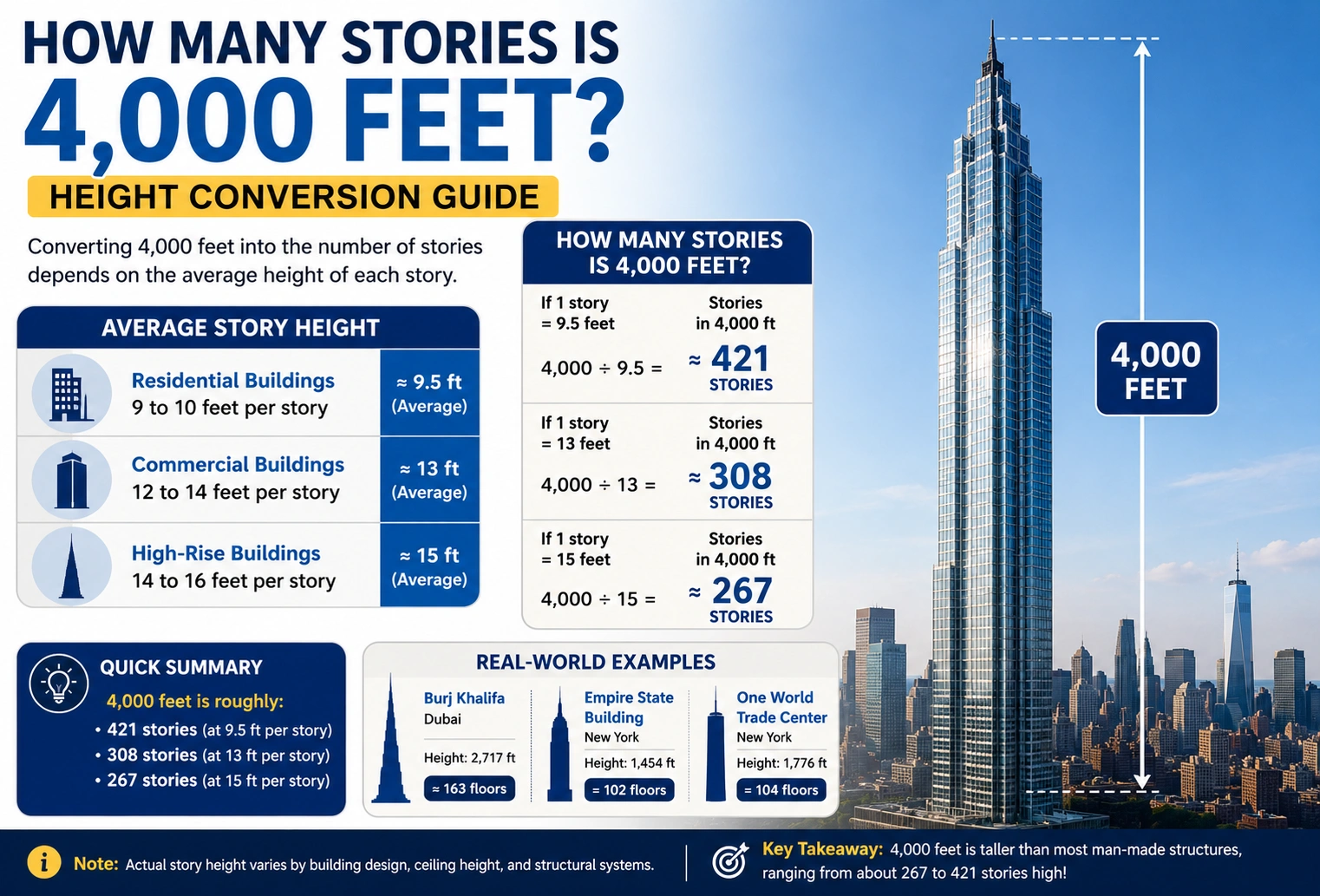
4,000 feet is approximately 267 to 400 stories, depending on the average height of each story.
Using a common estimate of 10 feet per story:
4,000 ÷ 10 = 400 stories
For a taller average floor height of 15 feet:
4,000 ÷ 15 ≈ 267 stories
| Average Height per Story | Approximate Stories in 4,000 Feet |
|---|---|
| 8 ft | 500 stories |
| 10 ft | 400 stories |
| 12 ft | 333 stories |
| 13 ft | 308 stories |
| 15 ft | 267 stories |
| 20 ft | 200 stories |
For a general building-height estimate, about 400 stories is a useful answer when using 10 feet per story.
How Many Stories Is 4,000 Feet?
There is no single exact answer to how many stories is 4,000 feet because buildings do not have a universal floor height.
A typical story might be around 10 feet tall, but some buildings have floors that are shorter or considerably taller.
Using the simple 10-foot estimate:
4,000 feet ÷ 10 feet per story = 400 stories
So, 4,000 feet is approximately 400 stories under this assumption.
However, if each story averages 12 feet:
4,000 ÷ 12 = 333.3 stories
That would be approximately 333 stories.
This is why the assumed floor height matters.
How to Calculate Stories From Feet
The basic formula is:
Number of stories = Total height ÷ Height per story
For a 4,000-foot building with an assumed 10-foot story height:
4,000 ÷ 10 = 400
Therefore:
4,000 feet ≈ 400 stories
If the average story height changes, the answer changes too.
Example
Suppose each floor is 12 feet:
4,000 ÷ 12 = 333.33
So the building would be approximately:
333 stories
The calculation is simple, but the result is only an estimate unless the actual floor-to-floor height is known.
4,000 Feet Using Different Story Heights
Different buildings have different floor heights. The following table shows how the result changes.
| Average Story Height | Calculation | Approx. Stories |
|---|---|---|
| 8 ft | 4,000 ÷ 8 | 500 |
| 9 ft | 4,000 ÷ 9 | 444 |
| 10 ft | 4,000 ÷ 10 | 400 |
| 11 ft | 4,000 ÷ 11 | 364 |
| 12 ft | 4,000 ÷ 12 | 333 |
| 13 ft | 4,000 ÷ 13 | 308 |
| 14 ft | 4,000 ÷ 14 | 286 |
| 15 ft | 4,000 ÷ 15 | 267 |
| 16 ft | 4,000 ÷ 16 | 250 |
| 20 ft | 4,000 ÷ 20 | 200 |
This demonstrates why saying that 4,000 feet equals one exact number of stories can be misleading.
What Is the Average Height of One Story?
For a basic estimation, 10 feet per story is commonly used.
But actual floor-to-floor heights vary based on the type of building.
A residential floor might have a smaller floor-to-floor height, while a commercial building may have taller spaces for mechanical systems, ceilings, ducts, lighting, and other equipment.
A skyscraper can also have special floors with much greater heights.
For that reason, a real 4,000-foot tower would not necessarily contain exactly 400 floors.
4,000 Feet Compared With Common Buildings
A 4,000-foot structure would be extraordinarily tall.
For perspective, compare it with different hypothetical building heights.
| Building Height | Using 10 ft per Story | Approx. Stories |
|---|---|---|
| 100 ft | 100 ÷ 10 | 10 stories |
| 200 ft | 200 ÷ 10 | 20 stories |
| 500 ft | 500 ÷ 10 | 50 stories |
| 1,000 ft | 1,000 ÷ 10 | 100 stories |
| 2,000 ft | 2,000 ÷ 10 | 200 stories |
| 3,000 ft | 3,000 ÷ 10 | 300 stories |
| 4,000 ft | 4,000 ÷ 10 | 400 stories |
This puts the scale of 4,000 feet into perspective.
Why Story Heights Vary
A “story” is a level of a building, but stories do not all have the same physical height.
Several factors affect floor-to-floor height.
Ceiling Height
A building with high ceilings needs more vertical space per floor.
Structural Systems
Beams, columns, slabs, and other structural components take up space between floors.
Mechanical Equipment
Commercial and high-rise buildings often require space for:
- Heating systems
- Cooling systems
- Electrical equipment
- Plumbing
- Ventilation
- Fire protection systems
Building Purpose
A residential apartment, office, hotel, warehouse, and industrial facility can all have different floor heights.
Special Floors
Some skyscrapers have mechanical floors or other levels that are significantly taller than standard occupied floors.
Because of these factors, converting feet directly into stories is always an approximation unless detailed building plans are available.
Residential vs. Commercial Story Heights
The average height of a story depends partly on the building type.
| Building Type | General Story-Height Range | 4,000-Foot Equivalent |
|---|---|---|
| Low-rise residential | 8–10 ft | 400–500 stories |
| Apartments | 9–11 ft | 364–444 stories |
| Offices | 12–15 ft | 267–333 stories |
| Commercial spaces | 12–18 ft | 222–333 stories |
| Industrial spaces | 15–25+ ft | 160–267 stories |
These are simplified examples, not construction standards.
The actual floor-to-floor height can vary substantially from one building to another.
How Tall Would a 4,000-Foot Building Be?
A 4,000-foot building would be approximately:
4,000 feet tall
To convert that to miles:
4,000 ÷ 5,280 ≈ 0.758 miles
So 4,000 feet is about 0.76 miles vertically.
It is also approximately:
1,219 meters
because:
4,000 × 0.3048 = 1,219.2 meters
4,000 Feet in Different Units
| Unit | Equivalent |
|---|---|
| Feet | 4,000 ft |
| Miles | 0.758 mi |
| Yards | 1,333.33 yd |
| Meters | 1,219.2 m |
| Kilometers | 1.219 km |
This gives a better sense of the enormous vertical scale involved.
How Many Floors Is 4,000 Feet?
“Stories” and “floors” are commonly used to describe building levels, although terminology can vary by region and building design.
If you use a 10-foot average:
4,000 feet = approximately 400 floors
With a 12-foot average:
4,000 feet ≈ 333 floors
With a 15-foot average:
4,000 feet ≈ 267 floors
So if someone asks how many floors a 4,000-foot building would have, the most accurate answer is:
It depends on the average floor-to-floor height.
4,000 Feet vs. Other Heights
Here’s another useful comparison.
| Height | Stories at 10 ft/Story |
|---|---|
| 500 ft | 50 stories |
| 750 ft | 75 stories |
| 1,000 ft | 100 stories |
| 1,500 ft | 150 stories |
| 2,000 ft | 200 stories |
| 2,500 ft | 250 stories |
| 3,000 ft | 300 stories |
| 3,500 ft | 350 stories |
| 4,000 ft | 400 stories |
The relationship is simple when the same 10-foot assumption is used.
Is 4,000 Feet Taller Than a Typical Skyscraper?
Yes. A 4,000-foot building would be exceptionally tall compared with conventional skyscrapers.
Even though height comparisons can vary depending on whether antennas, spires, or architectural features are included, 4,000 feet represents an enormous structure.
It would also require highly specialized structural engineering, elevators, mechanical systems, emergency systems, and wind-resistance strategies.
So while the mathematical conversion may suggest 400 stories, designing a real 4,000-foot building would involve much more than simply stacking 400 ten-foot floors.
Common Conversion Mistakes
Mistake 1: Assuming Every Story Is 10 Feet
Ten feet is useful for a quick estimate, but it is not a universal rule.
A building could have 12-, 15-, or even 20-foot floor-to-floor heights.
Mistake 2: Treating Stories Like a Standard Unit
Feet are a fixed unit of length.
A story is a building level whose height varies.
Therefore, “stories” cannot be converted from feet without making an assumption about floor height.
Mistake 3: Ignoring Mechanical Floors
Large towers can include floors that are much taller than normal occupied floors.
This can change the total story count.
Mistake 4: Confusing Building Height With Floor Count
Two buildings can have the same height but different numbers of floors.
For example:
| Building | Average Story Height | Approx. Stories at 4,000 ft |
|---|---|---|
| Building A | 10 ft | 400 |
| Building B | 12 ft | 333 |
| Building C | 15 ft | 267 |
The height stays the same, but the number of stories changes.
How to Estimate Stories Quickly
If you only need a rough answer, use 10 feet per story.
Quick Formula
Stories ≈ Height in feet ÷ 10
For 4,000 feet:
4,000 ÷ 10 = 400 stories
For a more realistic estimate, use the approximate floor height of the type of building you’re considering.
FAQs
1. How many stories is 4,000 feet?
Using an average of 10 feet per story, 4,000 feet is approximately 400 stories. The actual number could be lower or higher depending on floor height.
2. How many floors is a 4,000-foot building?
It depends on the floor-to-floor height. At 10 feet per floor, it would be about 400 floors. At 15 feet per floor, it would be about 267 floors.
3. Is 4,000 feet equal to 400 stories?
Not exactly. 400 stories is the estimate when each story averages 10 feet. Stories do not have a fixed height.
4. How many miles is 4,000 feet?
4,000 feet is approximately 0.758 miles, or about 0.76 miles.
5. How many meters is 4,000 feet?
4,000 feet equals 1,219.2 meters, or approximately 1.219 kilometers.
9. Conclusion
So, how many stories is 4,000 feet? Using the common estimate of 10 feet per story, the answer is approximately 400 stories.
However, this is only an estimate because story heights vary. At 12 feet per story, 4,000 feet would be about 333 stories, while at 15 feet per story, it would be about 267 stories.
The basic formula is:
Number of stories = Building height ÷ Average story height
For a quick estimate:
4,000 ÷ 10 = 400 stories
Therefore, 4,000 feet is roughly 400 stories tall when using a 10-foot-per-story assumption.
Discover More Articles
One Gajam Equal to How Many Square Feet? Exact Guide