
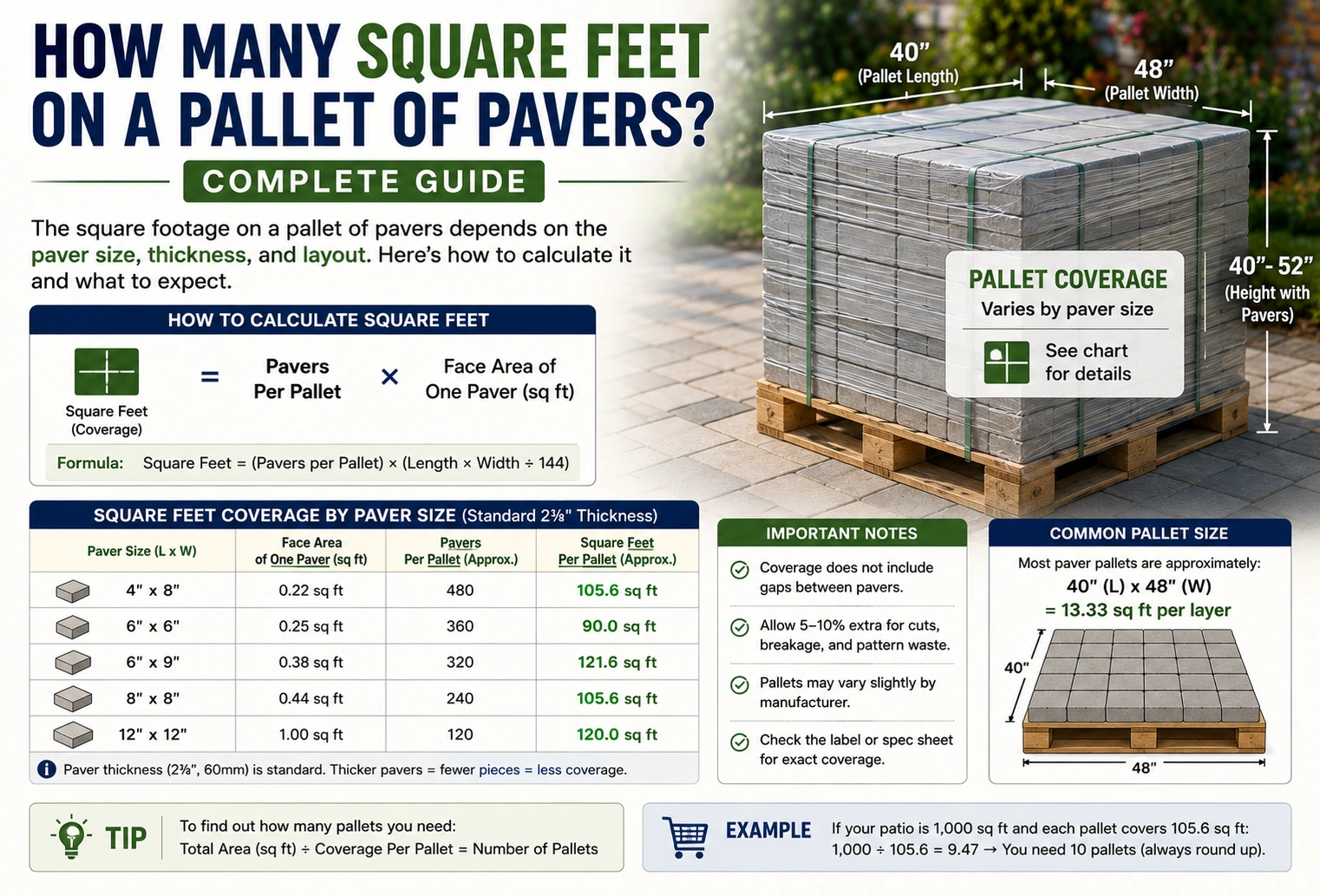
If you’re wondering how many square feet on a pallet of pavers, there is no single answer. The coverage depends on the paver size, thickness, shape, manufacturer, and number of pieces packed on the pallet.
A typical pallet of concrete pavers may cover around 80 to 120 square feet, but some pallets cover considerably less or more.
For a quick estimate, many standard paver pallets cover approximately 100 square feet.
| Paver Pallet Type | Approximate Coverage |
|---|---|
| Small-format pavers | 60–90 sq ft |
| Standard pavers | 80–120 sq ft |
| Large-format pavers | 70–110 sq ft |
| Mixed-size paver system | 90–120+ sq ft |
| Heavy/thick pavers | Varies considerably |
Always check the manufacturer’s stated square-foot coverage before ordering.
What Does “Square Feet per Pallet” Mean?
When pavers are sold by the pallet, the manufacturer usually specifies how much surface area the entire pallet can cover.
For example, if a pallet contains enough pavers to cover 100 square feet, then:
1 pallet = 100 square feet
If your patio is 500 square feet:
500 ÷ 100 = 5 pallets
You would need approximately 5 pallets, before adding extra material for cuts and waste.
The important thing is that pallet coverage isn’t determined by weight alone. Two pallets can weigh similarly while covering different areas because the pavers can have different dimensions and thicknesses.
How Many Square Feet Does One Pallet of Pavers Cover?
A common planning range is 80–120 square feet per pallet.
However, actual coverage can vary substantially.
For example:
- A small paver may cover less area per piece, requiring more pieces.
- A large paver covers more area per piece.
- Thick pavers may contain fewer pieces per pallet because of weight limitations.
- Interlocking systems may use several sizes together.
- Manufacturer packaging can change the number of pieces per pallet.
Therefore, the product specification is more accurate than a general estimate.
| Example Pallet Coverage | 1 Pallet Covers |
|---|---|
| Small pallet | 60 sq ft |
| Medium pallet | 80 sq ft |
| Common example | 100 sq ft |
| Large pallet | 120 sq ft |
| Extra-large coverage | 150 sq ft |
These are examples for estimating purposes, not universal pallet sizes.
How to Calculate Paver Coverage
If you know the number of pavers on a pallet and the dimensions of each paver, you can calculate the theoretical coverage.
Step 1: Convert Paver Dimensions to Feet
Suppose a paver measures:
12 inches × 12 inches
That’s:
1 foot × 1 foot
So one paver covers:
1 square foot
If the pallet contains 100 pavers:
100 × 1 = 100 square feet
Step 2: Account for Joint Space
Real installations have gaps between pavers for joints.
The manufacturer’s coverage figure generally accounts for the intended installation pattern and joint spacing.
That’s why it’s best to use the manufacturer’s stated coverage whenever available.
Common Paver Sizes and Their Coverage
Pavers come in many sizes.
Here are some examples of the area covered by individual rectangular pavers before considering joints.
| Paver Size | Area per Paver |
|---|---|
| 4 × 8 in | 0.22 sq ft |
| 6 × 6 in | 0.25 sq ft |
| 6 × 9 in | 0.38 sq ft |
| 8 × 8 in | 0.44 sq ft |
| 12 × 12 in | 1.00 sq ft |
| 12 × 24 in | 2.00 sq ft |
| 16 × 16 in | 1.78 sq ft |
| 18 × 18 in | 2.25 sq ft |
The larger the individual paver, the more surface area each piece covers.
However, larger pavers don’t necessarily mean that a pallet will cover more square feet because pallet weight and packaging also matter.
How Many Pallets of Pavers Do I Need?
Once you know your project’s square footage and the pallet coverage, the calculation is simple.
Formula
Number of pallets = Total project area ÷ Square feet per pallet
Then round up to a whole pallet.
Example
Suppose your patio is:
500 square feet
And one pallet covers:
100 square feet
Calculation:
500 ÷ 100 = 5 pallets
You would need 5 pallets before accounting for waste.
If the project has many curves, corners, or cuts, you may want additional material.
How Much Extra Paver Material Should You Order?
It’s common to order extra pavers because some pieces will need to be cut, and others may be damaged during transportation or installation.
A common planning allowance is around 5% to 10%, although complicated designs may require more.
| Project Area | 5% Extra | 10% Extra |
|---|---|---|
| 100 sq ft | 105 sq ft | 110 sq ft |
| 200 sq ft | 210 sq ft | 220 sq ft |
| 300 sq ft | 315 sq ft | 330 sq ft |
| 500 sq ft | 525 sq ft | 550 sq ft |
| 1,000 sq ft | 1,050 sq ft | 1,100 sq ft |
For example, a 500-square-foot patio with 10% extra requires:
500 × 1.10 = 550 square feet
If each pallet covers 100 square feet:
550 ÷ 100 = 5.5 pallets
Since you can’t normally purchase half a pallet, you would need 6 pallets.
How Many Pavers Are on a Pallet?
The number of pavers per pallet varies widely.
A pallet might contain:
- Dozens of large pavers
- Hundreds of standard pavers
- Many hundreds of small pavers
The number isn’t as useful as the coverage rating.
For example:
| Pavers per Pallet | Coverage per Paver | Theoretical Coverage |
|---|---|---|
| 100 | 1 sq ft | 100 sq ft |
| 200 | 0.5 sq ft | 100 sq ft |
| 400 | 0.25 sq ft | 100 sq ft |
| 500 | 0.20 sq ft | 100 sq ft |
Different combinations can provide the same total coverage.
Does Paver Thickness Affect Square-Foot Coverage?
Yes and no.
Thickness doesn’t directly change the surface area of an individual paver. A 2-inch-thick paver with a 12 × 12-inch face still covers approximately 1 square foot.
However, thickness can affect:
- Number of pieces per pallet
- Pallet weight
- Shipping limitations
- Product availability
- Intended application
For example, thick pavers may be designed for heavier-duty applications and may have fewer pieces packed onto a pallet.
Therefore, don’t estimate pallet coverage from thickness alone.
How Many Square Feet Does a Pallet of 4×8 Pavers Cover?
A 4×8-inch paver has a face area of:
4 × 8 = 32 square inches
Convert to square feet:
32 ÷ 144 = 0.222 square feet
So each paver covers approximately 0.22 square feet, before accounting for joints.
If a pallet contains 450 pavers:
450 × 0.222 ≈ 100 square feet
That pallet would theoretically cover around 100 square feet.
The actual manufacturer’s coverage may differ because of joint spacing and the particular product.
How Many Square Feet Is a Pallet of 12×12 Pavers?
A 12 × 12-inch paver measures:
1 × 1 foot
So each paver covers:
1 square foot
If a pallet contains 100 pieces, it would theoretically cover:
100 × 1 = 100 square feet
Again, joint spacing and installation patterns can affect actual coverage.
Paver Pallet Coverage vs. Project Size
Here’s a quick reference if you assume a pallet covers 100 square feet.
| Project Size | Pallets Needed | With ~10% Extra |
|---|---|---|
| 100 sq ft | 1 | 2 pallets |
| 200 sq ft | 2 | 3 pallets |
| 300 sq ft | 3 | 4 pallets |
| 400 sq ft | 4 | 5 pallets |
| 500 sq ft | 5 | 6 pallets |
| 600 sq ft | 6 | 7 pallets |
| 800 sq ft | 8 | 9 pallets |
| 1,000 sq ft | 10 | 11 pallets |
The final number depends on the actual pallet coverage and how much waste your design produces.
How Much Does a Pallet of Pavers Cost?
Paver prices vary considerably based on material, style, thickness, brand, region, and quantity.
Rather than assuming one fixed price, it’s useful to compare possible per-pallet prices.
For example, if a pallet covers 100 square feet:
| Example Pallet Price | Coverage | Effective Cost per Sq Ft |
|---|---|---|
| $400 | 100 sq ft | $4.00/sq ft |
| $500 | 100 sq ft | $5.00/sq ft |
| $600 | 100 sq ft | $6.00/sq ft |
| $700 | 100 sq ft | $7.00/sq ft |
| $800 | 100 sq ft | $8.00/sq ft |
These are illustrative calculations, not current market prices.
When comparing products, always calculate the cost per square foot, not just the price of one pallet.
How Many Pallets for a 12×20 Patio?
First calculate the patio area:
12 × 20 = 240 square feet
If one pallet covers 100 square feet:
240 ÷ 100 = 2.4 pallets
You would need to purchase 3 pallets.
With 10% extra:
240 × 1.10 = 264 square feet
Then:
264 ÷ 100 = 2.64 pallets
You would still need 3 pallets.
How Many Pallets for a 20×20 Patio?
Calculate:
20 × 20 = 400 square feet
If each pallet covers 100 square feet:
400 ÷ 100 = 4 pallets
With 10% extra:
400 × 1.10 = 440 square feet
440 ÷ 100 = 4.4 pallets
So you would need 5 pallets if purchasing by full pallets.
Do All Pavers on a Pallet Cover the Same Area?
No.
Some pallets contain a single paver size, while others contain mixed-size paver systems.
A mixed pallet might include:
- Small rectangles
- Medium rectangles
- Large rectangles
These pieces are designed to create a specific repeating pattern.
For mixed systems, don’t calculate coverage by counting pieces individually unless the manufacturer provides the exact installation pattern. Use the stated square feet per pallet.
How to Read a Paver Product Label
Look for information such as:
- Coverage per pallet
- Pieces per pallet
- Paver dimensions
- Thickness
- Weight per pallet
- Recommended joint width
- Installation pattern
The most important number for estimating your project is usually:
Coverage: ___ square feet per pallet
If the label says 100 sq ft per pallet, use that number directly.
Common Mistakes When Buying Pavers
1. Assuming Every Pallet Covers 100 Square Feet
100 square feet is only a convenient estimate.
2. Buying by Weight
Weight doesn’t tell you the exact surface coverage.
3. Forgetting Waste
Cuts and damaged pieces can increase your material requirement.
4. Mixing Different Products
Pavers from different product lines may have different dimensions and colors.
5. Ignoring Pattern Requirements
Mixed-size patterns require the correct combination of pieces.
6. Calculating Only the Patio
If you’re also paving walkways, steps, borders, or other areas, include them in the total project area.
7. Rounding Down
Always round your pallet requirement up, not down.
Expert Tips for Ordering Pavers
Before ordering:
- Measure the project carefully.
- Calculate the total square footage.
- Add 5–10% for waste when appropriate.
- Check the manufacturer’s coverage per pallet.
- Divide total required area by pallet coverage.
- Round up to the next whole pallet.
- Confirm that all pallets are from the same product and color batch if possible.
- Plan where the pallets will be delivered and stored.
For large projects, having the pavers delivered close to the installation area can also reduce unnecessary handling.
FAQs
1. How many square feet are on a pallet of pavers?
A pallet can cover roughly 80–120 square feet in many common applications, but actual coverage varies by product. Always check the manufacturer’s specifications.
2. How many pallets do I need for 1,000 square feet?
If one pallet covers 100 square feet, you need 10 pallets for 1,000 square feet. With 10% extra material, you would need 11 pallets.
3. How much extra paver material should I buy?
A 5–10% allowance is commonly useful for straightforward projects. Complex patterns, curves, and extensive cutting may require more.
4. How do I calculate pavers per pallet?
Use the manufacturer’s stated coverage whenever possible. If it isn’t available, calculate the area of each paver and multiply by the number of pieces, while accounting for installation joints.
5. Does paver thickness change how many square feet a pallet covers?
Thickness doesn’t directly change the face area of a paver, but it can affect how many pieces fit on a pallet and the pallet’s total weight. Always use the manufacturer’s coverage figure.
Conclusion
So, how many square feet on a pallet of pavers? A common estimate is around 80–120 square feet per pallet, with 100 square feet being a useful example for planning. However, actual coverage varies based on paver dimensions, thickness, design, and manufacturer packaging.
To calculate how many pallets you need, first determine your project’s total square footage, add an appropriate amount for waste, and then divide by the manufacturer’s square-feet-per-pallet rating.
For example, a 500-square-foot patio using pavers that cover 100 square feet per pallet requires 5 pallets before waste. With 10% extra, you’d need enough material for 550 square feet, which means 6 pallets.
Always check the product label or manufacturer’s specifications before placing your order.
Discover More Articles
How Many Feet of Runner for 13 Stairs? Complete Guide